Alone With Twins All Day: The Solo-Day Playbook
A day alone with twins is survivable when you stop trying to parent two babies simultaneously and start sequencing: both babies on one clock, two or three safe places you can set a baby down for ninety seconds without guilt, feeds run as a single round rather than two, and a bedtime you do in a fixed order every night. The standard drops, and that’s the plan working — a solo twin day is a logistics shift, not a parenting performance. Here’s the shape of one, the triage for when both babies cry, and the parts nobody warns you about.
The shape of a solo day
Not a prescription — a skeleton. Times shift with age; the order is the useful part.
| Time | Baby A | Baby B |
|---|---|---|
| 7:00 | Wake + feed round | Woken + fed |
| 7:45 | Floor mat | Bouncer |
| 8:30 | Nap 1 (both down together) | Nap 1 |
| 8:35 | Your breakfast, bottles washed | — |
| 10:00 | Feed round | Feed round |
| 10:45 | Out of the house, or floor time | Swapped stations |
| 11:30 | Nap 2 | Nap 2 |
| 1:00 | Feed round | Feed round |
| 2:30 | Nap 3 | Nap 3 |
| 4:00 | Feed + the long stretch | Feed + the long stretch |
| 6:30 | Bath (or not), bedtime routine | Same routine, same room |
| 7:00 | Down | Down |
Two things carry the whole day. Everything happens in rounds — both babies fed, both changed, both down, in one pass. And the first ten minutes of nap one belong to you, not to the dishwasher. If you spend every nap catching up, you’ll hit 4pm with nothing left and two babies who need you most at exactly that hour.
The shared clock is the precondition for all of it. If your twins are still running on separate schedules, fix that before anything here will work — the protocol is in getting twins on the same schedule.
Three safe places to put a baby down
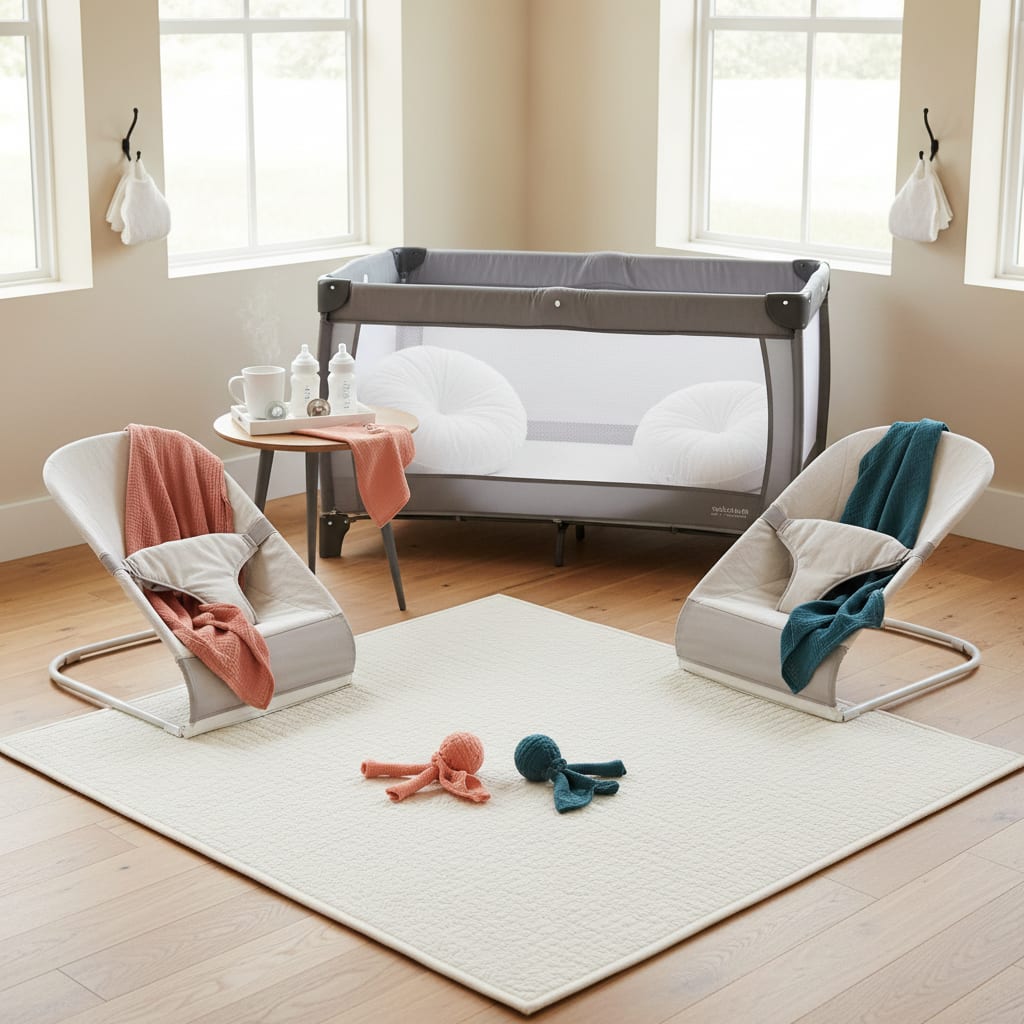
The single biggest difference between a solo day that works and one that doesn’t is having somewhere to put the second baby. You need at least two stations in the room you’re actually in, and you rotate rather than leaving a baby in one thing for an hour.
- The floor. A firm playmat on the floor is the safest, cheapest station there is, and the one you’ll use most. Nothing to fall off.
- A bouncer or seat, for supervised awake time only. Reclined seats buy you two free hands and a baby who can see you. The BabyBjörn Bouncer Bliss is the standard worked example — light enough to carry room to room, which is the whole feature. Keep it on the floor, never a table or counter, and if a baby falls asleep in it, move them to a flat surface. Bouncers, swings and carriers are not sleep spaces.
- A play yard, for actual sleep. A portable crib that meets current safety standards gives you a second legitimate flat sleep surface downstairs, which spares you the stairs on the day nobody naps. A Graco Pack ‘n Play is the common pick. Bare surface, fitted sheet, one baby — the same rules as upstairs.
Rotate stations every 15 to 20 minutes and swap which twin gets which. Babies tolerate containment much better when the view changes, and it stops one twin quietly living on the mat while the other lives in the seat.
When both babies cry at once
This happens most days and it is not a failure. Triage it the same way every time so you’re not deciding under fire:
- Anything that’s actually urgent goes first — a fall, choking, a baby who’s stuck. Rare, obvious.
- Then the escalator, not the loudest. Attend to the twin who winds up fastest and stays wound up longest; the steadier baby can hold for ninety seconds.
- Then the one you went to last time. Keep it roughly even across the day. Not for fairness — because a baby who’s always second learns to escalate to get seen.
- Then, honestly, both at once. One on each forearm, one on the mat with a hand on the chest and the other in a carrier, both in the play yard while you sit on the floor between them. Twin parents invent a two-baby hold within a fortnight; yours will be fine.
And the option nobody lists: put both babies down somewhere safe and step out of the room for two minutes. Two babies crying in a safe flat space while a parent breathes in the hallway is a good outcome, not a bad one.
Feeding, showering, eating, and the bathroom
- Feed both in one round, always. Solo bottle-feeding two babies at once has a specific safe setup — babies supported and semi-upright, an adult holding both bottles, never a propped bottle — laid out fully in bottle feeding twins alone.
- Eat at nap one. Not “when there’s time”. Make the food the night before if you have to.
- Shower during a nap with the monitor on, or with both babies in the play yard where you can hear them. Waiting for a second adult means not showering.
- Take the babies to the bathroom with you. Two bouncers in a doorway, or the play yard in the hall. Absurd for about a week, then furniture.
The solo bedtime, in order
One adult, two babies, one routine — and the order is the trick:
- Both babies changed and into sleep clothes before the last feed, so nobody gets woken up to be dressed.
- Last feed as a round, lights low.
- Down the calmer twin first. They settle without help, which frees your hands for the one who needs them.
- Stay for the harder twin. Same words, same exit, every night.
- If the second twin goes off before you’re out, resettle in the room without picking up if you can — leaving and returning restarts them both.
Bath is optional and not every night. A solo twin bath is a two-adult job more often than not; a warm flannel counts.
The 4-to-7pm trench
The late-afternoon stretch is the hardest part of a solo day and it isn’t your technique. Fussiness that clusters in the evening — the witching hour — is common in the newborn months and, with twins, arrives in stereo.
What helps: a late-afternoon catnap, going outside even for ten minutes, a carrier for one baby while the other has the floor, and dinner made at noon. What doesn’t: trying to fix it. It eases as the babies mature, and the day’s nap total matters more than anything you do at 5pm — the by-age picture is in twin nap schedules by age.
FAQ: solo days with twins
Can one person look after newborn twins alone?
Yes, and enormous numbers of people do it daily. It takes a shared feeding clock, safe places to set a baby down, and a genuinely lowered bar on housework. If you’re doing it long-term without any relief, that’s worth raising with your own doctor or health visitor — twin parents are stretched thin and screening for it exists for a reason.
How do you nap two babies alone?
Down together, every time, even if one would have gone twenty minutes later. Shared start times are what create the gap you use; letting them stagger costs you the whole afternoon.
What if one twin naps and the other won’t?
Give the awake twin quiet one-to-one time rather than fighting for a second sleeper, and hold the shared clock for the next nap. One short-napping twin is normal and usually stage-specific; two different sleep plans inside one schedule is the standard fix.
How do I shower with twins at home alone?
During a nap with a monitor, or with both babies in a play yard or on a floor mat within earshot. It’s a safe, ordinary thing to do — the alternative of waiting for another adult means it doesn’t happen.