Telling Newborn Twins Apart (Systems That Work)
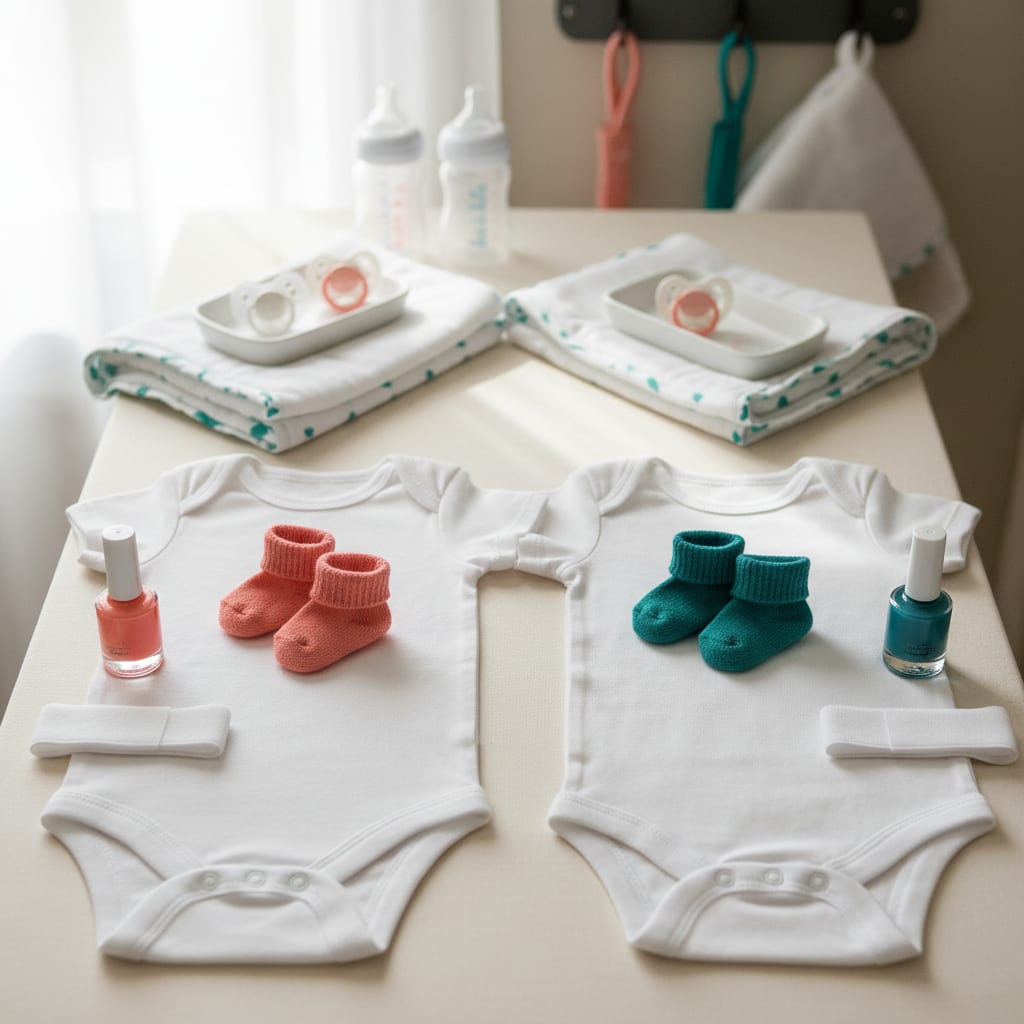
Telling newborn twins apart reliably takes a designated system, not parental intuition: assign each baby a permanent color the day they’re born, keep the hospital bands on until the system is running, put the color on the baby (painted toenail, colored sock or band) rather than only on removable clothes, and log every feed and med against the color, not the name. Every twin parent believes they’ll just know their own children. Most of us also have one 3am story that says otherwise — and with newborns, “which baby got the vitamin D drops” is a question you must be able to answer cold.
Here’s the full system, from a house where the babies are boy/girl and we still run it.
Why you need a system even if you think you don’t
Three honest scenarios, all from real weeks one through six:
- The 3am handoff. You feed a baby, resettle her, and stumble back to bed. Your partner takes the 5am round. Which baby was the 3am baby? If the answer lives in your sleep-deprived memory, it doesn’t exist by morning — this is how one twin gets double vitamin drops and the other gets none.
- Other caregivers. Grandma, the night doula, the pediatrician’s nurse — anyone helping needs to identify babies without your intuition. A system that lives in your head doesn’t transfer; a coral sock does.
- Same-outfit sabotage. Identical twins get mixed up in photos within weeks — ask any adult identical twin about their family albums, and the famous cases of families genuinely losing track for a day are not urban legends. Even with fraternal twins who look nothing alike, newborn fraternal twins often look exactly alike for the first blurry month.
The stakes are mostly mundane (mislogged feeds) but occasionally real (medications, medical histories — one twin’s reflux prescription is not community property). Build the system in week zero while the hospital bands are still doing the work for you.
The system: one color per baby, forever
The core move this whole site is named for: Baby A is coral, Baby B is teal — pick your own pair, but pick it once and apply it to everything:
- On the baby (the anchor): a dab of baby-safe nail polish on one twin’s big toenail is the classic identical-twin move — cheap, survives baths for a week, invisible in photos if you want it to be. Alternatives that also work: one twin always wears the colored ankle sock, or a soft cotton ID anklet in their color. Whatever it is, it must be something that doesn’t come off with the outfit. (Run any on-skin choice past your pediatrician at the first visit — it’s a 10-second question.)
- Keep the hospital bands on until your own system is fully running — they’re the only ID with official standing, and there’s no prize for cutting them off on day two.
- On the gear: coral and teal bottle bands, swaddles, pacifier clips, burp cloths, crib-corner ribbons. The 3am rule is that the color finds you — you should never have to generate the answer “whose bottle is this?” from memory.
- On the paperwork: every line of the feeding-and-med log gets the color, not just a name (names smear together at 3am; colors don’t). The A|B log format is laid out in the newborn twin schedule hub — it’s the single place the whole system cashes out.
For identical twins, add one more layer: photograph the genuinely distinguishing features in week one (birthmark placement, hair whorl, the shape of an ear) and put the annotated photos in the shared family album, so there’s a ground-truth record that outlives sleep deprivation.
Making the system survive other people
A system only counts if it runs without you:
- Brief every caregiver in one sentence: “Coral is Arlo, teal is Vera, the log is on the fridge, log the color.” That’s the whole onboarding.
- Dress to the code when it matters. You don’t have to color-code every outfit forever — but for the newborn months, defaulting each twin’s sleepers and socks toward their color means everyone’s first glance is usually right, and the anklet settles anything the glance gets wrong. (And if you’re still choosing names: names that don’t rhyme or alliterate do this same disambiguation work forever — bigfamilyplaybook’s boy and girl twin names guide makes that case well.)
- Never relabel. The colors are permanent assignments, not outfits. The one way this system fails catastrophically is a well-meaning helper swapping the coral sock to the other baby because it matched the outfit better. House rule: the colors are medical equipment.
Fair warning from the far side: by three or four months, personality and face do most of the work and you’ll rarely need the anklet — see the di-di twins explainer for why fraternal twins in particular diverge fast. We kept the color-code anyway, because it had quietly become the household operating system: whose laundry, whose bottle, whose column in the log. It scales beautifully from “which baby is this” to “which toddler’s cup is this,” and it’s the reason this site renders everything in coral and teal.
FAQ: telling newborn twins apart
How do parents tell identical newborn twins apart?
With a designated marker, not intuition: baby-safe nail polish on one twin’s toenail, a consistent colored sock or soft ID anklet, and hospital bands left on until the home system runs. Most parents of identicals also learn one true distinguishing feature (birthmark, hair whorl) as the backstop.
Do parents ever actually mix up their twins?
Yes — routinely in the newborn months, and nearly every twin family has at least one story. Sleep deprivation plus two similar-sized babies in identical white onesies defeats intuition reliably. The mix-ups are usually harmless if feeds and meds are logged against a marker rather than a memory.
Is it safe to put nail polish on a newborn’s toenail?
It’s the time-honored identical-twin move, kept to a tiny dab on the big toenail — far from the mouth — and many pediatricians are fine with it; ask yours at the first visit, and use a water-based, baby-marketed polish if you go this route. If you’d rather not, a colored sock or soft cotton anklet does the same job.
When do twins become easy to tell apart?
Sooner than the newborn haze suggests: fraternal twins often look clearly different by two to four months, and even identicals develop distinguishing expressions, sizes and personalities across the first year. Most families keep the color-code long after it stops being necessary — it turns out to be great logistics infrastructure.