Twins Waking Each Other Up: Fixes That Work
Twins waking each other up happens far less than twin parents fear — in most shared rooms the babies sleep straight through each other’s fussing, and the person who wakes is you. So before you rearrange the house, run a three-night audit and find out who genuinely woke first. If it turns out to be real chain-waking, work the fixes in this order: steady white noise, a properly dark room, more distance between the two sleep surfaces, and a slower response to the first squawk. Splitting the twins into separate rooms is the last lever, not the first.
Step one: prove it’s actually happening
For three nights, write down four things at every waking: the time, which twin made noise first, whether the second twin stirred or fully woke, and what you did in between. That last column is the one that changes minds.
Most twin parents discover one of three things. Either the second twin never actually woke — they grunted, kicked, resettled, and got recorded as “awake” because you were standing over the crib at the time. Or both twins woke within a minute of each other because they were both hungry and both at the end of a sleep cycle, which is a schedule event, not a transmission event. Or — the honest one — the second twin woke because you turned on a light, opened a door, said something to your partner, and carried the first twin out over the second twin’s head.
You are the loudest thing in that room. Newborns and babies also twitch, grunt, startle and half-cry their way through light sleep without ever being awake, which means a lot of “wakings” you’re crediting to the co-twin were never wakings at all.
What actually transmits a waking between twins
Four things, in rough order of how often they’re the real culprit:
- The parent. Light, door hinges, whispered logistics, the transfer path across the room. Nearly all of this is fixable tonight.
- Sharp onset noise, not volume. Steady noise gets tuned out; a sudden shriek from silence does not. This is why white noise works — it raises the floor so the peaks aren’t a cliff edge.
- Aligned sleep cycles. Twins on the same schedule surface from a sleep cycle at nearly the same moment, and one of them doesn’t bridge to the next cycle. That’s a short-nap problem, not a roommate problem, and it gets fixed on the schedule side.
- Genuine chain-waking. It exists. It’s the smallest category, and it’s the only one that ever justifies separating twins.
The fix order that actually works
1. Steady white noise, one machine, placed away from both babies. One machine covers a room — two babies, one unit. A mechanical-sound machine like the Yogasleep Dohm runs at a genuinely constant volume all night, which is what you want; app-based tracks that loop or fade are worse at flattening a sudden cry. Put it across the room rather than beside either sleep surface, and keep it around the level of a running shower, not louder.
2. Black the room out properly. Two babies on one clock means one shaft of 5:15am light wakes the household, not one baby. Cheap panels with an actual blackout liner — the NICETOWN blackout panels are the standard worked example — cost less than one bad night and do more than most sleep gadgets. Tape or a temporary blackout film around the window edges finishes the job.
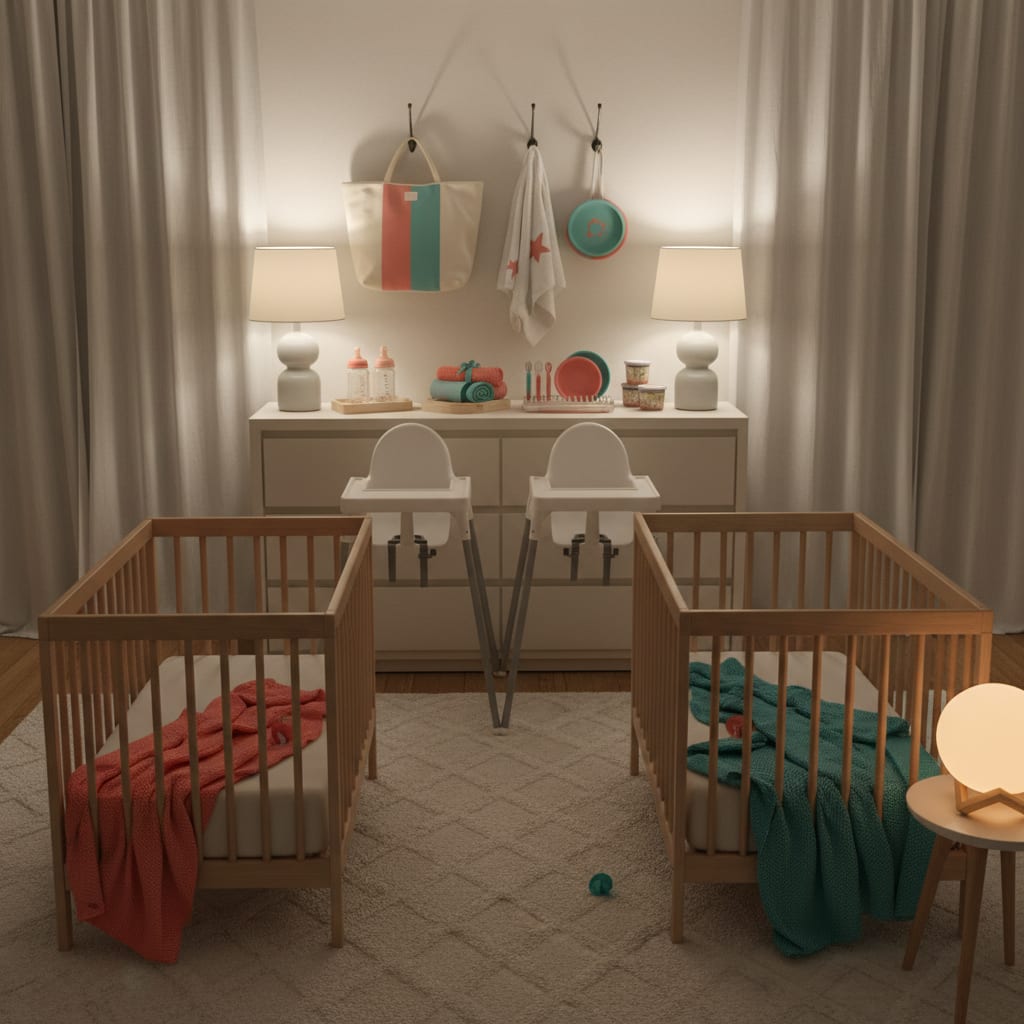
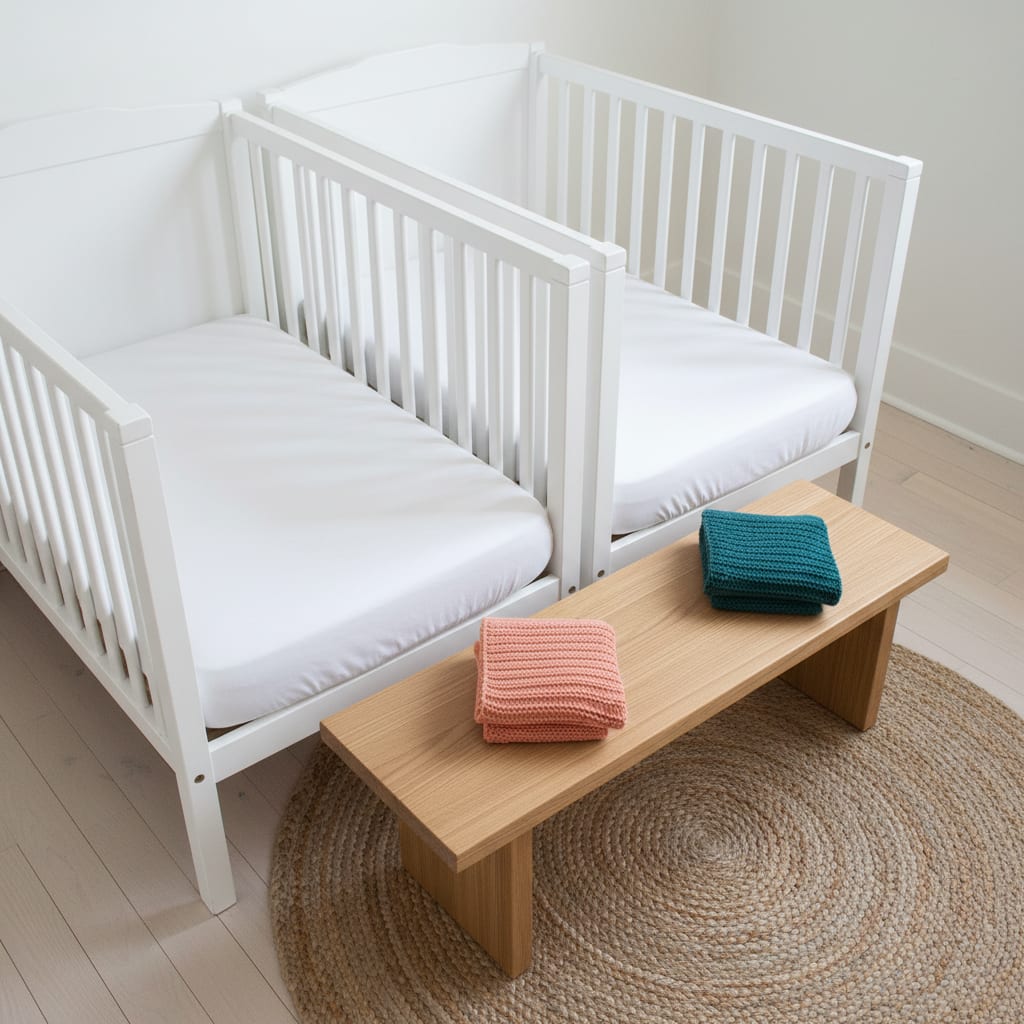
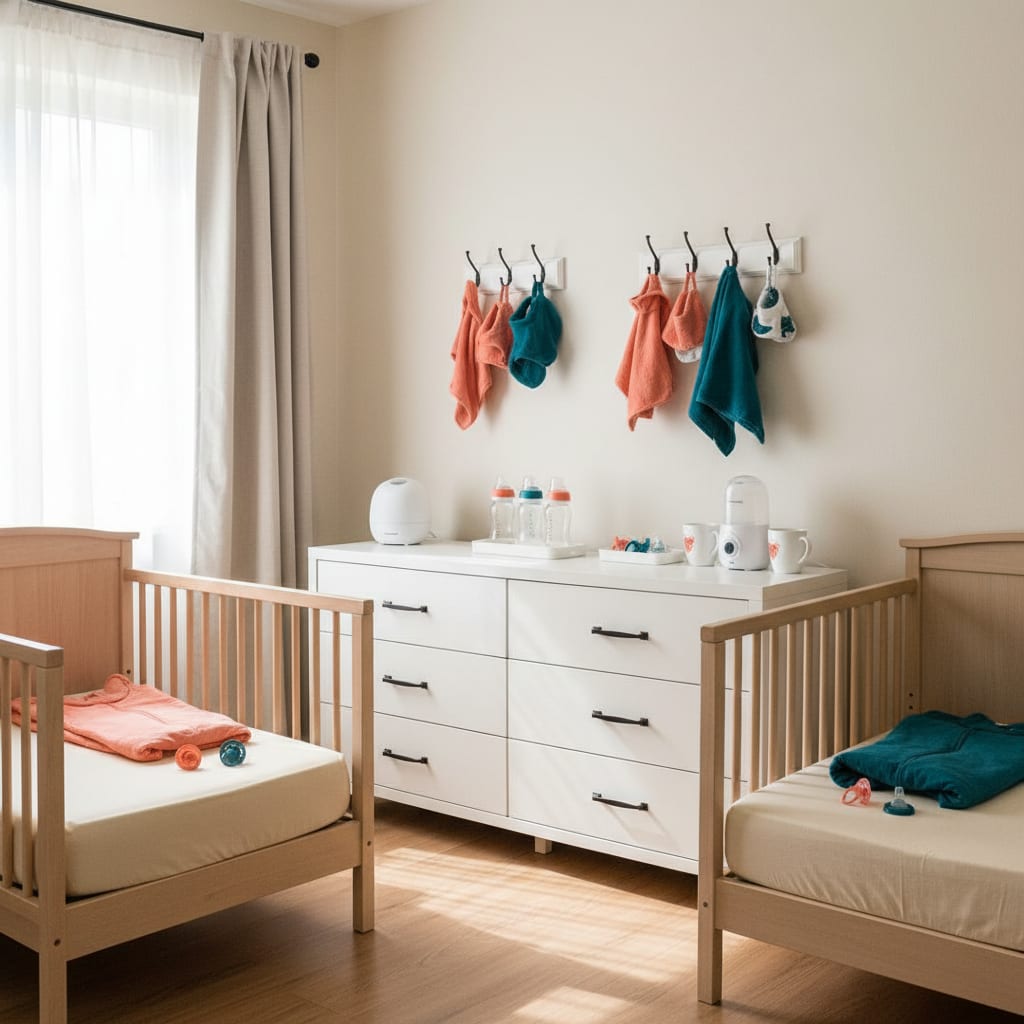
3. Add distance and change the orientation. Move the two sleep surfaces as far apart as the room allows, and stop the babies from being head-to-head. Feet-toward-feet, or one crib on each of two walls, cuts the direct line of noise. What does not count as a fix: putting both twins in one crib. Each twin needs their own firm, flat, bare sleep surface, on the back — the AAP’s safe sleep guidance applies to twins exactly as it does to singletons, and sharing a sleep space is not on the menu. Same room, two surfaces. The full setup lives in safe sleep for twins.
4. Slow your own response by 60 to 90 seconds. The great irony of twin sleep is that the fastest responder creates the most wakings. Give the noisy twin a beat before you move — a real fraction of first cries evaporate on their own, and the ones that don’t cost you ninety seconds. Obvious exceptions: a newborn due a feed, a baby who escalates from zero to frantic in five seconds, any baby who seems unwell.
5. Take the loud part of the night out of the room. Feed and change in a different room with a dim light, then return. If both twins need feeding, bring the second one out too rather than doing a full production over a sleeping baby’s head.
Adjusted age changes what you should even expect
Twins arrive early more often than singletons, and often smaller. If your twins were preterm, run every sleep expectation on adjusted age — weeks since your due date, not since the birthday. A pair born at 34 weeks is doing 12-week-old sleep at 18 weeks of life, and judging them by the calendar will convince you something’s wrong when nothing is. Feeding intervals, night-waking frequency and any “should they be sleeping longer by now” question belong to your pediatrician, especially if either twin had a NICU stay, reflux, or ongoing weight-gain monitoring.
When it’s genuinely chain-waking
You’ve done all five fixes, consistently, for two weeks, and the audit still says: twin A cries, twin B wakes within a minute, both are up for 40 minutes, three times a night. That’s real, and it’s the point where a temporary split earns its keep. Do it as a defined experiment with an end date, not a permanent surrender — the how, the timing and the reunion plan are in when to separate twins for sleep.
The other common shape is that only one twin is the problem in the first place, in which case the room isn’t the variable at all — see one twin sleeps, one doesn’t.
FAQ: twins waking each other up
Will twins learn to sleep through each other’s crying?
Most do, and faster than parents expect — co-twins share nine months of a very loud environment and habituate to each other readily. Steady white noise and a consistently dark, boring room speed it up. The usual holdout in the household is the parent.
Should I move one twin out at the first sign of night waking?
No. Separation is the escalation after the room fixes and a consistent response plan have had a fair run — usually two to three weeks. Moving a twin out on night three means you never learn which variable was actually doing the damage, and you may need to redo the whole process when they move back in.
Can I sleep train twins in the same room if they’re waking each other?
Yes, and same-room training is how most twin families do it. The mechanics — prep, method choice, the first three nights and what to do when both babies are up — are in sleep training twins in the same room. Wait until your pediatrician agrees your twins are ready by adjusted age.
Is it safer to put twins in one crib so they settle each other?
No. Whatever the settling argument, twins should not share a sleep surface for sleep — each baby gets their own firm, flat, bare surface in the same room. Any question about your specific twins, especially preterm or low-birthweight twins, goes to your pediatrician.