Can Twins Share a Crib? No — Here's the Safe Setup
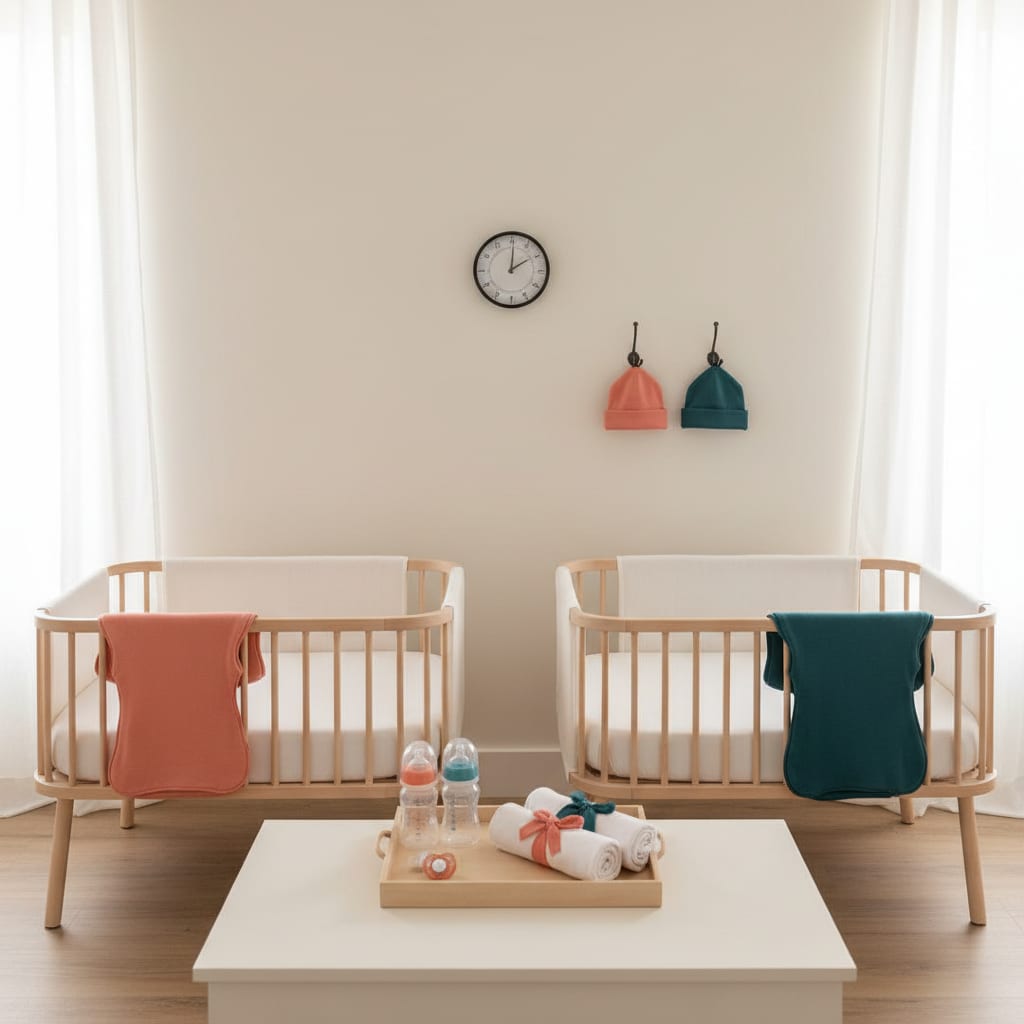
No, twins should not share a crib for sleep. The AAP’s safe-sleep guidance gives every baby their own firm, flat, bare sleep surface, on the back, in the parents’ room for at least the first six months — and it says so explicitly for twins and other multiples. The twin version of the rule is short: two surfaces, one room. Everything else on this page is the practical translation — what that looks like in a small bedroom, what to buy, what to skip, and why preterm twins need their adjusted age in the conversation.
The safe-sleep rules, translated for two
The core set doesn’t change with twin count; the logistics do.
- Back to sleep, every sleep, both babies. Every nap, every night, both twins, including when one seems to hate it. A baby who rolls both ways on their own can be left in the position they choose, but you always place them on the back.
- Firm, flat, bare surface each. A crib, bassinet, portable crib or play yard that meets current federal safety standards, with a fitted sheet and nothing else. No pillows, no positioners, no bumpers (including “breathable” mesh ones), no loose blankets, no stuffed animals, no crib nests.
- Room-sharing, not surface-sharing. Both twins’ sleep spaces in your room for at least six months is the recommendation. Two bassinets beside the bed is the standard twin setup — not both babies in one bassinet, and never a baby in an adult bed.
- Nothing inclined. Sleep happens flat. If either twin falls asleep in a swing, bouncer, car seat or carrier, move them to a flat surface when you can safely do it.
- No side-sleeping. The reasons side-sleeping isn’t a safe alternative apply identically to the twin who “only settles that way”.
Can twins share a crib? The honest version
You will see co-bedded twins everywhere — in stock photos, in NICU photos of skin-to-skin sessions, in your relatives’ memories. Two things are true at once. Supervised, awake co-holding is lovely and normal. Unsupervised sleep in a shared space is not what current guidance supports, because two babies in one surface reintroduce exactly the hazards the flat-and-bare rule exists to remove: another body to be pressed against, another blanket, another head near a face, overheating from a second warm body.
The argument you’ll hear is that twins settle each other. Sometimes they visibly do — and it still doesn’t buy an exception. If settling is your actual problem, the levers are white noise, darkness, distance and response timing, all covered in twins waking each other up.
The NICU is a different context: some units practise supervised co-bedding under continuous monitoring for specific clinical reasons. That is a monitored hospital setting with staff in the room. It is not a home instruction, and the handover conversation on discharge day — “what do we do at home?” — is one to have deliberately with your neonatal team.
Two surfaces in a small room: what actually fits
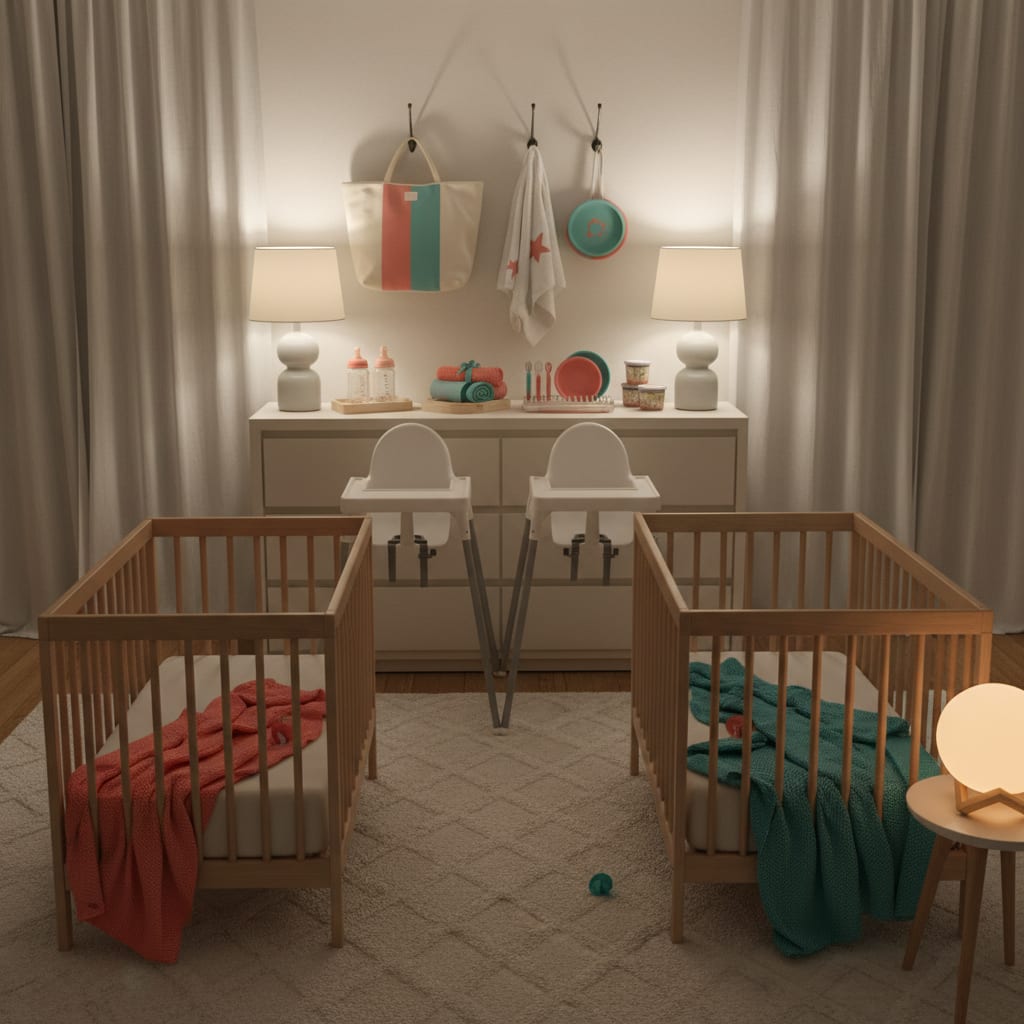
The reason twin parents bend the rule is usually square footage, not conviction. Options that keep both babies legal and still fit next to a bed:
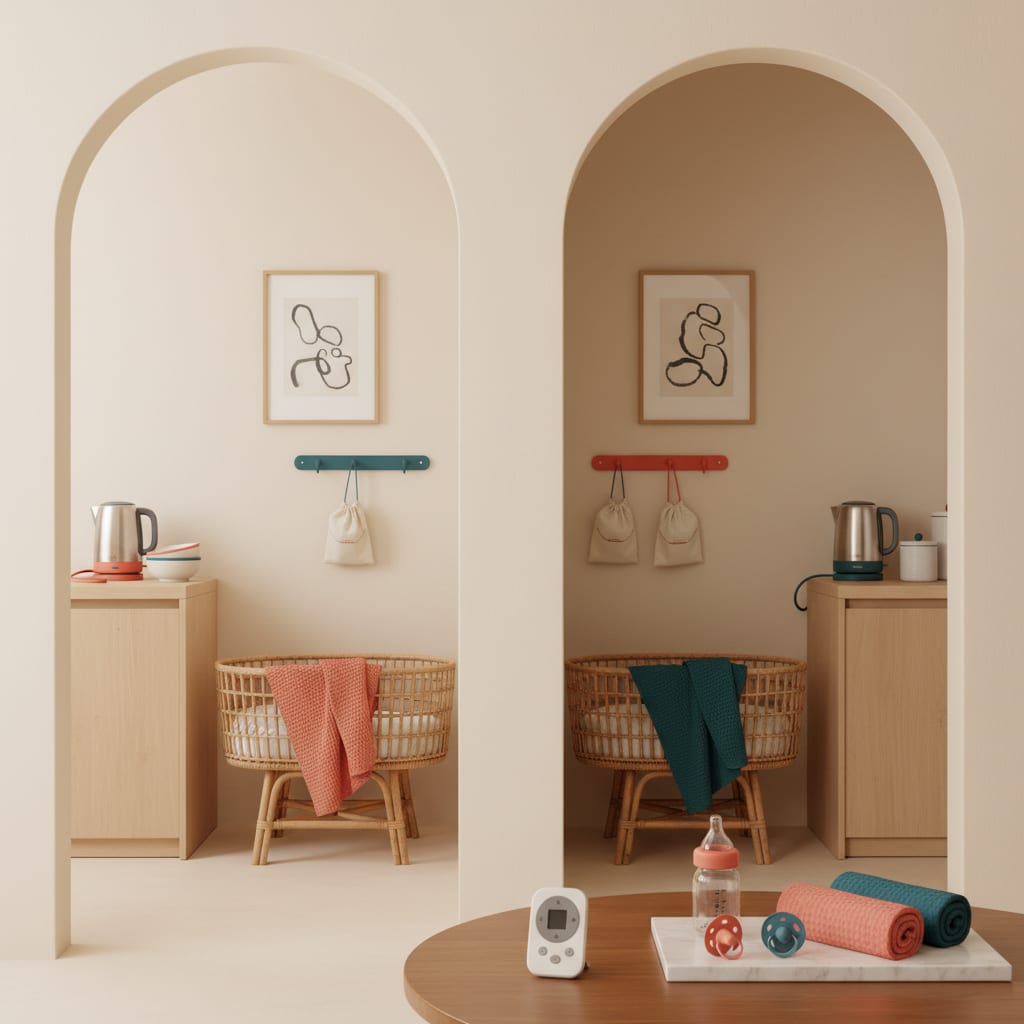
- Two bassinets side by side. The most common twin newborn setup. Bassinets are small, wheel-able and outgrown fast, which is exactly why they suit the six-month room-sharing window.
- One play yard with a bassinet insert plus one bassinet. Mismatched is fine. Nothing requires the twins’ surfaces to be identical.
- A crib in your room. Ugly, effective. If a crib fits, a crib counts.
- Feet-to-feet spacing. In a tight room, orient the surfaces so the babies’ heads aren’t adjacent — noise separation at zero cost.
Skip regardless of space: inclined sleepers, positioners, wedges, bumpers and any hand-me-down surface predating current standards.
Warmth without blankets, times two
Loose blankets are out — babies can safely sleep with a blanket a lot later than most parents assume, and preterm twins should be judged on adjusted age even then. The replacement is a wearable blanket per baby: a HALO SleepSack in a low TOG is the standard worked example, and yes, you need two — sized by weight per baby, not bought as a matched pair.
Keep the room at a temperature that’s comfortable for a lightly dressed adult, skip hats indoors, and check the back of the neck rather than hands to judge whether a baby is too warm. Two babies in one room raise the temperature slightly more than one — worth a thermometer on the wall, not worth anxiety.
Swaddling is compatible with all of this while it lasts, and it stops the moment either twin shows signs of rolling — which, importantly, is per baby, not per pair. The wrapping technique, the zip-sack shortcut and the twin-specific sizing problem are in swaddling twins.
Preterm and low-birthweight twins: the adjusted-age layer
Twins are more often born early and smaller than singletons, and that changes how you read every age-based statement about sleep — including this one. Use adjusted age (weeks from your due date) for any developmental milestone: readiness to stop swaddling, rolling, the point at which “sleeping longer stretches” is a reasonable expectation, and readiness for any sleep-training approach. Safe-sleep rules themselves don’t get adjusted — back, flat, bare, own surface applies from day one — but expectations do.
If either twin came home on monitoring, with reflux management, with a feeding plan or after a NICU stay, treat sleep as a clinical conversation rather than a parenting-forum one. Ask your pediatrician or neonatal team directly about positioning, night feeding intervals and whether anything in your home setup needs adapting. That’s the correct place for those questions, and twin parents ask them far less often than they should.
Sources, and why some advice says otherwise
If you search this question you will find confident “yes, with caveats” answers, and it is worth knowing where each one comes from before you weigh them.
- AAP, Sleep-Related Infant Deaths: Updated 2022 Recommendations — the policy statement itself, which addresses multiples directly and concludes that any potential benefits of cobedding twins are outweighed by the risk.
- AAP HealthyChildren, A Parent’s Guide to Safe Sleep — the plain-language version, which states the recommendation covers twins and other multiples.
- NICHD Safe to Sleep, safe sleep environment — firm, flat, level, fitted sheet only, one baby.
- Twins Trust (UK), safe sleep guidance for twins and triplets — the honest divergence: UK multiples guidance does allow co-bedding young twins in a full-size cot, feet to opposite ends, and rules it out in a bassinet or Moses basket and from the first signs of rolling.
So the two national positions genuinely differ, and this page follows the AAP because that is the guidance our readers’ pediatricians are working from. What isn’t a source is a product page: “experts say yes if they’re swaddled tightly” is a marketing sentence attached to something for sale, and a tight swaddle is not what makes a shared surface safe.
FAQ: safe sleep with twins
Can newborn twins share a bassinet?
No. Each twin needs their own sleep surface, including in the newborn weeks when they’re small enough to physically fit together. Same room is the goal; same surface isn’t.
Is one white noise machine enough for two babies?
Yes — one machine covers a room. Place it well away from both sleep surfaces and keep it at a moderate, steady volume rather than pointed at a bassinet. Setup details are in the newborn twin sleep guide.
Do both twins have to stop swaddling at the same time?
No. Swaddling ends per baby, at the first signs of rolling for that baby. Twins hit motor milestones at different times, and the twin who rolls first comes out of the swaddle first even if the other stays wrapped for weeks.
When can twins move out of our room?
The recommendation is room-sharing for at least the first six months, adjusted age for preterm twins. Moving them out is a family decision after that; if you’re moving only one twin because of night waking, read when to separate twins for sleep first — the timing and the trial structure matter.
Is a mesh divider in one crib a safe way to split twins?
Treat any aftermarket crib insert, divider or nest as an add-on the safe-sleep rules don’t allow: nothing goes in the crib but a fitted sheet and the baby. Two surfaces is the answer, even when the two surfaces are unglamorous.