Newborn Twin Sleep: The Two-Baby Survival Guide
Newborn twin sleep works when you run both babies on one clock: same room, separate sleep spaces, feeds synced (when one twin wakes to eat, the other gets woken to eat too), the same brief wind-down before every sleep, and a consistent dark-and-white-noise environment from day one. That’s the whole system. Newborns sleep 14 to 17 hours a day in short bursts, so your job isn’t to create sleep — it’s to keep two babies’ bursts happening at roughly the same time, so that some of those hours land on you.
Everything below is the version of that system that survived our first twelve weeks, with the shortcuts labeled.
The one-clock rule
The single decision that determines whether newborn twins are hard or impossible: do the babies run on one schedule or two? Two newborns free-running on separate clocks means someone is always awake, feeding, or about to be — I did the math in week two, and two babies eating every 3 hours on offset clocks is a feed every 90 minutes, around the clock, forever.
So we synced, the way most twin parents eventually do: when one baby woke hungry at night, we fed both — the sleeping twin got picked up, fed drowsy, and put back down. Waking a sleeping baby feels criminal the first time. Do it anyway. The sync is what turns “a feed every 90 minutes” into “a feed every 3 hours with two babies at once,” and that second thing is survivable. The full day structure — eat, wake, sleep, in that order, ×2 — lives in the newborn twin schedule hub.
Same room, separate spaces
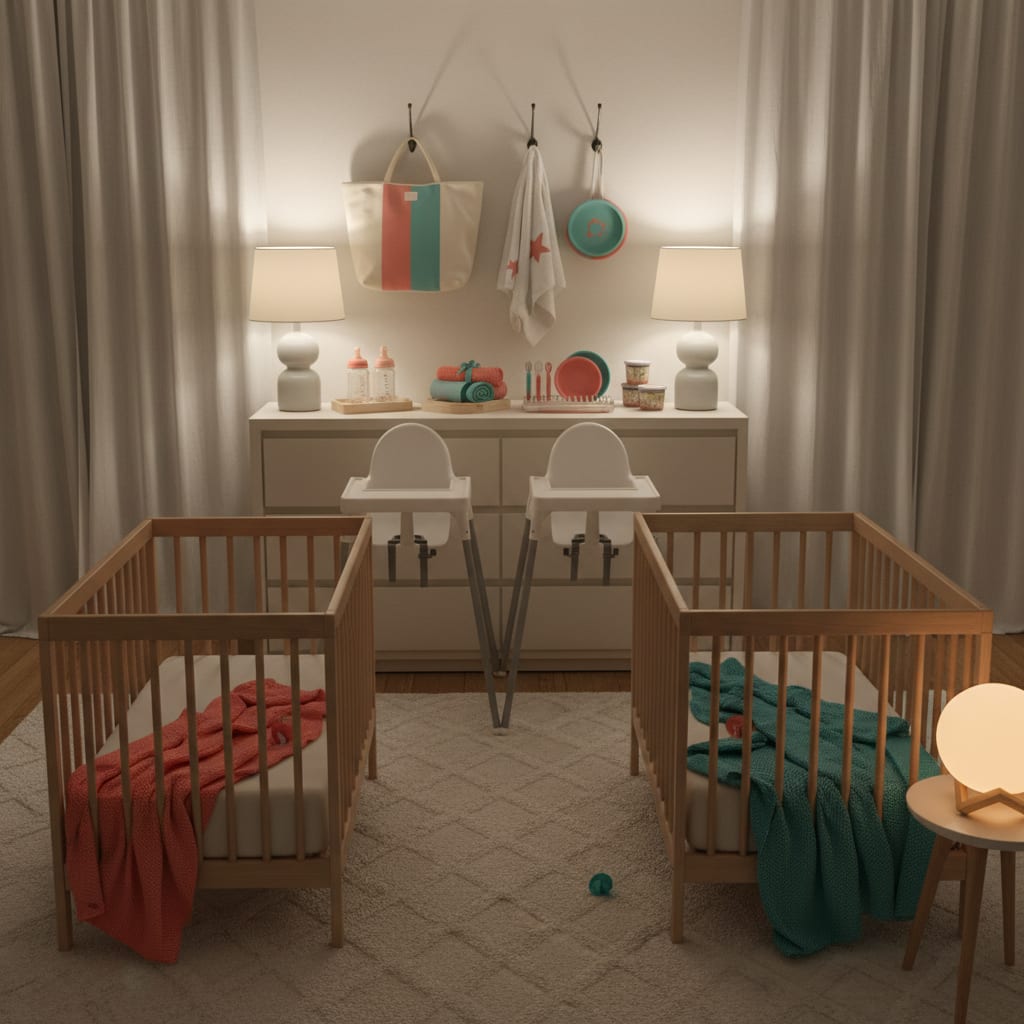
Our setup, which is also the safe-sleep baseline: both babies in our room, each in their own bassinet, flat on their backs, nothing in the sleep space. The AAP’s safe sleep guidance recommends room-sharing with parents (without bed-sharing) for at least the first six months, and it does not endorse twins sharing one crib — separate sleep surfaces, even for twins. Ask your pediatrician about your specific setup; that’s their call, not a blog’s.
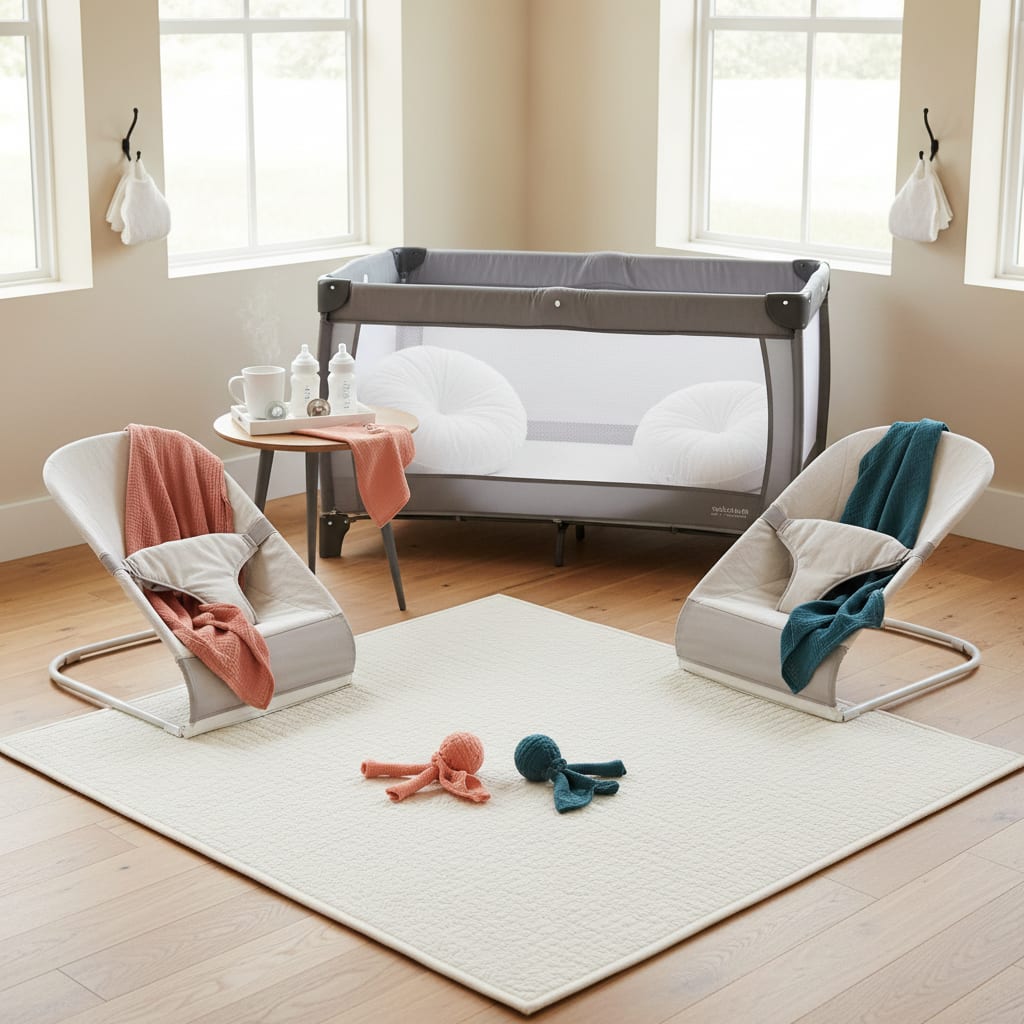
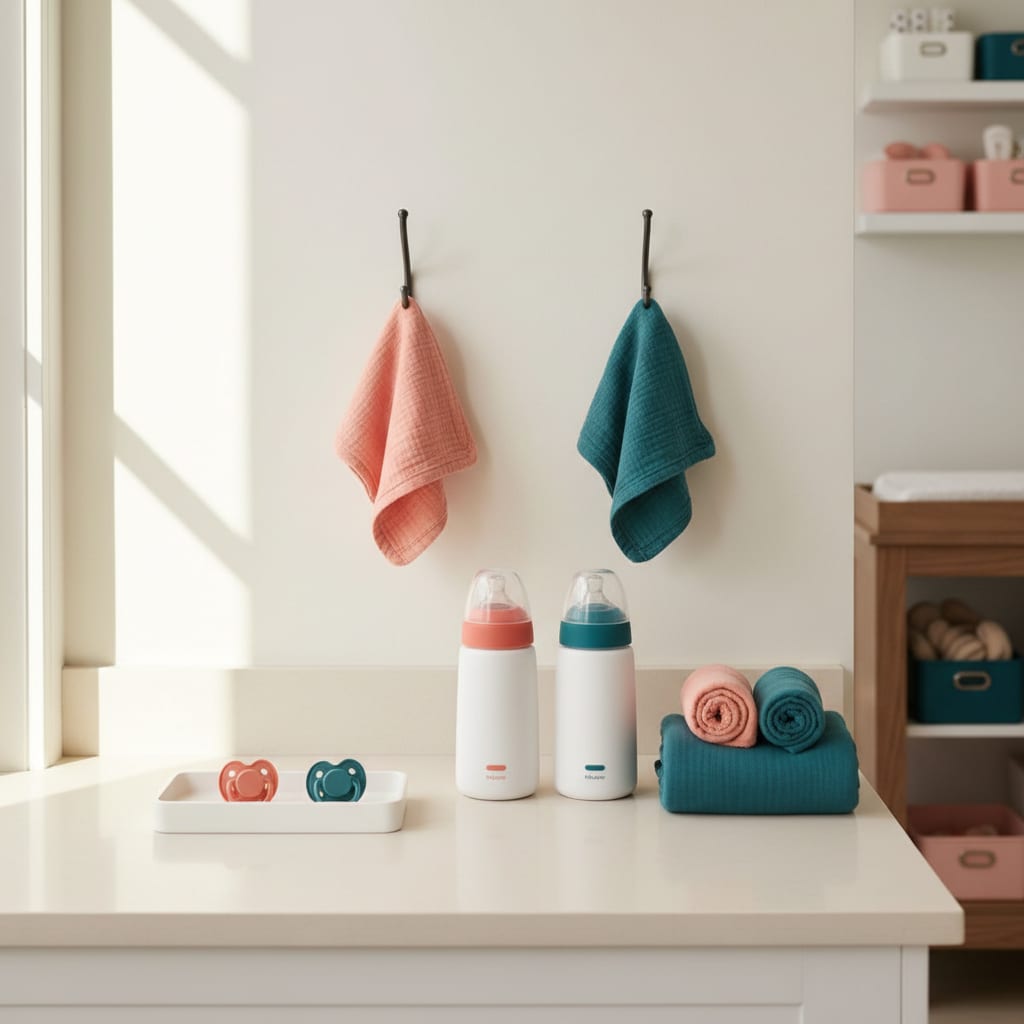
Two bassinets side by side also gives you the A|B system this site runs on: Baby A’s space on the left with the coral swaddle, Baby B’s on the right with the teal. At 3am, you want zero cognitive load about who’s who and who’s been fed. Color-code everything.
Will they wake each other up?
Less than you fear. Newborn twins spent nine months sleeping through each other’s kicks; a crying co-twin is background noise to them in a way it will never be to you. In our first twelve weeks I can count on one hand the times one twin’s crying genuinely woke the other. What actually wakes the second twin is hunger — which is why the sync matters more than soundproofing.
White noise helps anyway, mostly by flattening the difference between “one baby fussing” and “quiet”: a machine like the Yogasleep Dohm — one per room is plenty — runs all night at a steady volume, placed well away from both bassinets.
Swaddle both, every sleep
Swaddling was the highest-return sleep move of our newborn stage — it takes the startle reflex out of the equation, and with twins the startle reflex has twice as many chances to end a nap. The wrap technique that finally held (and this domain’s signature move since its first life in 2010) gets its own post: swaddling twins, including the two-baby assembly-line version and when to stop.
Nights: the shift system
The real newborn twin sleep problem isn’t the babies’ sleep — it’s yours. Two parents both “helping” with every feed means two people getting no sleep instead of one getting some. We ran shifts like a hospital unit, because I used to coordinate one: I owned 9pm to 2am, my husband owned 2am to 7am, and whoever was off duty slept in another room, earplugs in, guilt off. One night feed with two babies takes a practiced team of one about 40 to 50 minutes — bottle-feeding both, changing both, resettling both. Plan for that number, not the fantasy 20 minutes.
If you’re a solo parent or your partner’s leave has ended, the sync matters even more, and the bar goes down: the goal is one protected 4-hour block for you in every 24. Take help for exactly that block.
When it’s not working
Some honest triage, learned the hard way:
- Both babies fighting sleep at every put-down: the wake windows are too long. Newborn wake windows are brutally short — 45 to 60 minutes including the feed. Watch the clock, not the babies; twins’ tired cues get lost in the noise of two.
- One twin sleeps, one doesn’t: the most common twin-sleep complaint there is, and it gets its own playbook.
- Evening cluster-fuss (roughly weeks 3 to 10): this is the witching hour and it is developmental, not a schedule failure. Tag-team, swaddle, white noise, motion, repeat. It ends.
- A baby who won’t sleep anywhere but on you, around the clock, or anything that feels off medically: pediatrician, same week. Reflux, weight-gain issues and the like are their lane, and twins (often early, often small) earn extra vigilance there.
Around 10 to 12 weeks, the fog lifts a little: nights consolidate, the bedtime hour stabilizes, and you can start thinking about actual sleep structure. When that day comes, the next post in this cluster is sleep training twins in the same room.
FAQ: newborn twin sleep
Should newborn twins sleep on the same schedule?
Yes — it’s the closest thing twin parenting has to a universal rule. Sync the feeds (wake the second twin when the first wakes to eat) and put both down for sleep together. Separate clocks mean a feed every 90 minutes for whoever is on duty; one clock means real gaps between rounds.
Can newborn twins sleep in the same crib?
The AAP recommends a separate sleep surface for each baby — so the standard answer is no, even though plenty of hospital photos suggest otherwise. Two bassinets in the parents’ room is the setup that matches the guidance. Whatever you’re considering, run it past your pediatrician.
How much do newborn twins actually sleep?
The same as singletons: roughly 14 to 17 hours per baby per 24 hours, in bursts of 2 to 4 hours. The twin difference isn’t the amount — it’s that unsynced bursts destroy the gaps. Protect the sync and you protect your own 2-to-3-hour sleep blocks.
When do twins start sleeping longer stretches at night?
Expect the first meaningfully longer night stretches somewhere in the 8-to-12-week range, and treat anything earlier as a gift, not a baseline. Feeding method, prematurity and plain luck all move this; twins born early tend to hit milestones on their adjusted age, not the calendar.