Newborn Twin Schedule: Samples That Work

A newborn twin schedule is one schedule, not two: both babies eat at the same times (wake the second twin when the first wakes hungry), both go down at the same times, and the day runs in repeating eat → wake → sleep cycles of roughly 3 hours in the early weeks. You don’t schedule newborn twins to the minute — you schedule the order of events and the sync between babies, and let the clock breathe by 20 to 30 minutes either side. Below are the sample days that ran our first twelve weeks, by stage, in the A|B format this site is built on.
The three rules under every sample
- One clock. The second twin always gets woken to feed when the first wakes. This is the rule everything else depends on — the full reasoning lives in the newborn twin sleep guide, but the one-line version: offset twins mean a feed every 90 minutes forever.
- Eat, wake, sleep — in that order. Feed at the start of a cycle, not into sleep, so feeding and falling asleep stay separate skills. The “wake” part of a newborn cycle is short and unglamorous: a diaper change and some staring counts.
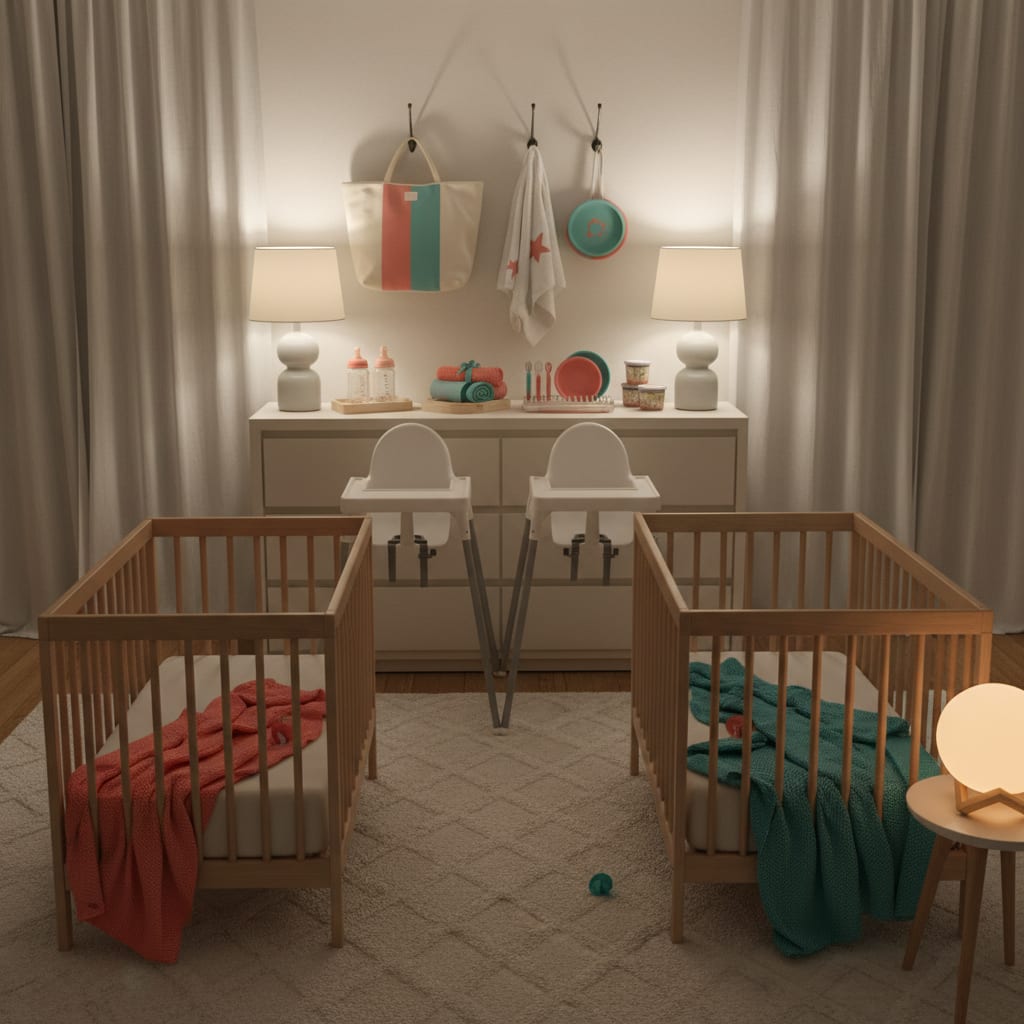
- Log it, don’t remember it. With two babies, memory is fiction by Tuesday. A paper A|B log — time, baby, ounces or minutes, which side, diaper — hanging where the feeds happen. Coral column for A, teal for B. When the pediatrician asks “how much is she eating?”, the log answers; the haze doesn’t.
Weeks 0–4: survival cadence (8 feeds/day)
Newborns this age eat roughly every 2.5 to 3 hours and stay awake 45 to 60 minutes tops, feed included. The day is just this cycle, repeated until morning:
| Time | Baby A | Baby B |
|---|---|---|
| 7:00 | Wake + feed | Woken + fed |
| 7:45 | Diaper, burrow, swaddle | Same, 2 min behind |
| 8:00 | Down for nap | Down for nap |
| 10:00 | Feed | Feed |
| 1:00 | Feed | Feed |
| 4:00 | Feed | Feed |
| 7:00 | Feed + bedtime routine | Feed + bedtime routine |
| 10:00 | Dream feed | Dream feed |
| 1:00 & 4:00 | Night feeds, lights low | Synced, always |
The night feeds at 1:00 and 4:00 aren’t scheduled so much as anticipated — whoever wakes first sets the time and the co-twin joins. Total: about 8 feeds per baby per day, 16 feeds a day passing through the household. Yes, write down all sixteen.
Weeks 4–8: stretching (7 feeds/day)
Around a month in, wake windows stretch toward 60 to 75 minutes and one night stretch usually lengthens. The day gains shape — a real morning wake time and a real bedtime:
| Time | Baby A | Baby B |
|---|---|---|
| 7:00 | Wake + feed | Woken + fed |
| 8:15 | Nap 1 | Nap 1 |
| 10:00 | Feed, then play mat | Feed, then play mat |
| 11:30 | Nap 2 | Nap 2 |
| 1:00 | Feed | Feed |
| 2:30 | Nap 3 | Nap 3 |
| 4:00 | Feed, then the fussy hours | Feed, in the same trench |
| 5:30 | Catnap | Catnap |
| 7:00 | Feed + bed | Feed + bed |
| 10:30 | Dream feed | Dream feed |
| ~2:30 | One night feed (ish) | Synced |
The 4-to-7pm block is the witching hour and no table fixes it; the catnap keeps it from metastasizing. If your evenings run 5:30-to-8:30 chaos anyway, that’s normal at this stage — and it’s schedule-adjacent, not schedule-failure.
Weeks 8–12: the pattern emerges (6 feeds/day)
By two to three months, feeds settle toward every 3 to 3.5 hours, three real naps plus a catnap, and — if you’re lucky and consistent — one long night stretch of 5 to 6 hours:
| Time | Baby A | Baby B |
|---|---|---|
| 7:00 | Wake + feed | Woken + fed |
| 8:30 | Nap 1 (long) | Nap 1 (long) |
| 10:30 | Feed | Feed |
| 12:00 | Nap 2 | Nap 2 |
| 1:30 | Feed | Feed |
| 3:00 | Nap 3 | Nap 3 |
| 4:30 | Feed | Feed |
| 5:45 | Catnap (20–30 min) | Catnap |
| 6:45 | Feed + bedtime | Feed + bedtime |
| 10:00 | Dream feed | Dream feed |
| Night | 1 feed, trending to 0 | Synced |
This is also the stage where the two babies start showing you they’re two different people — one twin drops the night feed, the other files a formal objection. Hold the shared skeleton and differentiate inside it; the one twin sleeps, one doesn’t playbook covers exactly that fork.
Adjusting the samples to your actual babies
- Prematurity: twins often arrive early; run expectations on adjusted age, and expect your pediatrician to set feeding minimums that override any schedule — some early or small twins must be woken to eat on a strict interval for a while. Medical instructions beat tables, always.
- Feeding method moves the clock: breastfed newborns often eat closer to every 2 to 2.5 hours, bottle-fed closer to 3. Tandem feeding compresses the round dramatically — the setups are in the feeding twins guide.
- The 20-minute rule: any time in these tables can slide 20 to 30 minutes without “breaking” anything. What breaks the system is letting the babies slide apart from each other. Sync between twins first, clock second.
- Who’s who at 3am: none of this works if you can’t tell whose ounces you just logged — the color-code and the other telling-them-apart systems are the boring infrastructure under the whole schedule.
FAQ: newborn twin schedules
Should twins be on the same schedule?
Yes — it’s the closest thing to a unanimous verdict in twin parenting. Feed both when one wakes hungry, put both down together, accept a rough edge or two. The alternative is two offset newborn schedules, which means a feed every 90 minutes around the clock for whoever’s on duty.
How strict should a newborn twin schedule be?
Strict on order and sync, relaxed on clock. Eat-wake-sleep in that sequence, babies within minutes of each other — but any given feed drifting 20 or 30 minutes is Tuesday, not failure. Newborns aren’t schedulable to the minute; the repeating cycle is the schedule.
Do you really wake a sleeping twin to feed?
Really. It’s the least intuitive, highest-value move in twin logistics: feed the woken twin drowsy and back down, and you’ve bought a 2.5-to-3-hour gap before anyone needs you again. The exception is medical — if your pediatrician has set specific feeding rules for a small or early twin, theirs win.
When can twins go longer between night feeds?
When weight gain is solid and your pediatrician signs off on letting them stretch — often somewhere in the 2-to-3-month zone, earlier for some, later for many. Twins born early hit this on adjusted age. Until then, night feeds are on the schedule, synced like everything else.