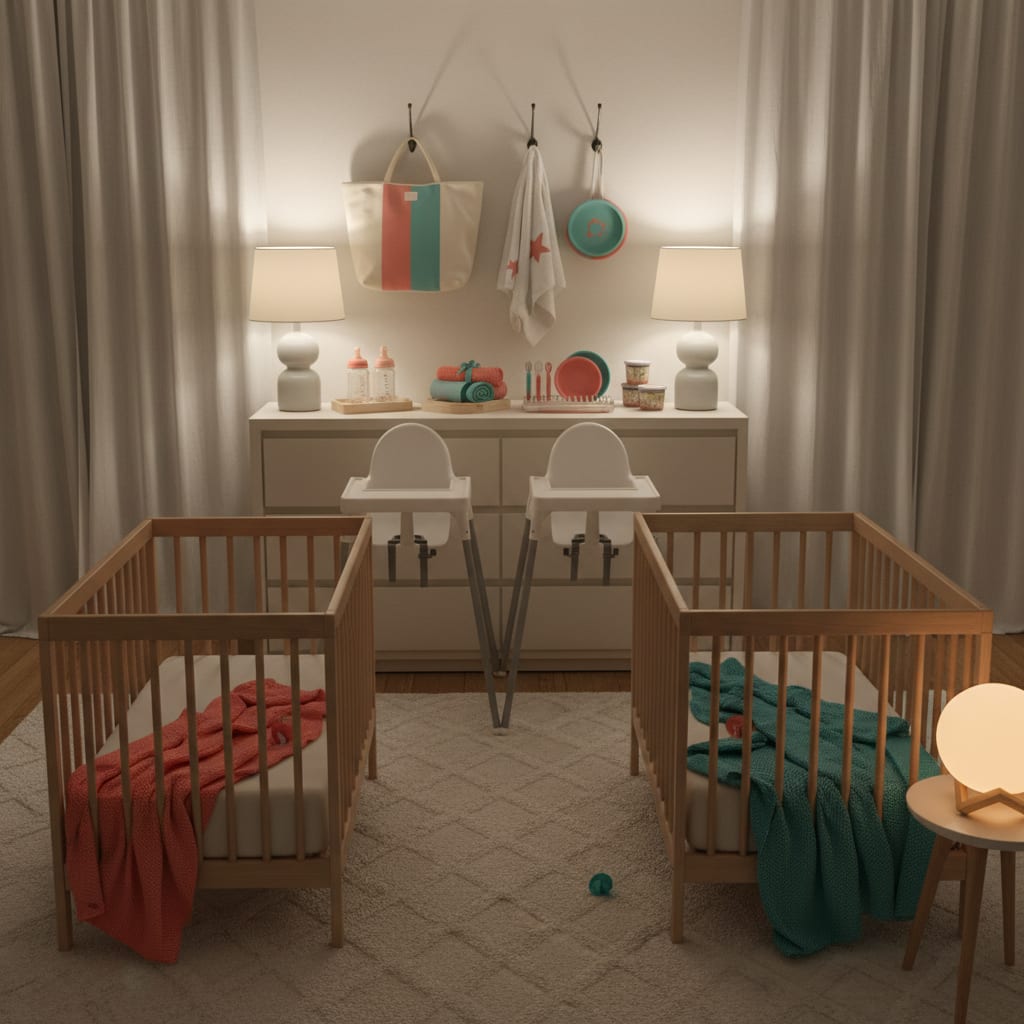
Twins Dropping to One Nap When Only One Is Walking

When a baby learns to walk, the morning nap usually starts coming apart — and with twins it comes apart for one of them weeks before the other. Do not drop it for both. Keep the two anchors that hold a twin day together, a shared wake time and a shared afternoon nap start, and let the morning nap be the one thing that differs: the newly mobile twin gets quiet awake time while the other one sleeps. Drop naps per baby, never per pair. Most toddlers are down to one nap by eighteen months, and yours will get there separately.
The stagger is the default, not bad luck
Milestone charts read like appointment times, and they aren’t. The CDC states plainly that its milestones are things “most children (75% or more) can do by a certain age” — that is a population threshold, not a date. Its list puts “takes a few steps on his own” at fifteen months and “walks without holding on to anyone or anything” at eighteen. Betteroo’s walkthrough of the nine-to-eighteen-month walking window covers the same spread from the other end.
Two babies who share a birthday, a house, a floor and an identical schedule are still two separate draws from that spread. Mine were about five weeks apart, which is unremarkable — twin parents just feel it more sharply, because the comparison is standing right there on the same rug.
One thing that is genuinely twin-specific here: because both babies were born on the same day, corrected age cannot explain the gap. If your twins arrived early — and twins often do — you are counting from the same adjusted date for both. Prematurity moves the whole pair, not one of them. When they split, it really is individual variation, and there is nothing to fix.
Why walking is the thing that eats the morning nap
Two separate things arrive at once, and they compound.
The first is practice. A baby who has just worked out that vertical is available will practise it in the cot, in the dark, with total commitment. That is a new skill with nowhere else to go.
The second is real and it is the one that lasts: the daytime sleep requirement genuinely drops around this age. Nemours KidsHealth puts young toddlers at two naps but says most are down to one a day by eighteen months, and gives one- to two-year-olds about eleven to fourteen hours of sleep in twenty-four, naps included. So the walking twin lying awake at 9:15 a.m. usually isn’t refusing. The pressure isn’t there yet.
Betteroo’s guide to how the two-nap-to-one change usually runs is the clearest single-baby version of the mechanics. Everything below is what changes when you run it twice at once.
What actually breaks is the overlap
Two babies on two naps is not four nap events. It is two, because they share a start — that shared start is the whole reason a twin day is survivable, and it is the thing this transition removes.
The morning stops being a hands-free block and becomes a one-on-one block with a mobile toddler. That is not automatically worse — a lot of twin parents find it is the first uninterrupted time they have ever had with one baby — but it is unpaid, and it makes the afternoon nap the only overlap left in the day, which promotes it from a nap to the nap. Protect it the way you used to protect both. If your afternoon nap has never been the long one, extend it before you touch the morning.

Keep the anchors, move only the variable
The working rule is short. Wake them at the same time. Start the afternoon nap at the same time. Let the morning nap be optional, per baby.
That keeps everything the shared-clock system is built on and changes exactly one input. It also means the day does not fork into two timetables, which is the failure mode that makes twin parents give up and drop the nap for both.
Some practical detail on the handover. The still-napping twin goes down for the morning nap in the room, on their own flat firm surface, exactly as before — nothing about a transition justifies doubling two toddlers into one cot to free up floor space, and nothing soft goes in to make it work. The walking twin leaves the room with you. Expect the morning nap to shorten before it disappears: an hour becomes forty minutes becomes a twenty-minute cat nap that wrecks the afternoon, and the last of those is your signal.
Log it per baby for a fortnight. The A|B feeding and sleep sheet is enough — nap start, nap length, bedtime, night wakings, two columns. Two weeks of that will tell you whether the second twin is following or holding, and you will not be able to tell from memory.
Where the awake twin goes
The shared bedroom is out. A newly walking toddler and a sleeping toddler in one dark room is not a plan, it is a countdown.
You need one contained floor space elsewhere in the house where the mobile twin can be safely deposited for twenty minutes while you settle the other one — and it is worth being honest that this is a hands problem, not a sleep problem. A large panel play yard does it: something like the Regalo My Play 6-panel, which gives roughly four feet of enclosed floor rather than a cot-sized footprint. It buys the settling window and nothing more, and it stops working the week they learn to climb it — which will also happen unevenly.
Telling a real drop from a bad fortnight
A genuine drop is boring and gradual. It looks like twenty-plus minutes to fall asleep for the morning nap, several days running; or the morning nap happening and the afternoon one collapsing; or bedtime sliding later without an obvious cause. It persists for a week or two and it does not reverse.
A strike is dramatic and short. Three loud days around a new skill, then the nap comes back. New walkers throw a lot of these. If you restructure the day on day three you will be restructuring it back on day nine.
One thing to rule out first: a twin whose morning nap is being wrecked by a sibling banging around the house is not dropping a nap, they are being woken, and that is a noise problem with a different fix. The by-age nap timings will tell you what is age-typical before you decide which you are looking at.
FAQ
Should I drop the morning nap for both twins to keep the day simple? It is tempting and it is the most common regret I hear. You buy a symmetrical day and an overtired toddler, and overtiredness shows up at bedtime and at 5 a.m. rather than at nap time, so most people never connect it back. If you do it deliberately, give it four or five days and judge it on the late afternoon and the night, not on the nap.
How far apart can the two transitions run? Weeks, commonly. A month or more is not unusual and is not a sign anything is wrong with the slower twin. The pair reconverge on one nap on their own; you do not have to engineer it.
Does the walking twin need an earlier bedtime now? Usually yes, at least for a while. KidsHealth’s advice when a nap goes is to move bedtime earlier so the twenty-four-hour total holds. You can move one bedtime without the other, but a shared room makes staggered entry fiddly, so most people move both by fifteen or twenty minutes and accept the compromise.
Can I just cap the morning nap instead of dropping it? Yes, and it is a good middle step for the twin who is nearly there. Cap it at thirty or forty minutes, keep the afternoon start where it is, and see whether the afternoon nap survives. If it does, you have bought yourself another few weeks of overlap.
Sources: CDC Learn the Signs. Act Early. milestone lists for 15 months and 18 months; Nemours KidsHealth on naps and toddler sleep at 1–2 years. None of this replaces your own pediatrician, who is the right person to ask if one twin’s development is worrying you rather than merely differing.