Twin Feeding & Sleep Log: A Printable A|B Sheet
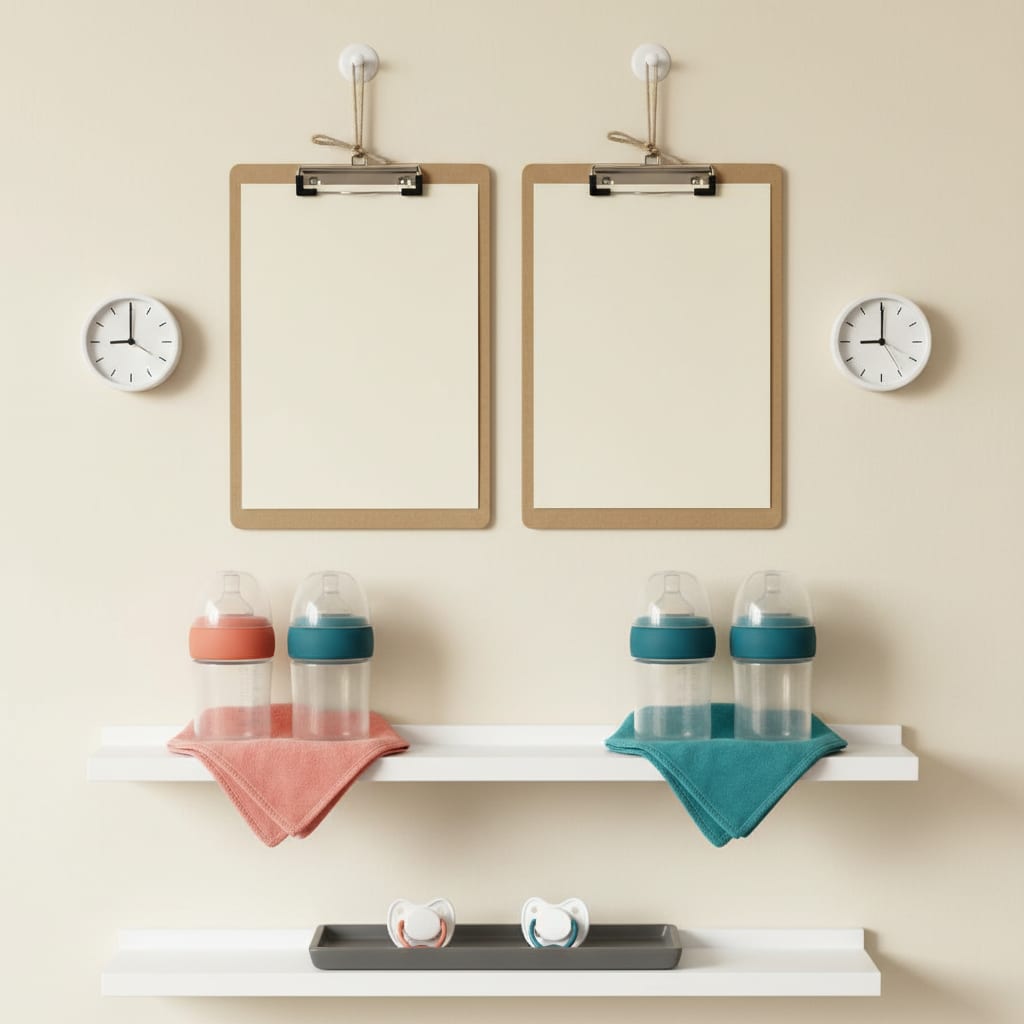
A twin feeding and sleep log should be one sheet with two baby columns, not two logs. One page per 24 hours, five columns, filled in at the moment rather than from memory: time, which twin, what went in, what sleep happened, and diapers. Baby A in the coral column, Baby B in the teal one. You print it, you hang it where the feeds happen, and you read it on day seven — not day three. Below is the exact layout, what each column is actually for, and the handful of things that make a twin log survive past week one.
The sheet, exactly as it should look
This is the whole thing. Two columns, one row per event, filled in as it happens:
| Time | Baby A | Baby B |
|---|---|---|
| 7:05 | Breast L 18 min | Bottle 3 oz |
| 7:40 | Sleep down | Sleep down |
| 9:10 | Wake | — |
| 9:25 | — | Wake |
| 10:00 | Bottle 3.5 oz, wet + dirty | Breast R 22 min, wet |
| 11:15 | Sleep down | Sleep down |
Two rules make it readable at 3am. Time goes in the left column, always — one shared clock down the page is what lets you see the gap between twins at a glance. And a dash is data. An empty cell means “I forgot”; a dash means “nothing happened for this baby at this time”, which is exactly the thing you’ll want to know on Friday.
If your twins run on the shared-clock system in the newborn twin schedule, most rows will have two entries and the dashes will be the interesting ones.
Rule the page in 90 seconds
There is no signup, no PDF, no email wall here. Two ways to get the sheet:
- Print this page. Your browser’s print view keeps the table above, and the A|B columns come through as the shaded coral and teal blocks. One printed page covers a day. Print seven.
- Draw it. A sheet of letter paper, a ruler, three vertical lines. Write A at the top of the middle column and B at the top of the right one, in the two colors you’re already using for bands, socks and hats. Total effort: 90 seconds, and it survives being wet.
Whichever you pick, the sheet lives where the feeds happen — taped inside a kitchen cupboard door, clipped to the side of the changing table, stuck to the fridge at eye level. A log in a drawer is a log you invented and never used.
The five columns that earn their space
Everything else is optional. These five are the ones that answer a real question later:
- Time. Written when the feed starts, not when you finally sit down afterwards.
- Which twin. Not “the hungry one”. Use the color-code, and if you’re still at the stage where that’s genuinely hard, the systems in telling newborn twins apart come before the log does.
- Intake. Ounces for bottles; minutes and which side for the breast. Both babies get their own number, even when you fed them at the same moment — twins commonly differ by an ounce or two per feed, and the difference is only visible if you write both.
- Sleep down / wake. Two entries per nap, not one. Down-time alone tells you nothing; the pair tells you the length, and the gap between “wake” and the next “down” is the wake window.
- Diapers. Wet and dirty, per baby. This is the column you’ll resent until the week your pediatrician asks about output for one specific twin.
What to leave off: mood, weather, minute-by-minute fussing, anything requiring a sentence. A twin log has to be fillable one-handed, in the dark, by an adult running on four hours’ sleep. Every extra column is a reason the sheet dies by Wednesday.
Night pages are different
Use a separate page for 7pm to 7am, and strip it down further: time, baby, ounces or minutes, back-down time. That’s it — no diapers unless there was a change, no notes.
Keep a pen physically attached to the clipboard (a loop of string, taped down) and a small dim light in the feeding spot. The reason night rows go missing isn’t discipline. It’s that you’re holding a baby and the pen is downstairs.
How to read seven days
On day eight, sit down with all seven pages and look for four things, in this order:
- Total feeds per baby per day. Not per household — per baby. Two twins fed “the same” all week routinely turn out to be one baby on eight feeds and one on six.
- The longest night stretch, per baby. Circle it on each page. If it’s growing for one twin and flat for the other, that’s the real picture behind “our twins sleep terribly” — and it’s the fork the one twin sleeps, one doesn’t playbook is written for.
- The wake-window drift. Measure the gap from “wake” to the next “down”. If it’s stretching, the schedule needs to move before the day starts falling apart on its own.
- The sync gap. How many minutes apart did the two babies actually run? Under 20 minutes is a working sync; an hour and rising means the shared clock has slipped and needs the reset in getting twins on the same schedule.
Nights one to three are noise — a new sheet makes everyone log more carefully, then reality reasserts itself. Judge from day four onward.
Paper or an app?
Both work; they fail differently. Paper never runs out of battery, is legible to a partner or grandparent at a glance, and hands over to your pediatrician as a physical object. An app does the arithmetic for you, syncs between two caregivers, and doesn’t get a bottle spilled on it — the trade-off is that feeding tracker apps mostly assume one baby, so with twins you’re either paying for two profiles or tapping between them at 3am.
The honest twin verdict: paper for the newborn stretch, an app later if you still want the data. In the weeks when you most need the record, you are least able to unlock a phone with one hand while a second baby escalates.
What to hand the pediatrician
At the two-week, one-month and two-month visits, bring the last seven pages rather than a summary. What they tend to want is feeds per 24 hours per baby, rough intake, wet and dirty diapers per baby, and the longest sleep stretch. Bring the actual sheets and let them read it — that’s how a difference between your two babies gets spotted early instead of being averaged away.
Any concern about weight gain, output, or one twin feeding noticeably less than the other belongs in that room and not on a blog. The log’s job is to make the conversation specific.
FAQ: twin feeding and sleep logs
How long should I keep a twin feeding log?
Most families run it hard for the first eight to twelve weeks, then drop to nights only, then stop. Bring it back for a week any time something changes — a nap transition, a suspected regression, a feeding switch — because a week of data beats a month of impressions.
Do I need to log both twins separately?
Yes, and it’s the entire point. One combined number hides the thing you most need to see: two babies with different intakes, different night stretches and different wake windows living on one schedule.
What if I miss entries?
Leave the row blank and carry on. A log with gaps is still usable; a log you abandoned because you fell behind on Tuesday isn’t. Aim for feeds and night wakings, and treat everything else as a bonus.
Should both parents use the same sheet?
One sheet, both hands. Two logs kept by two people is how a twin household ends up with two versions of the night and no way to reconcile them. Shared sheet, shared pen, whoever is on duty writes.