One Twin Sleeps, One Doesn't: What to Do
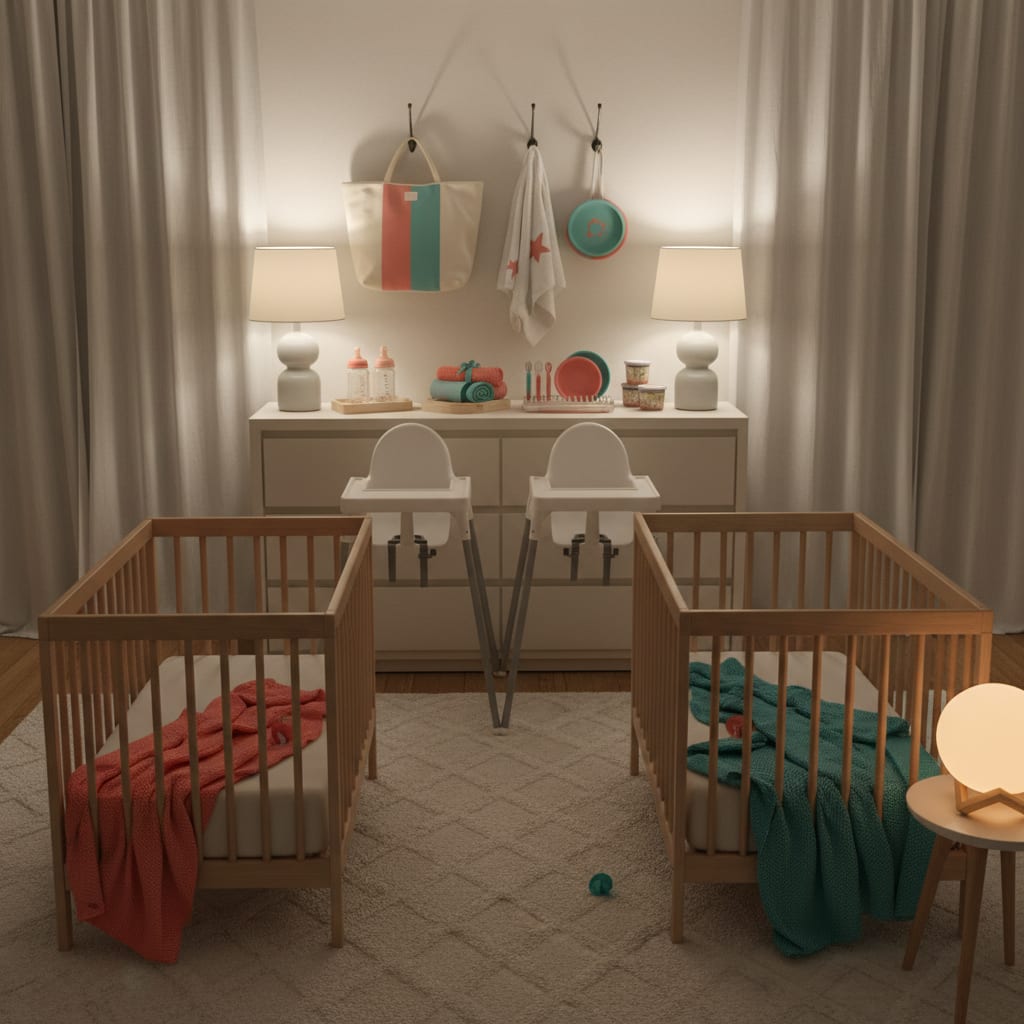
When one twin sleeps and one doesn’t, the fix is almost never “try harder with the difficult one” — it’s admitting you have two different sleepers and running a plan per baby: same bedtime and same room, but each twin’s own soothing method, own night-waking response, and if needed, own nap lengths inside the shared schedule. Twins share a birthday, not a temperament. The parents who crack this are the ones who stop treating twin sleep as one project and start treating it as two projects that happen to share a room.
Here’s how that works in practice, from a house where Baby A slept like a hibernating bear and Baby B treated bedtime as a negotiable opening offer.
First, rule out the boring explanations
Before you diagnose a temperament difference, check the mechanical stuff — it’s fixable by Thursday:
- Different real intake. The “bad sleeper” is often the lighter eater. With twins it’s easy to assume both babies ate because both were fed; our B consistently took less per bottle and then billed us for it at 2am. Track a few days of actual amounts on an A|B log (the newborn twin schedule hub has the format).
- Different wake tolerance. Some babies genuinely need a shorter wake window. Ten minutes of extra awake time can be the whole difference; try putting the struggling twin down one slot earlier for three days.
- Different comfort in the setup. Check the unglamorous list: swaddle fit (the wrap matters more than the brand), room temperature, a bassinet near a draft or a light.
- Something medical. Reflux, ear infections and eczema-itch all sabotage one twin’s sleep while sparing the other. A sleep gap that appears suddenly, or comes with feeding changes or obvious discomfort, is a pediatrician call — this week, not eventually.
The core move: one bedtime, two playbooks
Keep the shared skeleton — same room, same bedtime hour, same wind-down order — because the household schedule is the thing keeping you alive. Inside it, differentiate:
- Soothing: A settled with a hand on the chest; B needed a full pick-up-put-down cycle. Running “the same method for fairness” just meant it worked for neither. Give each baby the method that works on that baby.
- Night response: decide, per twin, what happens at a night waking. For the solid sleeper: a beat of waiting, because she resettles. For the struggler: the response ladder you’re actually willing to repeat at 3am.
- Naps: if one twin chronically needs more day sleep, let their naps run longer at the edges while the start times stay shared. Shared starts protect the schedule; flexible ends respect the baby.
What you protect at all costs is the shared clock — one bedtime, one morning wake time, naps launched together. That’s also why the good sleeper mostly keeps sleeping through the other’s protests: co-twins are famously good at ignoring each other, and a consistent room (dark, white noise, boring) makes it even easier. If the interference genuinely runs the other direction — twins waking each other in a chain reaction — that’s a separate problem with separate fixes, and same-room training has its own post.
Why “one plan per baby” is hard to write yourself
The honest answer: by the time you’re deep in a one-twin-won’t-sleep stretch, you are too tired to be your own sleep consultant. You need someone to hold the variables — this baby’s age, this baby’s naps, this baby’s temperament, your tolerance for crying — and hand you tonight’s numbers, per baby.
That’s the one place I’ll point at a tool: Betteroo builds a personalized, day-by-day sleep plan from a quiz about your baby and your parenting style — and because the plan is per child, twins get what they actually are: two children. We ran the quiz twice, once per twin, and got two genuinely different plans — B’s had an earlier bedtime and a gentler night-waking ladder than A’s, which matched exactly what we’d half-figured out through trial and error, except it arrived in one evening instead of six weeks. Balanced verdict: it’s a tool, not magic — around $20 a month, it won’t do the 2am resettles for you, and a twin with a medical issue needs a pediatrician, not an app. But for the specific problem of this post — two different sleepers, one exhausted plan-writer — a per-baby plan is precisely the product.

What not to do
- Don’t delay the good sleeper to match the struggler. Never handicap the twin who’s working. The schedule serves the family; the strong sleeper anchors it.
- Don’t move the struggling twin out of the room as step one. Separation is a big lever with its own costs (and a second room you may not have). Try per-baby methods inside the shared room for a couple of weeks first; separation is the escalation, not the opener.
- Don’t relitigate the plan nightly. Pick the per-baby playbook, run it for five to seven nights, and only then judge it. Nightly plan-switching is how you end up with two bad sleepers.
- Don’t compare in front of the data. “Why can’t you sleep like your sister” is a sentence with a long shelf life. The gap usually narrows by toddlerhood; the labels stick longer than the sleep problems do.
FAQ: one twin sleeping worse than the other
Is it normal for one twin to sleep so much worse than the other?
Completely — it might be the single most common twin-sleep complaint. Even identical twins can differ in temperament, feeding efficiency and soothability, and fraternal twins are simply two siblings who happen to be the same age. A gap is normal; a sudden new gap, or one with feeding or health changes attached, is a pediatrician question.
Should I sleep train both twins at the same time?
Usually yes on the same timeline — one training window, one consistent room — but with methods allowed to differ per baby. Training one twin while indulging the other’s old habits in the same room confuses both. The same-room mechanics are covered in sleep training twins in the same room.
Will the wakeful twin ruin the good sleeper’s sleep?
Far less than you’d think — co-twins habituate to each other’s noise remarkably well, especially with steady white noise in the room. In most houses the person whose sleep the wakeful twin ruins is you. Protect the shared schedule and let the good sleeper prove how unbothered she is.
When should I separate the twins for sleep?
When you’ve run consistent per-baby methods for a few weeks and one twin’s wakings are still genuinely dragging the other down — separation for training can be temporary, with a reunion once both sleep. For a broader family-schedule view of twins-plus-siblings, bigfamilyplaybook’s twin sleep schedule guide is the companion read to this whole cluster.