Sleep Training Twins in the Same Room
Sleep training twins in the same room is not only possible — it’s how most twin families do it, because most twin families don’t have a spare bedroom per baby. The method: pick one training approach you can sustain, start on a night you can afford to lose, run bedtime for both babies together, and respond to each twin individually while trusting white noise and nine months of womb-cohabitation to keep them from derailing each other. Most twins bother each other far less than their parents fear, and the shared room usually stops being the story by night three.
This domain has history here: its first life was a Boston twin-mom blog whose sleep-training diary — bedtime chaos starting at 5:30, babies finally down at 8:30 — ran under this roof in 2010. Fifteen years later, the problem hasn’t changed. Here’s the modern version of the answer.
Before you train: the checklist
Sleep training fails for preparation reasons more than method reasons. Before night one:
- Age and green light. Most approaches are aimed at roughly 4 to 6 months and up; twins are often born early, so think in adjusted age, and clear it with your pediatrician first — that appointment is also where medical wrinkles like reflux get ruled out.
- A schedule that already roughly works. Training teaches babies to fall asleep independently; it can’t fix a bedtime fighting biology. If your evenings are chaos from 5:30 to 8:30, fix the day structure first — the newborn twin schedule hub and its sample days are the prerequisite reading.
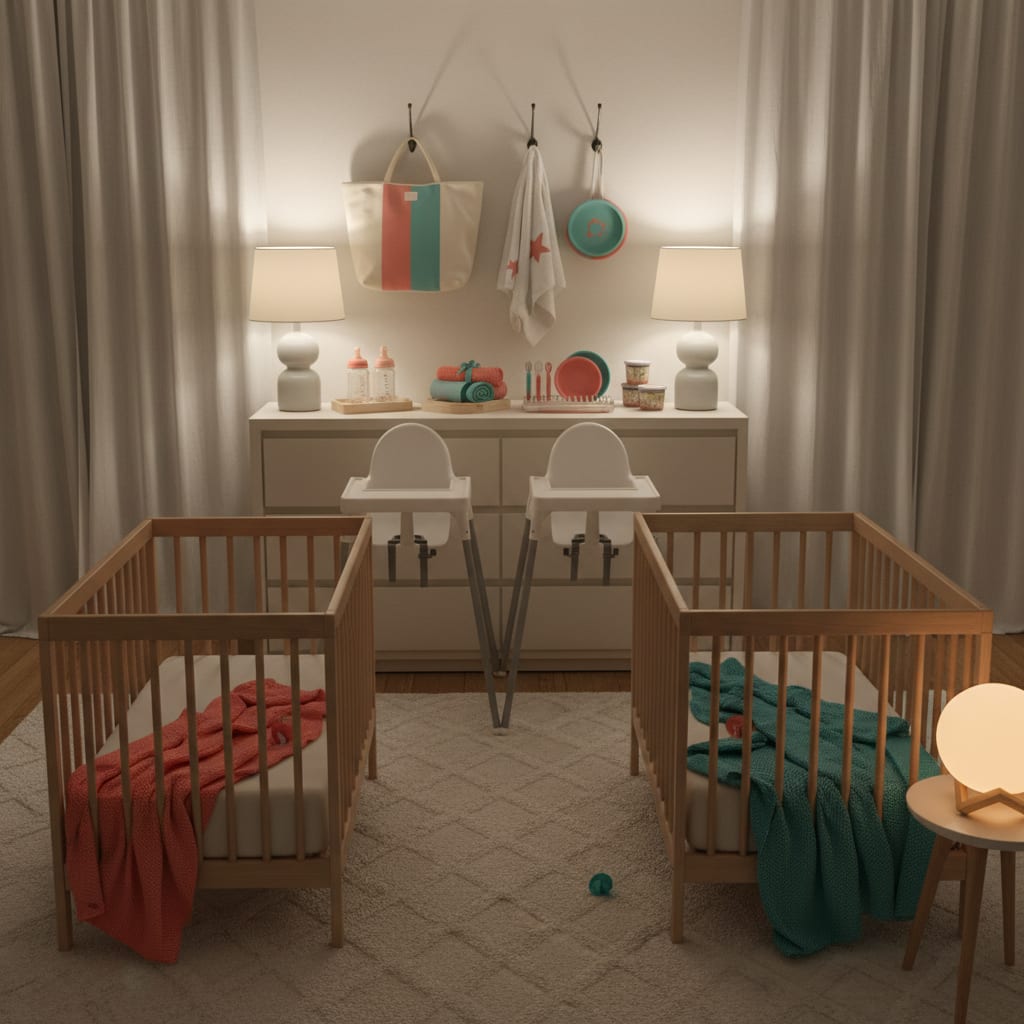
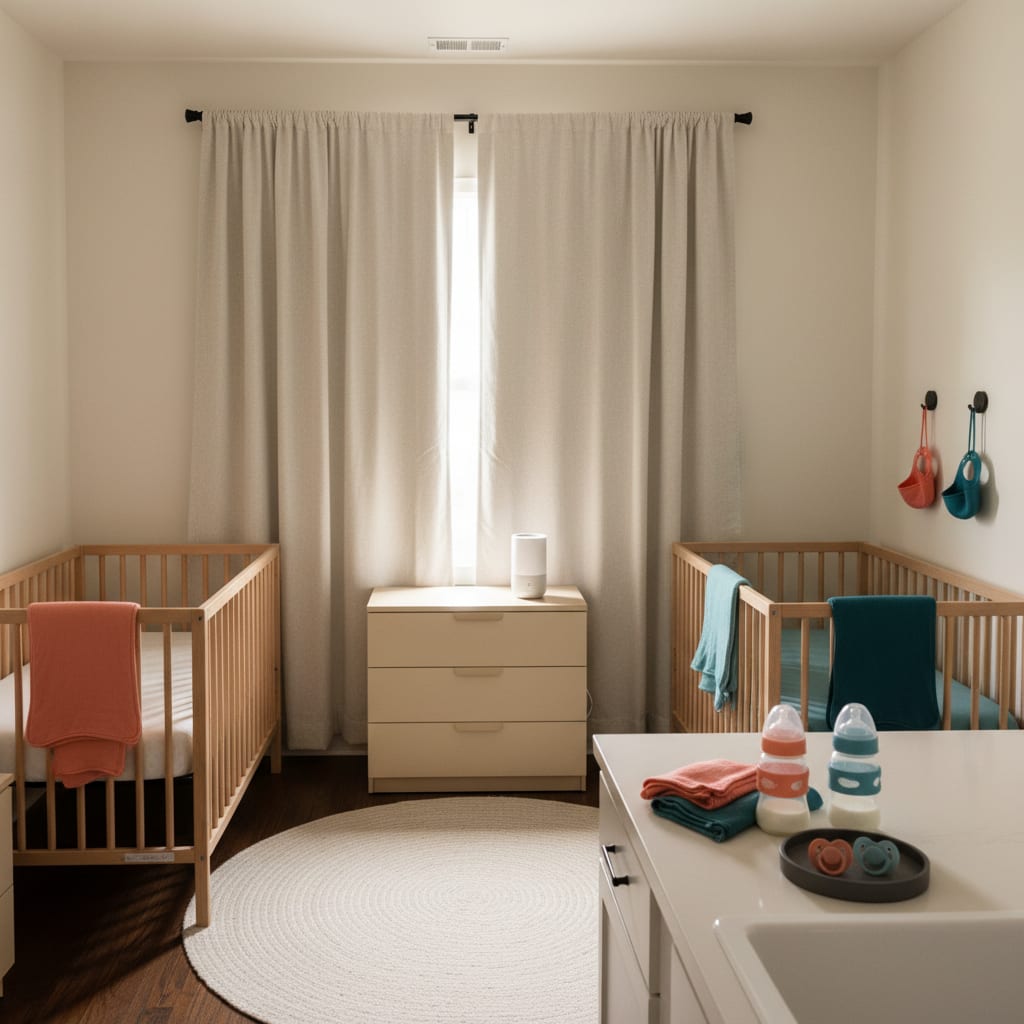
- The room, staged. Dark enough that you’d trip, white noise steady all night, one baby per sleep space (that part is non-negotiable safety, not preference), and the A|B color-code on everything so 2am-you doesn’t have to think.
- Both adults on the same page. Write the plan down — method, night-waking response per twin, who’s on duty which night. A plan renegotiated at 1am in a hallway is not a plan.
Choosing a method with two babies
Every mainstream method — graduated check-ins (“Ferber”), full extinction, chair/fading — works with twins. What changes is the logistics:
- Graduated check-ins are the twin workhorse. Do bedtime together, leave, and time your check-ins per baby: if A fusses at minute 3 and B at minute 7, they’re each on their own clock. Check on the baby who’s crying; leave the other alone even though you’re already in the room — a bonus visit teaches the quiet twin that crying’s sibling gets rewarded.
- Extinction is, honestly, logistically simplest with twins — no in-room visits to tempt the other baby awake — but it’s emotionally hardest, and with two criers in stereo the first night is loud. Choose it only if you can genuinely hold it; starting extinction and folding at minute 40 trains exactly the wrong lesson, twice.
- Chair/fading methods are the hardest with twins in one room, because you’re a visible attraction for two audiences with different fuss cycles. If gradual presence-fading is your style, expect a slower run.
Whichever you pick, the differentiation rule from one twin sleeps, one doesn’t applies: same timeline, same room, but each baby gets the response pattern that works on that baby.
The chain-reaction fear (and the truth)
The reason parents put off same-room training is the image of an endless loop: A cries, wakes B, B cries, wakes A. The reality in most rooms:
- Twins habituate to each other. They are each other’s oldest roommate. A crying co-twin ranks somewhere below a garbage truck on their alarm scale.
- White noise flattens the spikes. A steady machine across the room, such as a Yogasleep Dohm, masks the difference between fussing and quiet enough for the sleeping twin to stay asleep.
- The awake twin was usually about to wake anyway. Check the log: what looks like “A woke B” is very often two babies with synced schedules hitting the same sleep-cycle boundary. The fix is schedule-level, not soundproofing.
During training week, wakings do bounce around more than usual. Hold the line for five to seven nights before judging — the loop you’re afraid of mostly extinguishes itself as both babies learn to resettle. If one twin’s genuine, persistent night-waking keeps strafing the other after a solid two weeks, a temporary separation (pack-and-play in your room or the hallway office for the struggler) while training finishes, then reunion, is a legitimate escalation. Long-term room assignments across the whole sibling constellation are a different question — bigfamilyplaybook’s siblings sharing a room guide covers that layer well.
Night one, honestly
Our night one: 34 minutes of crying from B, 11 from A, two check-ins each, and one parent (me) sitting on the kitchen floor eating cereal at 8pm out of stress. Night two: 15 and 6. Night three: B fussed for 4 minutes; A was asleep before the door clicked. By the end of the first week, bedtime — formerly a 90-minute two-adult wrestling event — took 20 minutes and one adult. Your numbers will differ. The shape usually doesn’t: night two is often the hardest to hold, and the cliff comes around night three or four.
Two rules for the week: don’t audit at the door (the app-monitor graph will make 9 minutes feel like 90 — set a timer and step away), and don’t change methods mid-week. Consistency is the entire mechanism.
FAQ: sleep training twins in one room
Will sleep training one twin wake up the other?
Sometimes, in week one — and dramatically less than feared after that. Steady white noise, separated sleep spaces and twins’ deep habituation to each other do most of the protection. Most families find the “chain reaction” fear was the biggest obstacle that never materialized.
Should I sleep train twins together or one at a time?
Together, on the same timeline — one training week, one consistent room policy. Training serially means running two different bedtime regimes in one room for weeks, which confuses both babies and doubles your training window. Methods can differ per twin; the calendar shouldn’t.
What age can you sleep train twins?
The mainstream window opens around 4 to 6 months — but twins are frequently born early, so count from adjusted age, and get your pediatrician’s sign-off first. Earlier than that, focus on schedule, swaddle and sync (the swaddling-twins system carries the early months), not formal training.
Do twins need separate rooms to sleep well?
No. Most twins share a room for years and sleep fine — same-room is the default, not the compromise. Separate rooms are an escalation for a specific persistent problem, and even then often temporary. Separate sleep surfaces, on the other hand, are a safety requirement from the start.