Twin Registry Checklist: What You Need Two Of
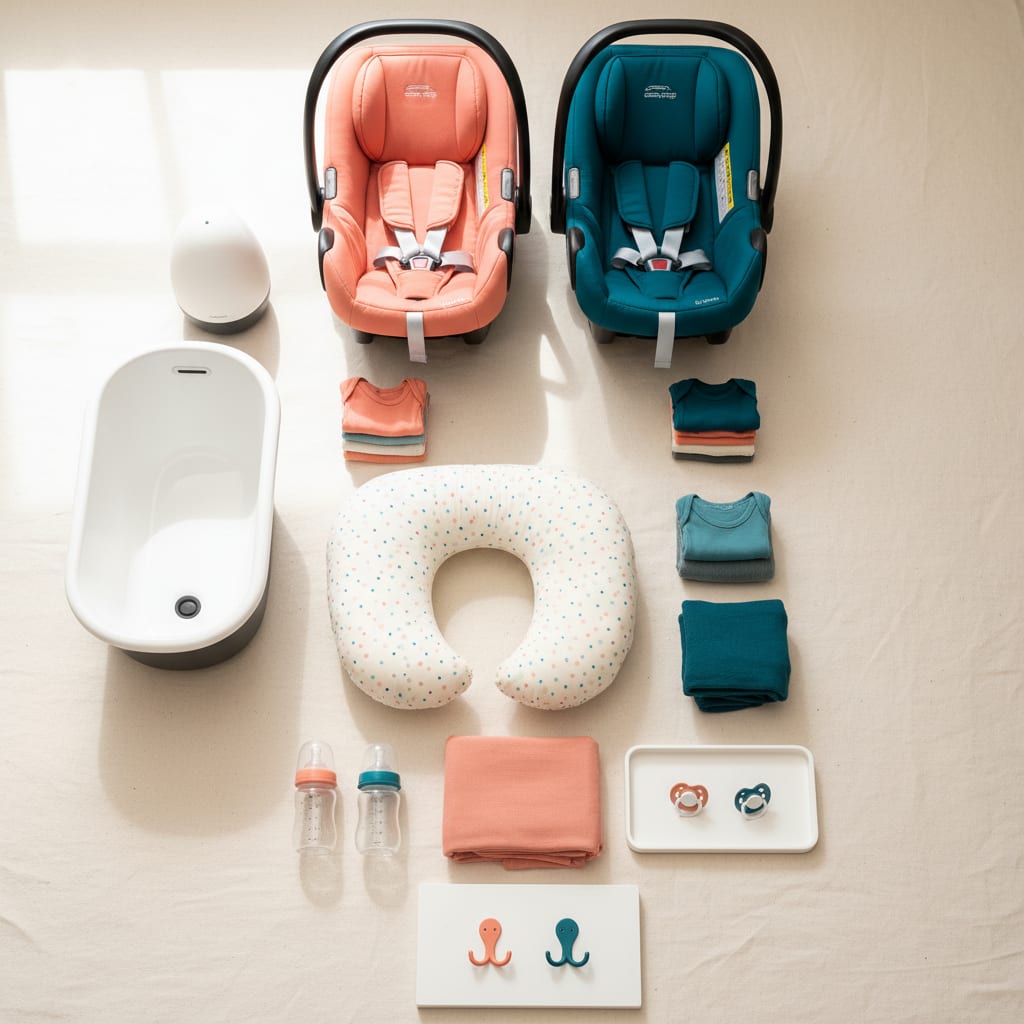
A twin registry checklist has exactly three quantities: two (car seats, sleep surfaces — the short, expensive list), one twin-capable version (a double stroller, a twin feeding pillow), and one or zero, which covers most of the registry despite what twin marketing implies. Sort every item into one of those three and the registry builds itself. Skip the sorting and you buy two of everything, spend a fortune, and furnish a nursery with a second bathtub nobody will ever use.
This is also this domain’s oldest question. The blog that lived here in its first life ran a post in 2010 called “Twin Gear: Do I Really Need That?” — pure twin-gear skepticism, fifteen years ahead of the discourse. Same promise here, with a registry’s worth of specifics.
The twin registry quantity table
Every item, with the number and the one-line reason. Bands are ballpark planning ranges across budget-to-premium versions, not quotes — check current prices before you commit, and let the registry completion discount do some of the work.
| Item | How many | Why that number | Rough band |
|---|---|---|---|
| Infant car seats | Two | No hospital discharges two babies in one seat, and there is no shared option to buy | ~$100–$300 each |
| Sleep surfaces | Two | One baby per surface, per AAP guidance — this is the line that never bends | ~$60–$400 each |
| Mattresses + fitted sheets | Two, plus 4–6 sheets | One mattress per surface; sheets fail at 3am and never politely one at a time | ~$40–$120 each |
| Swaddles / sleep sacks | 3–4 per baby, per size | Per baby, per laundry cycle, and twins outgrow sizes weeks apart | ~$15–$40 each |
| Bottles | 12–16 total | Double a singleton stash so the wash cycle never sets the schedule | ~$20–$35 per 4-pack |
| Pacifiers | Two of one model, times three | Loss rate, not baby count, sets this number | ~$8–$15 per pack |
| Onesies and daily clothes | Roughly 1.5× singleton | Laundry already runs daily; sizes drift apart fast | ~$8–$25 per pack |
| High chairs | Two — flagged “later” | Both babies eat at once from around six months | ~$40–$200 each |
| Double stroller | One | The biggest single twin decision, and one item covers both | ~$200–$900 |
| Twin feeding pillow | One | It serves both babies at the same time — that is its entire job | ~$60–$110 |
| White noise machine | One per room | It covers a room, not a baby | ~$30–$70 |
| Baby monitor | One | One room, one camera, two babies in frame | ~$50–$200 |
| Diaper caddy or cart | One per floor | Twin-scale consumption, not twin-specific gear | ~$20–$45 |
| Baby carrier | One per adult who will wear one | Quantity follows adults, not babies | ~$40–$180 |
| Baby bath | One | You bathe newborn twins one at a time, because a wet newborn uses both hands | ~$20–$45 |
| Playmat | One | Babies rotate through stations rather than occupying them in pairs | ~$30–$80 |
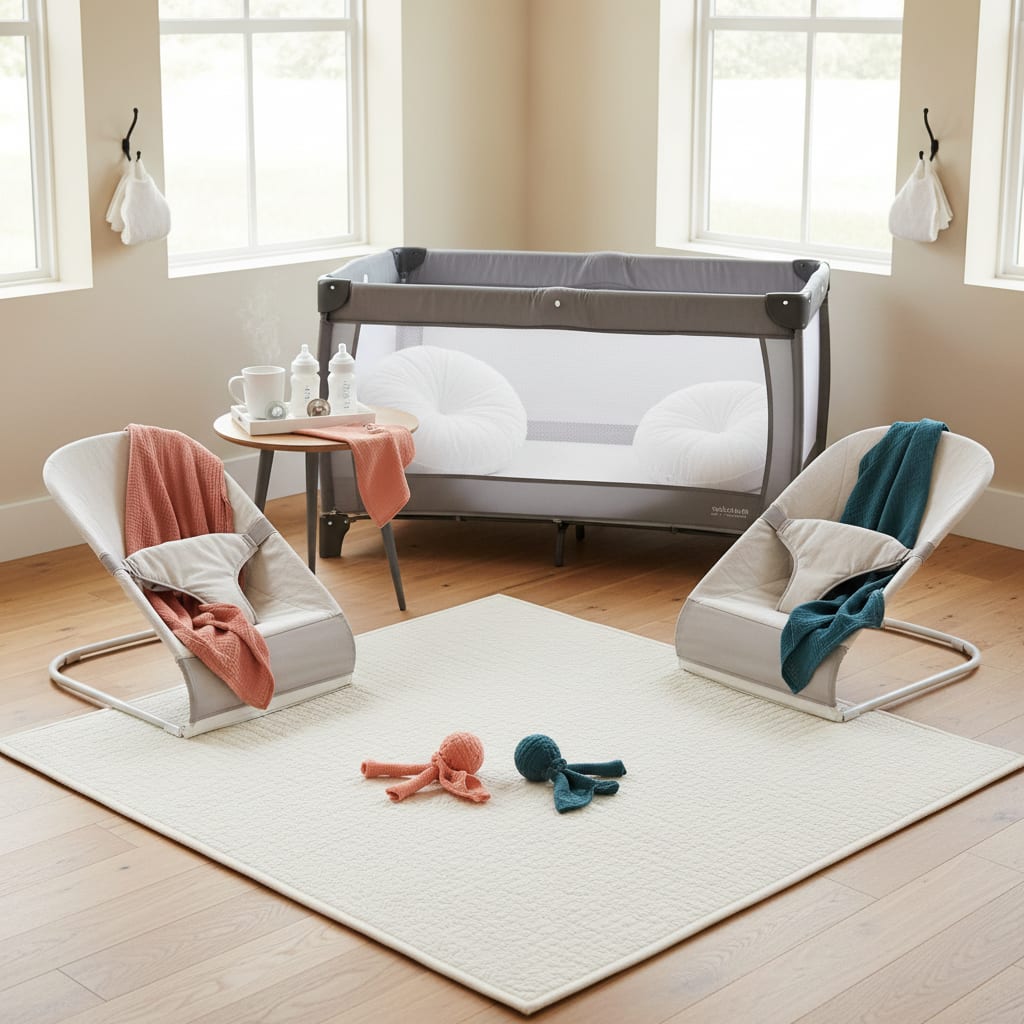
| Bouncer or swing | One, then judge | The second one is a postpartum decision, not a registry decision | ~$40–$250 |
| Changing table | One or zero | A caddy per floor beats one beautiful table you are never standing next to | ~$0–$250 |
| Wipe warmer, sterilizer tower, twin novelty gear | Zero | Gadget overhead gets punished twice with twins | — |
Two of: the short, expensive list
The two-of column is short on purpose. Four categories carry it.
Car seats. Two infant seats, and the decision that matters is what they click into. If you are planning the frame-stroller move below, buy seats that are compatible with a double frame before you fall in love with a fabric. A Chicco KeyFit 35 is the common worked example, and it shows why the compatibility chart matters more than the model name: as checked in October 2026, it is on Joovy’s Twin Roo+ chart with the Chicco adapter, while the Baby Trend Snap-N-Go Double, Contours’ Chicco V2 adapter and Mountain Buggy’s universal adaptor all list the KeyFit 30 and not the 35. Buy both seats the same: two identical seats means one set of strap-adjustment muscle memory at 5am, one manual, and interchangeable bases between cars.
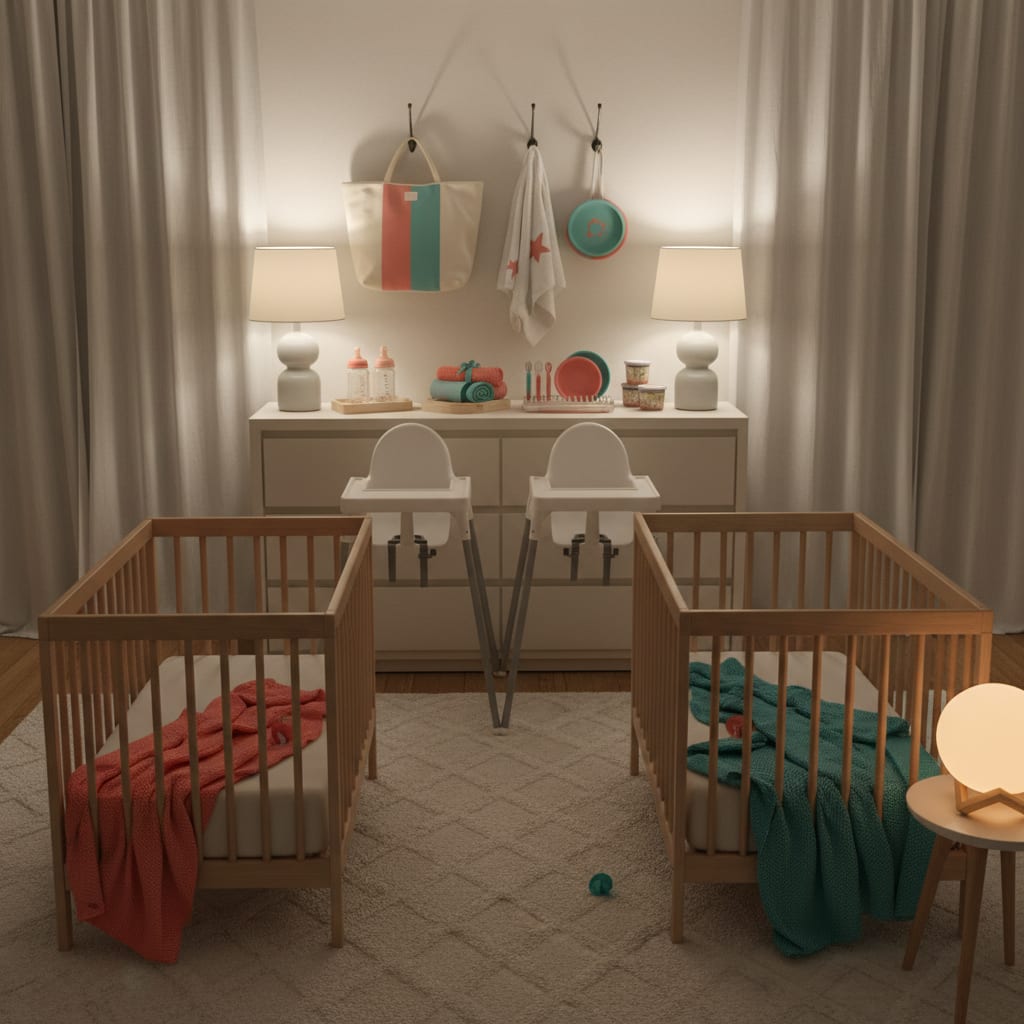
Sleep surfaces. Current AAP safe-sleep guidance is one baby per sleep surface, twins included, so two bassinets now and two cribs eventually. Side by side in one room is fine — ours were, and still are. The full ruleset and what fits in a small bedroom is in safe sleep for twins. They do not have to match: a bedside bassinet like the Chicco Close to You next to a hand-me-down that meets current standards is a completely legitimate twin setup. What matters is two surfaces from night one, not a symmetrical nursery photo.
Per-baby textiles. Swaddles and sleep sacks are the one soft-goods category where the answer really is per baby, because they are worn during the sleep you are trying to protect. Three to four per baby per size gets you through a laundry cycle plus one blowout. The sizing trap is specific to twins: buy by weight and fit rather than by month, because twins commonly land a pound or more apart and sizing them as a matched pair is how one twin ends up swimming. We ran a wrapped swaddle plus zip-up sacks — in coral and teal, because the color-code starts at the registry.
Bottles, if bottles are in the plan. Twelve to sixteen in rotation is the number that stops the dishwasher from dictating the day. Register for one bottle system rather than a sampler: twins mean twice the parts, and two systems means two sets of nipples, vents and rings to sort at midnight. Narrow bottles in the 4oz size, like Dr. Brown’s Options+, are a safe default because the newborn volumes are small and the size scales up later. Then band them by color, permanently, per baby.
High chairs are two, but not yet. Both babies will eat at the same time from around six months, and one high chair with two hungry babies is a stress test nobody needs. Register for them, use your registry’s “later” flag, and let people buy them at the six-month mark.
One twin-capable version, not two
Four items where the twin answer is a single, better-chosen thing.
The double stroller. The biggest twin-gear decision with the widest price band, and it has real trade-offs — side-by-side versus tandem versus car-seat frame, doorway width, trunk space, whether you walk or drive to things. It gets its own full breakdown in best double strollers for twins. The play I would recommend from experience: start with an inexpensive frame stroller that clicks in both infant seats, and defer the real stroller decision until you know how your family actually leaves the house. That sequence also spreads the spend across two months instead of one.
The twin feeding pillow. Whether you are nursing or bottle-feeding, a twin-sized pillow like the Twin Z is the piece that makes feeding two at once physically workable — full setup in the tandem breastfeeding guide. One pillow, both babies, simultaneously. A second one is not an upgrade; it is a second thing to store.
One white noise machine per room. A Dohm covers a whole room, and a room is the unit here. Two machines only when the twins someday split rooms, which is a decision a long way from the registry.
One diaper station per floor. Not twin gear, but twin-scale consumption: two newborns run through roughly 20 diapers a day between them. A caddy like the Munchkin portable organizer on each floor beats a changing table you have to walk to. On the diaper registry itself, weight the boxes toward size 1 rather than newborn — twins are often small at birth but rarely stay in newborn size long, and unopened boxes exchange easily.
One is plenty: where twin marketing overreaches
This is the column that saves the most money, and every item in it is one that a twin-specific product page will try to sell you twice.
One bath, one playmat, one carrier per wearing adult. Bathing two newborns simultaneously is not a thing that happens, so a second tub is storage. Playmats are stations babies rotate through; two of every station turns a living room into a daycare showroom with the acoustics to match. Carriers follow adults, because a carrier is worn by a person, and the two-adults-two-carriers math is the only version that ever gets used.
One bouncer to start, with a deliberate second. The exception we would grant in this column: a second inexpensive bouncer genuinely earns its place, because two safe put-down spots matter enormously during solo feeds and solo showers. Buy it after the babies arrive, though — twins routinely disagree about swings, and buying the second one on day 40 based on evidence beats buying it on day zero based on symmetry.
One monitor. One room means one camera with two babies in frame. Add a second camera when a second room happens.
Zero of: skip these outright
Anything whose main feature is the word twin. Twin-handled cart covers, tandem newborn carriers, matching-outfit subscriptions — these wait until a real problem demands them, and most never do. The exceptions that earned their keep for us are the two genuinely twin-shaped items above: the feeding pillow and the double stroller.
The singleton maybe-list, doubled. Wipe warmers, bottle sterilizer towers, bottle-prep machines, dedicated diaper pails per room. Every gadget carries setup, cleaning and counter space, and twin logistics charges you for that overhead twice a day. Hot water and soap scaled fine for us.
Crib inserts, dividers and nests marketed as a way to make one crib serve two babies. Nothing goes in a sleep space but a fitted sheet and one baby, which makes these a zero on safety grounds rather than budget grounds.
Newborn-size everything, in quantity. Twins are more often born early and small, so a little newborn-size clothing is sensible — but a wardrobe of it can go unworn entirely if your babies arrive bigger than expected, or get outgrown in eleven days if they do not.
What a twin registry actually costs
Add the two-of column at the low end of each band and the mandatory list — two car seats, two sleep surfaces, two mattresses, sheets, textiles — lands in the high hundreds before you have bought a single fun thing. That is the number worth knowing early, because it changes how you sequence the registry.
Three levers actually move it. Sequence over savings: car seats and sleep surfaces are legally and biologically mandatory, so they get the first shower and the first paycheck; the stroller is second; everything else can arrive as it comes. Buy the boring things new and the pretty things used — sleep surfaces and car seats should be new or of fully known history, while bouncers, playmats and clothing are excellent secondhand. Use the completion discount once, late, on the leftovers rather than on impulse, because whatever is still unbought at 36 weeks is the real list.
Registry timing and the return window
Twins arrive early often enough that the registry has a deadline: aim for registry-complete around 30 to 32 weeks and essentials in the house by 34 — the same compressed clock as everything in expecting-twins prep. Assembled, washed and installed, not still boxed in a hallway.
Then leave the tags on aggressively. The twin registry’s secret weapon is the return, because no amount of research beats two actual babies voting — and they vote differently from each other. Note the return window on the big items, keep the boxes for 60 days, and treat the first month as the experiment it is.
FAQ: twin registry
What do you actually need two of for twins?
The short list: car seats, sleep surfaces, high chairs (later), and per-baby textiles like swaddles and sleep sacks. Nearly everything else is either one twin-capable item — double stroller, twin feeding pillow — or plain singleton quantities. The two-of-everything registry is the classic and most expensive twin mistake.
Can twins share a crib?
The AAP’s guidance is one baby per sleep surface, twins included, so registries should carry two bassinets or cribs. Side by side in one room is fine. Run your specific setup past your pediatrician, and budget for two surfaces from the start rather than discovering the rule in month three.
How many bottles and diapers do twins need?
Bottles: 12 to 16 in rotation if bottle-feeding meaningfully, all one system, color-banded per baby. Diapers: newborn twins run around 20 a day between them, so register for boxes across sizes and weight the order toward size 1 rather than newborn. The size-by-size counts are in how many diapers twins use.
Do twins need two of the same stroller-compatible car seat?
Two seats, yes, and matching them is the practical choice: identical seats share bases, straps and muscle memory, and any double frame or twin-compatible stroller you later buy will list one compatibility chart rather than two.
When should a twin registry be done?
Built by 30 to 32 weeks, essentials delivered and assembled by 34. Twins keep earlier calendars than singletons and third-trimester twin energy is finite. Prioritize the two-of column first, defer the “later” items with your registry’s flag feature, and keep receipts.