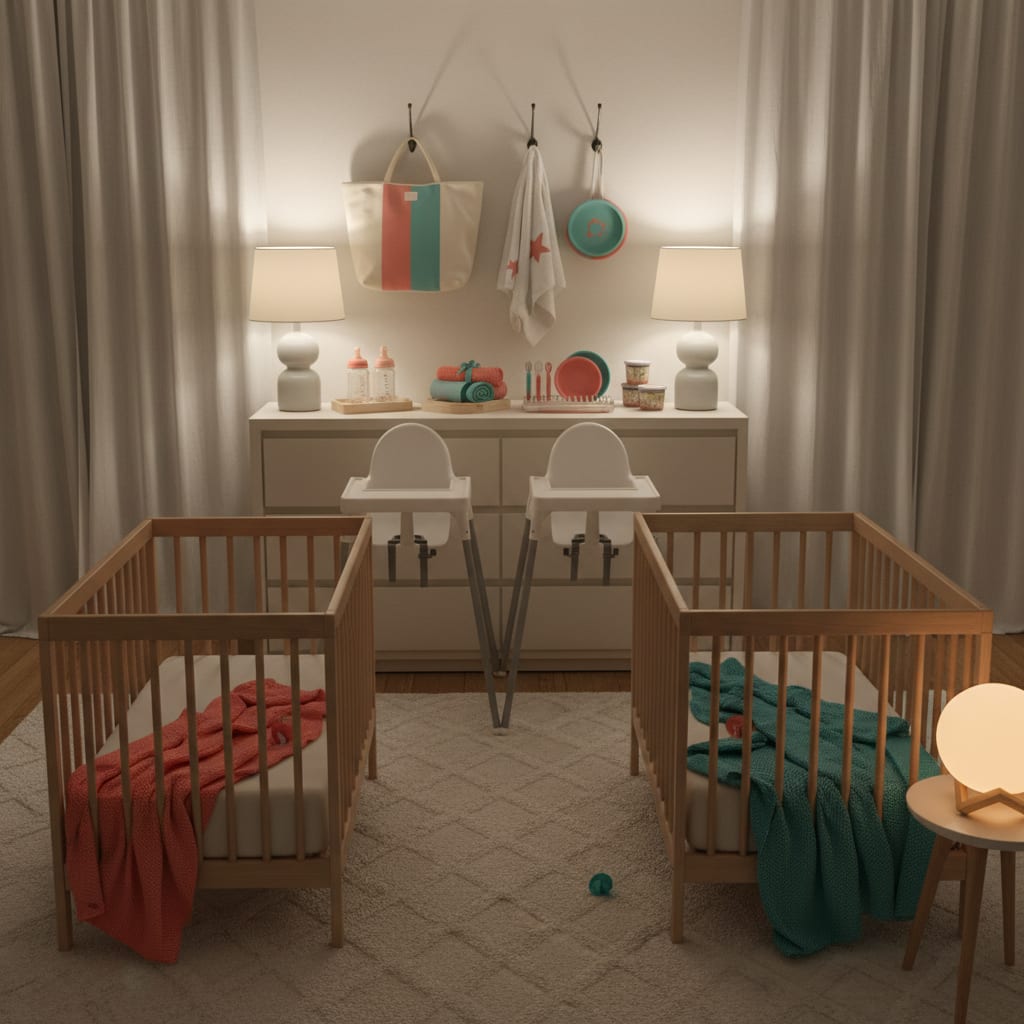
Twins Only Nap 45 Minutes? How to Extend Twin Naps
Forty-five minutes is one complete baby sleep cycle. Your twins wake at the end of it because they surface into light sleep and don’t bridge into the next cycle — that is developmental, not defiance, and it is at its loudest somewhere between roughly three and eight months. What lengthens the nap, in order of how often it works: a correctly sized wake window going in, a genuinely dark room with steady sound, and five to ten minutes of hands-off time before you open the door. With twins, change one thing for one baby at a time.
Why 45 minutes is the number
Baby sleep runs in much shorter cycles than yours — roughly 45 to 50 minutes in the first year, against something closer to 90 for an adult. At the end of every cycle everyone surfaces briefly. You roll over and rejoin the next one without remembering it. A baby who hasn’t learned that bridge arrives in light sleep, registers the room, and is done. Betteroo’s explainer on how a baby’s sleep cycle is built is the clearest version of the mechanism I’ve read.
Two things follow. The number is consistent across babies because cycle length is — that’s why “45 minutes” is the figure every parent forum lands on. And an overtired baby doesn’t nap longer, because sleep pressure isn’t what carries you across the gap. The first nap of the day bridges most reliably; the last almost never does, so judge progress on the morning nap.
What a short nap costs when there are two of them
With one baby, a 45-minute nap costs you 45 minutes of hands. With twins, what you get isn’t nap length — it’s overlap, and overlap punishes you twice.
| Scenario | Baby A | Baby B | Hands free |
|---|---|---|---|
| Both bridge | 9:30–11:00 | 9:30–10:50 | 80 min |
| One bridges | 9:30–11:00 | 9:30–10:15 | 45 min |
| Neither bridges, down together | 9:30–10:15 | 9:30–10:18 | 45 min |
| Neither bridges, down 20 min apart | 9:30–10:15 | 9:50–10:35 | 25 min |
Look at the last two rows: same two short naps, same total infant sleep, and the staggered version hands you barely half the break. So — when both twins are short nappers, put them down at the same moment, every time. A staggered start is affordable when one twin is bridging cycles and covering the gap, and not when neither is.
By-age wake windows and the A|B timelines are in the twin nap schedule. If you’re still in the newborn stretch, feeding drives all of this rather than sleep cycles — that’s newborn twin sleep, and short naps there are just what the stage is.
The wake window is the biggest lever
Nine times out of ten this is where the 45-minute nap actually gets fixed, and it moves in both directions.
Too long a window and the baby goes down past easy settling; the cycle transition is exactly where an overtired baby falls out of sleep. Too short and there isn’t enough drive to push through the surface. Both produce an identical-looking 45-minute nap, which is why guessing costs weeks.
Move it in 15-minute steps and hold each step three days — the first day of any change is noise. Then the twin discipline: change it for one baby. Two experiments on two babies at once give you a result you cannot attribute to anything. If A’s morning nap is short and B’s is fine, A’s window moves and B’s doesn’t. The shared start time stays shared; what you’re adjusting is how long A was awake before it. That asymmetry is the premise of one twin sleeps, one doesn’t.
Then the room, and only one machine in it
A cycle transition is when a baby is most sensitive to the room, so an environment that’s fine at minute five can end the nap at minute forty-five. Daylight climbing the wall, the heating cutting in, a delivery truck — none of it would wake a baby in deep sleep, all of it wakes one in light sleep.
Two cheap changes. Properly dark — not dim, dark enough that you can’t read your phone against the wall. And steady sound at a constant level. One machine covers a room; two babies don’t need two, and a mechanical unit like the Yogasleep Dohm Classic holds a constant volume all night in a way looping app tracks don’t. Put it across the room from both cribs rather than beside either.
If what ends twin A’s nap is twin B’s cycle landing at the same moment, that’s a different problem with its own audit — twins waking each other up — and it is rarer than most twin parents assume.

Give them the gap before you go in
The cheapest fix here, and the one twin parents skip — with two babies the instinct at the first squawk is to move fast before the other one goes too.
Wait five to ten minutes. A baby surfacing between cycles often makes noise on the way through — a shout, a roll, a minute of grumbling — then goes back down. If you’re in the room at minute forty-six you never find out which it was, and you convert every surface into a wake.
The structural version is a protected nap block: the nap is 90 minutes long whatever happens inside it, and the babies stay in their own cribs for that window whether asleep or not. With twins that’s worth more than with a singleton, because it protects your overlap and not just the sleep. Two firm caveats — each baby on their own safe, flat surface, never shared and never propped, and not for a newborn who is due a feed. Hunger is not a sleep-cycle problem and you should not wait it out.
What doesn’t work
- Keeping them up longer to “tire them out”. Overtired babies fall out of sleep at the cycle break more, not less.
- Waking the twin who’s still asleep so the day lines up. The one bridging cycles is doing the thing you want. Let them wake, and hold the next nap start shared.
- Moving naps into the stroller or carrier permanently. Motion does bridge the cycle — that’s why it works — but you’ve traded a 45-minute problem for a two-hour walk, twice a day, in whatever weather you get.
- Changing three things at once. With twins that’s six variables, and you learn nothing from any of them.
When 45 minutes is just their nap
Sometimes it isn’t a problem. Under about four months, short and fragmented is simply what infant sleep is. And some well-rested babies stay 45-minute nappers well into the second half of the first year, take four or five of them, and hit their totals fine.
The number to watch is sleep across 24 hours, not any single nap — Betteroo’s nap length by age tables give you the range. Total in range and a cheerful baby at the end of a wake window means a short napper, not a sleep problem. Total short and a fight before every nap means keep working the wake window.
Anything that looks less like scheduling and more like health — preterm twins on adjusted age, reflux, noisy breathing, poor weight gain, a baby who has suddenly stopped napping — goes to your pediatrician, not a chart.
FAQ: 45-minute naps with twins
Why do both my twins wake at almost exactly 45 minutes?
Because they’re the same age and cycle length is developmental. Two babies who went down together surface together — that’s a clock, not one twin waking the other.
Should I wake the twin who’s still asleep so I only do this once?
No. Let them finish, and re-sync at the next nap start instead. You lose more by shortening a working nap than you gain from a tidier morning.
How long before I know a wake-window change worked?
Three days minimum, judged on the first nap of the day. One good nap proves nothing and one bad nap disproves nothing.
Can I do this if my twins share a room?
Yes — all of it is room-agnostic. Dark, steady sound, a correct wake window and a hands-off gap all work with two cribs in one room.
Does a top-up feed before the nap extend it?
Not reliably. Hunger ends naps early in the newborn stretch, so a feed helps then. Past that, a clean 45-minute wake is a cycle, not an empty stomach.