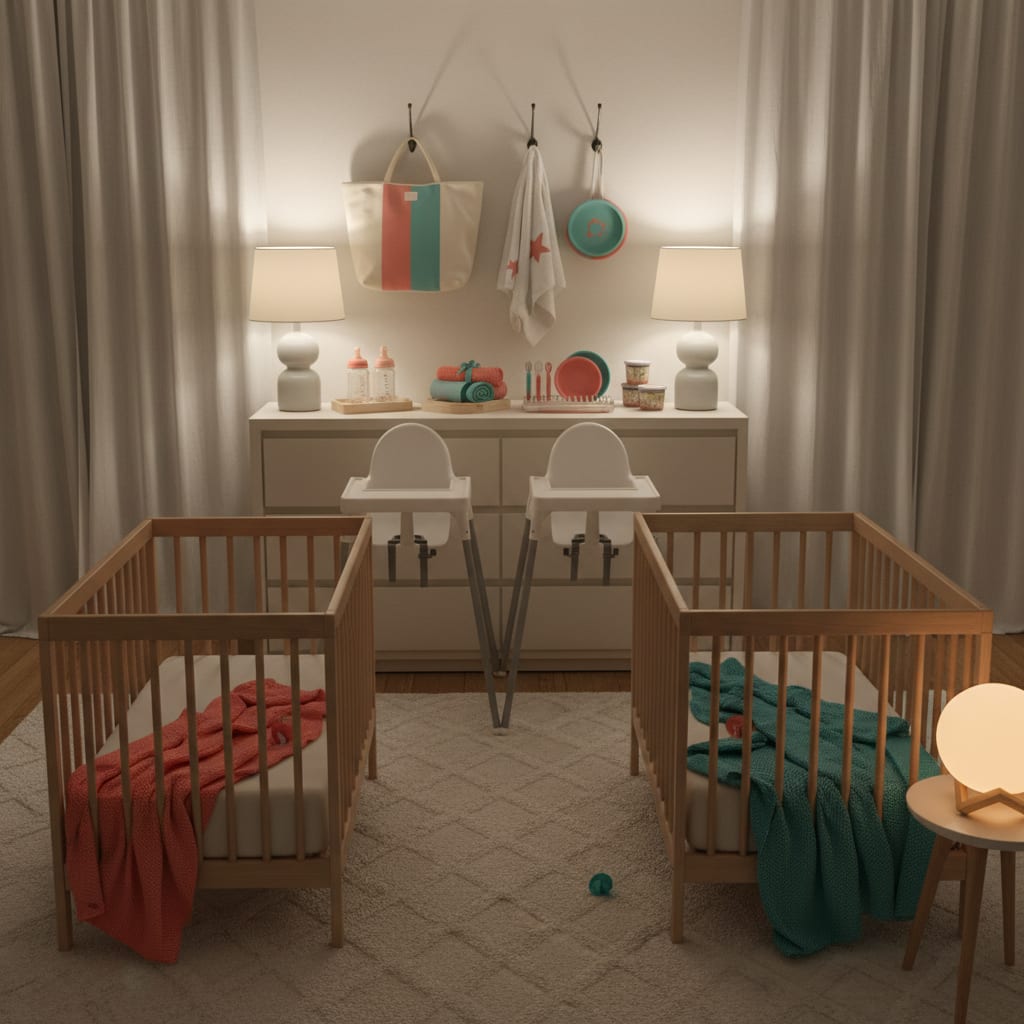
When to Separate Twins for Sleep (and How)
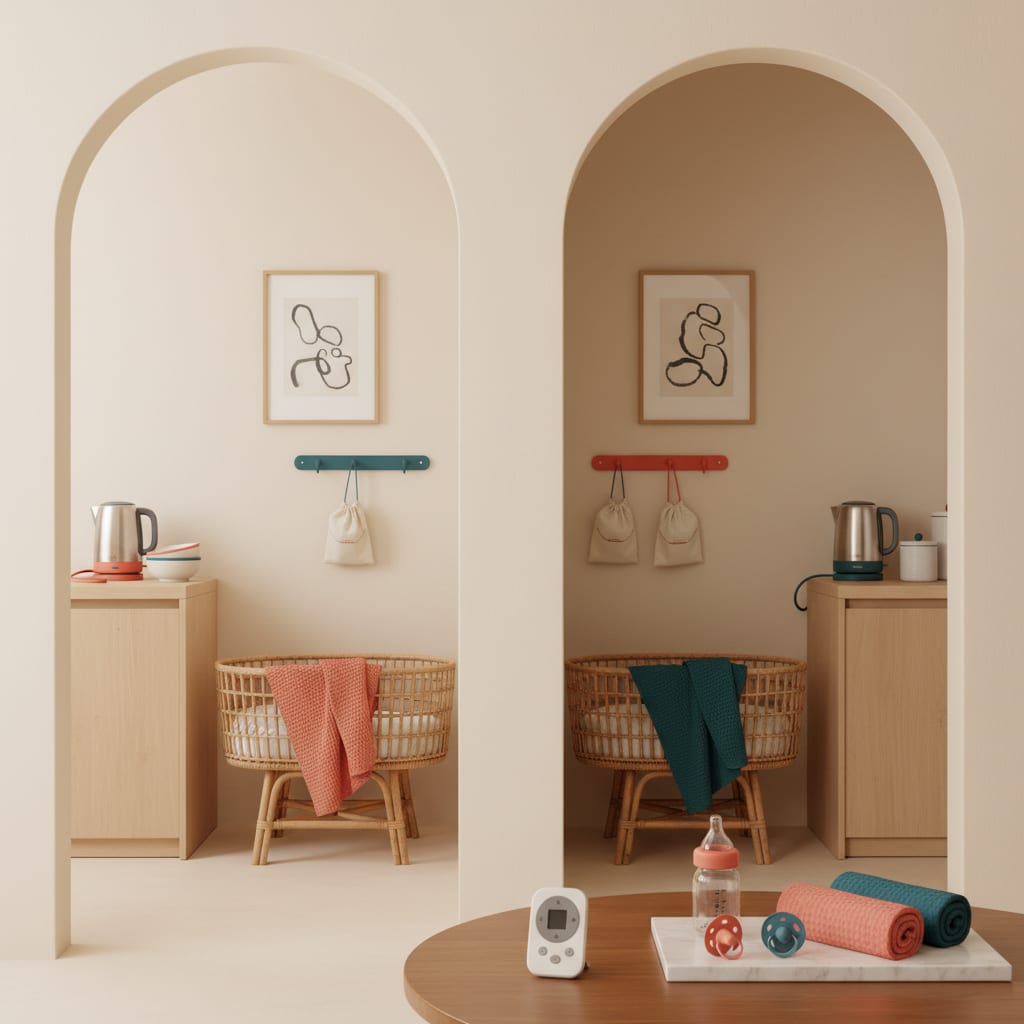
Separate twins for sleep when real, documented chain-waking has survived two to three weeks of consistent room fixes and a per-baby response plan — not before. The honest threshold is evidence: a written log showing one twin’s wakings reliably drag the other out of sleep, several nights a week. Everything else (noise you find stressful, one twin who’s simply a worse sleeper, a sleep-training week you’re nervous about) is usually solved inside the shared room. And under six months, “separating” means moving one twin’s own sleep surface into your room — not into a bedroom alone.
The four reasons that actually justify a split
- Verified chain-waking. Twin A cries, Twin B wakes within a minute, both are up for a real stretch, and it repeats most nights after you’ve fixed white noise, darkness, distance and your own response speed. The audit format is in twins waking each other up.
- A short, defined sleep-training window. Some families run five to ten nights with the twins apart so each baby’s plan can run clean, then move back in. Temporary and reversible is the point.
- A medical stretch. One twin with reflux, an ear infection, a post-surgery recovery or a period of monitored feeding may need a lot of night handling. Splitting protects the other twin’s sleep while it lasts. Your pediatrician drives this one, not a blog.
- Genuinely different night needs that can’t co-exist. A twin still on night feeds and a twin who’s night-weaned can share a room fine; a twin who needs 40 minutes of walking to resettle at 2am mostly can’t.
Four reasons that don’t hold up
- “They’d both sleep better apart.” Usually untested. Prove it with a log first.
- “One is a bad sleeper.” That’s a per-baby plan problem, not a room problem — see one twin sleeps, one doesn’t.
- “Sleep training won’t work with two in a room.” It works, and it’s how most twin families do it. The mechanics are in sleep training twins in the same room.
- A regression. Splitting twins in the middle of a developmental storm confuses cause and effect, and turns a hard week into a hard month. Sleep regressions resolve on their own timeline; change one variable at a time, and change it after the storm.
Where the second twin actually goes
This is the part nobody plans and everybody improvises at 11pm.
Under six months: the AAP recommends babies sleep in the parents’ room — own surface, not the parents’ bed — for at least the first six months. So the split is: one twin’s bassinet stays in the nursery, the other moves next to your bed. That’s the version that’s both safe and available to almost every family, and it’s the reason a second portable sleep surface is a better twin purchase than most gear on a registry. Whichever twin moves, they move onto their own firm, flat, bare surface — never into a bed with a parent, and never into a crib with the other twin. The full ruleset is in safe sleep for twins.
After six months: a sibling’s room, a spare room, or a partitioned corner all work. What matters is that the second space is as dark, as boring and as acoustically steady as the first — you’ll gain nothing by putting the light-sleeping twin in the room next to the kitchen.
What isn’t a room: a hallway, a walk-in closet without ventilation, a living room where the household stays up. The second space needs the same standard as the first, or you’ve moved the problem.
Run it as a two-week experiment, not a decision
Give the split a defined shape so you can actually read the result:
- Pick a start night you can afford to lose. Not the night before a work presentation.
- Change only the room. Same bedtime, same wind-down, same response method, same wake time. If you also switch soothing techniques, you’ll never know which lever moved.
- Keep logging. Same four columns as the audit: time, which twin, stirred or fully woke, what you did.
- Judge at fourteen nights. Nights one to three are noise — new room, new sounds, both babies unsettled. Real signal starts around night four or five.
- Have a written reunion trigger. For example: “if both twins are down to one waking each for five consecutive nights, they move back in together.”
If you’re using the split to run a training method, pick one you can sustain in two rooms with one pair of hands — the pick-up-put-down approach is physically demanding across two rooms, and knowing that in advance beats discovering it at 2am.
The logistics you’ll hit on night one
Monitoring two rooms. This is the actual cost of separating twins, and it’s the thing families forget to budget for. A monitor that takes a second camera on one parent unit is the cheap solve: the Infant Optics DXR-8 PRO pairs with an add-on camera so both rooms land on one screen instead of two apps and two glowing phones. If you already own a monitor you like, check whether it supports a second camera before buying anything new — most families discover they were one accessory away from solved.
Two bedtimes, one parent. Put the twins down in the same room together, wind-down and all, and move the second twin to their own space at the end of the routine, already drowsy. Two separate routines back to back adds 30 minutes to every evening and gets abandoned by week two.
The 2am walk. Sequence matters. Deal with the twin who escalates fastest first; the steadier twin buys you the ninety seconds.
Adjusted age, and when to ask a professional
If your twins were born preterm — and twins often are — every timing question here runs on adjusted age, counted from your due date rather than the birthday. Six months adjusted is not six months on the calendar, and the room-sharing recommendation, sleep-training readiness and night-feed expectations all move with it. Before you split twins for any reason that touches feeding, weight gain or a medical issue, that’s a pediatrician conversation, not a judgment call you should be making at 3am on your own.
FAQ: separating twins for sleep
At what age can twins sleep in separate rooms?
There’s no set age. Practically, most families who split do it after six months, because the AAP’s room-sharing-with-a-parent recommendation covers roughly the first six months and a solo nursery conflicts with it before then. Preterm twins run on adjusted age. Ask your pediatrician about your two specifically.
Do twins sleep better together or apart?
There’s no universal answer, and plenty of twin families report the shared room going better than expected. Treat it as an experiment on your own two babies: log two weeks together, two weeks apart, compare wakings and total night sleep. Your log beats anyone’s anecdote.
Will separating twins hurt their bond?
No evidence suggests where a baby sleeps determines a twin relationship, and twins get an enormous amount of shared waking time regardless. If it helps, frame the split the way most families end up framing it — a rota that can change back, not a verdict.
Can we separate them just for naps?
Yes, and it’s underrated. Nap-only separation gives each twin a clean daytime run while the shared night stays intact, and it’s easier to reverse. It works best once naps are predictable rather than during the newborn free-for-all.