Expecting Twins: What Changes (a Prep Guide)
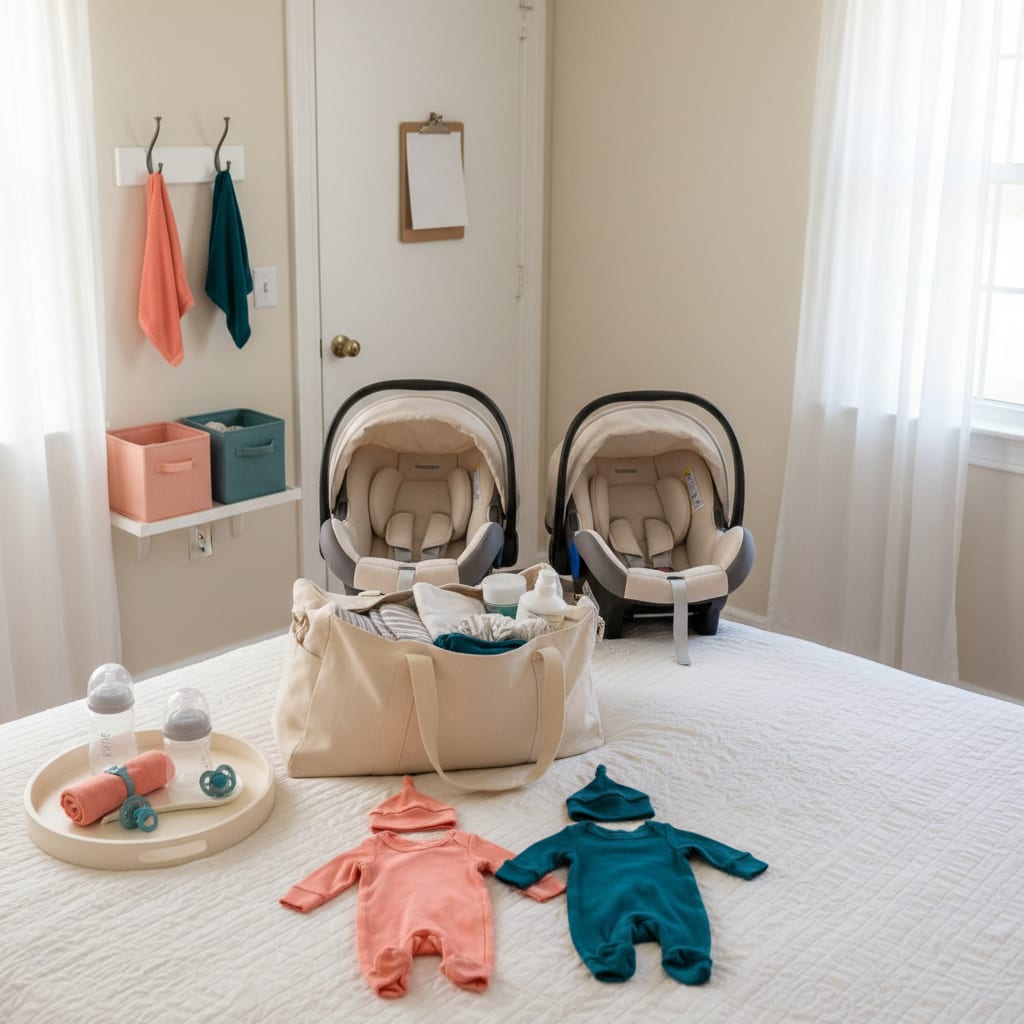
Expecting twins changes four practical things immediately: your prenatal care intensifies (more appointments, more ultrasounds, often earlier specialist involvement), your planning timeline compresses (twins frequently arrive before 40 weeks, so “ready by 40” becomes “ready by 34ish”), your gear math doubles in some places but not others, and your postpartum help plan stops being optional. This guide covers those four — the logistics layer. The medical layer belongs to your OB and, if involved, a maternal-fetal medicine (MFM) specialist, and every timeline question in a twin pregnancy has the same correct first answer: ask your OB what to plan for.
That division of labor is the whole editorial policy of this post. Twin pregnancy is, in ACOG’s plain language, managed as a higher-risk pregnancy — which mostly means more monitoring, not doom — and this site does not do medical advice. What it does do is the part nobody covers in appointments: what to buy, when to be ready, and how to set up the household for two.
What the appointment calendar looks like
Expect more of everything: more frequent OB visits, more ultrasounds (growth scans become a regular rhythm since measuring twins from the outside doesn’t work), and possibly an MFM consult as a routine part of twin care — its presence is standard practice, not a red flag. Early on, you’ll also learn your twins’ chorionicity — whether they share a placenta — which is the single most important fact in how the pregnancy is monitored. If your report says “di/di,” the di-di twins explainer translates it; whatever yours says, have your OB walk you through what it means for your monitoring plan specifically.
Logistics implications, since that’s our lane: block real calendar capacity for appointments (twins can mean double-digit visit counts across a pregnancy — treat it like a part-time commitment, especially in the third trimester), get work notified earlier than feels natural, and start the leave-and-coverage paperwork a trimester before singleton parents would.
The compressed timeline: ready means early
The planning fact that changes everything: twins, statistically, arrive early — many around 36 to 37 weeks, plenty earlier, and your OB will tell you what your pregnancy’s realistic window looks like. Plan for it rather than being surprised by it:
- “Done by 34 weeks” is the twin-prep motto. Nursery functional, car seats installed and checked, hospital bag by the door, freezer stocked. Everything a singleton family does in weeks 36 to 40, do a month-plus earlier — third-trimester twin energy is also not to be overestimated.
- The third-trimester checklist compounds fast, so run it as an actual checklist with dates, not vibes.
- A NICU stay is a real possibility with early arrivals — not a certainty, and not a prediction, but a thing sensible twin families pre-think at the logistics level: which hospital, how far, who covers the household if you’re doing hospital shifts. Pack and plan accordingly (the twin hospital-bag list differs from singleton lists for exactly this reason — longer-stay-possible packing, ×2 going-home outfits in preemie and newborn sizes).
- Names, paperwork, pediatrician selection: earlier. Two birth certificates, possibly two NICU wristbands, one pediatrician who needs to take two new patients at once — settle it all by month seven. (And settle the telling-them-apart system before delivery — it starts working in the hospital.)
The gear math: ×2, ×1, and ×0
The registry mistake every twin family gets warned about too late: doubling everything. The actual math has three columns — genuinely need two (car seats, sleep spaces, high chairs), need one twin-capable version (a double stroller like the Baby Jogger City Mini GT2 Double, a twin feeding pillow like the My Brest Friend Twins Plus), and need the same single one a singleton family needs (bathtub, changing pad, most toys, and nearly everything marketed as “twin essentials”). The full sorted list, with the worked examples and what we returned, is the twin registry checklist — it’s this guide’s companion piece and the single most useful hour of prep shopping you can do. Registry-complete by roughly 32 weeks is the twin-adjusted target, for the same arrives-early reason as everything else.
The help plan is part of the prep
The most consistent report from twin parents everywhere: the families who did well are the families who staffed up. Two newborns produce roughly 16 feeds and 20 diapers a day between them; that’s a workload, and workloads get staffed:
- Book the help before the babies. Family shifts, a postpartum doula (twin-experienced if you can find one), a meal train, a neighbor teen for laundry — whatever your budget and people allow, schedule it now, because coordinating help after two babies arrive is itself a job you won’t have hands for.
- Make the asks specific. “Let me know if you need anything” converts to nothing; “Tuesday 2 to 5, hold babies while I sleep” converts to sleep. Keep a standing list of concrete tasks for anyone who offers.
- Plan the parental split. If there are two parents, sketch the shift system now (who owns which night hours — the version we ran is in the newborn twin sleep guide). If there’s one, the help plan above is doubly load-bearing and worth building formally.
- Line up the feeding support too: an IBCLC’s number saved before delivery if breastfeeding is in the plan, and the pediatrician briefed that twins are coming.
FAQ: expecting twins
How early should I be ready for twins to arrive?
Working assumption: everything essential done by around 34 weeks — bag packed, seats installed, sleep spaces built. Twins commonly arrive in the 36-to-37-week zone and sometimes well before; your OB’s read on your specific pregnancy is the real planning number, so ask directly: “when should we be fully ready?”
Do I need a maternal-fetal medicine specialist for twins?
Many twin pregnancies include MFM involvement as routine — it reflects how twin care is structured, not something being wrong. Whether yours does depends on chorionicity, history and your OB’s practice. It’s an excellent early question for your OB, alongside “what will my appointment schedule look like?”
What should I buy two of for twins?
Fewer things than the marketing suggests: car seats, sleep spaces and (later) high chairs — plus one twin-capable stroller and feeding pillow rather than two singles. Most everything else stays at singleton quantities. The twin registry checklist linked above is the full sorted version.
Is a twin pregnancy automatically high-risk?
Twin pregnancies are managed with a higher level of monitoring — more visits, more scans — because some risks run statistically higher; that’s ACOG-standard practice, not a verdict on your pregnancy. What it means day-to-day is a fuller calendar and closer attention, and your OB is the only source worth trusting on your specific risk picture.