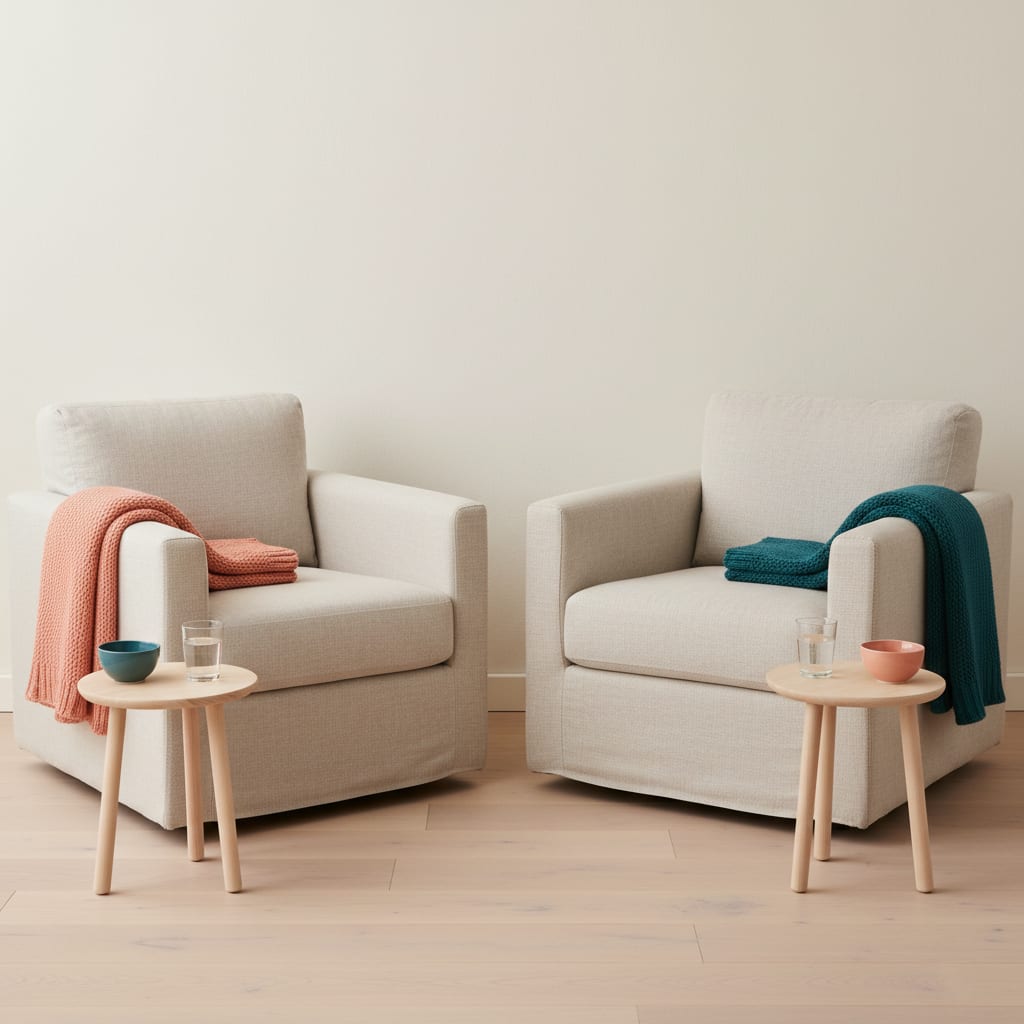
When one twin wants a night-light and the other wants the dark, you usually don’t have to pick a winner. Use one very dim, warm light (amber or red), plug it in low near the twin who wants it, and aim it at the floor or a wall so it never shines into the other bed. Turn the dark-lover’s bed so they face away from it. For many pairs that is enough, because a light dim enough not to bother one child is often still enough to reassure the other. If it isn’t, you have other options: a lit hallway and a cracked door, a light that switches off once both are asleep, or an agreed swap of which bed is nearer the light. Splitting rooms over a night-light is a last resort.
Why twins end up on opposite sides of this
Two children in one room are two separate people with separate fears, and fear of the dark usually turns up on its own schedule for each child. Cincinnati Children’s says plainly that “it is normal for young children to be afraid of the dark and to worry about safety and security at bedtime”. St. Louis Children’s Hospital puts it down to an active imagination: when a tired toddler’s brain meets a dark room, “their imagination can turn into real fears.”
So one twin may get scared at three while the other is untroubled until four, or never. Some children also sleep better in true darkness and complain when there is any light at all. Neither twin is being difficult. They just want different things from the same room.
Betteroo’s plain-language guide to night-time fears in small children walks through where those fears come from and the bedtime steps that help one child. This post is about the extra problem twins bring: one room, one light switch, two opinions.
Step one: make the light dim and warm enough for both
The night-light the scared twin wants is usually far brighter than they actually need. Start there, because brightness is what bothers the twin who wants the dark.
- Warm colour, low output. St. Louis Children’s warns that too much light in the bedroom “can disrupt the release of melatonin”, and suggests a night-light that uses red light. Betteroo’s write-up on which bulbs and colours suit bedtime recommends staying under about 2700K, warm amber or red, and keeping it as dim as you can.
- Plug-in, not a lamp. A small wall plug-in light like the GE SleepLite amber night light has no cord for a toddler to reach and gives a low, warm glow.
- Light the floor, not the faces. Point the glow downward or at a wall. The goal is a room where the scared twin can see shapes and the door, not a room that looks like early evening.
Cincinnati Children’s makes the same point from the other side: “As long as the light does not interfere with your child’s sleep, it is appropriate to have dim light at bedtime.” With twins, you’re checking that the light doesn’t interfere with either child’s sleep.
We went through the same reasoning about light colour for night feeds, and it carries over here. The detail is in our red light vs white light for twin night feeds post.
Step two: arrange the room around the light
Once the light is dim, where things sit does most of the rest.
- The scared twin sleeps nearer the light. Close enough to see it from bed, ideally with a view of the door.
- The dark-loving twin faces away. Turn their crib or bed so their head is at the end furthest from the light, or so they face the wall. A child who can’t see the glow often stops minding it.
- Block the line of sight if the room allows. A freestanding piece of furniture between the beds, well out of reach of both, does the job. Nothing hung on or over a crib.
- Darken the rest of the room. If streetlight or early sunrise is also leaking in, blackout curtains fix that part, and they make the night-light the only light the dark-lover has to cope with.
Moving the beds can change other things too. If the new layout puts the twins face to face and they start chatting after lights-out, see twins keeping each other awake at bedtime for setups that help with that.
Step three: if one dim light still doesn’t work
Some pairs won’t settle for a compromise light. Before you split them up, try these in order.
- Hallway light and a cracked door. Light out in the hall, door open a few inches. The scared twin can see the light; the room itself stays dark. This is often the cleanest fix for twins, because it gets the light out of the shared space.
- A light that goes off later. Many night-lights have a timer or can go on a plug-in timer. On for the first stretch while they fall asleep, off once both are asleep. This only works if the scared twin doesn’t wake in the night and look for it.
- Light only until the scared twin is asleep. If the dark-lover falls asleep easily anyway, turn the light off on your last check. If the scared twin wakes and needs it back, that tells you this approach isn’t working yet.
- Give each twin something of their own. The Cleveland Clinic page on night fears notes that some children feel safer with a special stuffed animal or blanket in bed, and that “a bit of light may do the trick, too.” For a toddler over 12 months, a comfort object can do some of the light’s job, so you need less light. Babies under 12 months sleep with nothing in the crib, and any light stays outside it.
When the night-light isn’t really about the dark
Sometimes the twin asking for a light is really asking for you. If the requests come with crying when you leave, clinging, or calling you back again and again, the fear may be about being alone, not about the dark. A sibling in the room doesn’t always fix that. The twin version of that problem is covered in twin separation anxiety at bedtime.
Talk to your pediatrician if a fear is severe, lasts for weeks, shows up in the daytime too, or is costing either child real sleep.
 One room, two bedtimes to plan
A night-light fight is often a tired-twin fight. Betteroo's quiz builds a sleep plan around one child's age and schedule, so run it once for each twin.
Take the sleep quiz →
FAQ: night-lights for twins sharing a room
Should twins have a night-light?
Only if one of them wants or needs one. A dark room is fine for children who sleep well in it. If one twin is scared, a very dim, warm light usually works for both.
What colour night-light is best for twins?
Warm amber or red, kept dim and pointed away from the beds. Bright white or blue light is the kind most likely to bother the twin who prefers the dark.
Can a night-light keep one twin awake?
It can if it’s bright or shining at their face. Dim it, aim it at the floor or a wall, and turn that twin’s bed to face away before you decide the light has to go.
Do I need to separate twins who disagree about the light?
Rarely, and not first. Try a dimmer light, a new layout, a hallway light or a timer before moving anyone. A separate room is a real option only once those have failed.
Is a night-light safe in a baby’s crib?
Nothing goes inside a crib for a baby under 12 months. Any light belongs on the wall, out of reach, and with no cord near either crib.