Red Light vs White Light for Twin Night Feeds
For night feeds with twins, use the dimmest light that still lets you feed both babies safely, and make it warm: red or amber rather than bright white. The research points that way without settling it. Blue-rich light suppresses melatonin most. In small adult studies, red light did not suppress it. Children react more strongly to evening light than adults. But nobody has tested red night lights on babies at 3 a.m. So brightness matters at least as much as colour. A warm, dim light is a small, cheap help, not a sleep fix.
What the research actually shows
Most claims about red night lights come from product pages. The studies behind them are real but small, and none involve babies.
- Blue light has the strongest effect on melatonin. A 2001 study in the Journal of Neuroscience (Brainard and colleagues, PMID 11487664) tested single-colour light on 72 young adults between 2:00 and 3:30 a.m. and found “446-477 nm as the most potent wavelength region” for suppressing melatonin. That is blue. A second 2001 study (Thapan and colleagues, Journal of Physiology, PMID 11507175) put the peak near 459 nm. Neither tested deep red.
- Red light did not suppress melatonin in one small night-time study. Figueiro and colleagues (Biological Research for Nursing, 2016, PMID 25697165) exposed 17 adults to red light (630 nm) and to warm white light at night. “Melatonin levels were significantly suppressed by white light only.” The same red light also made people more alert, with faster reaction times.
- Children respond more strongly than adults. In a 2018 study in Physiological Reports (PMC6295443), 22 children averaging 8.9 years old showed more melatonin suppression than adults under both warm and cool white light. Bluer light suppressed more than warm light in the children, and the authors recommend light “with a low color temperature” at night, “particularly for children’s sleep”.
- Even dim light counts. A 2022 study of 36 children aged 3 to 4 (PMC8933063) gave them an hour of light before bed at 5 to 5,000 lux. Melatonin fell by 69% to 99%. Even the dimmest group (5 to 40 lux) averaged a 77.5% drop.
Where the evidence is thin, plainly: none of these studies looked at babies. The exposures were fixed lab sessions, such as a 30-minute pulse in the Thapan study and an hour before bed in the preschool study, not a few minutes of feeding light. The red-light result rests on 17 adults. And in the first weeks it may matter even less. Betteroo’s guide to how a newborn’s body clock learns day from night explains that babies are born without a working circadian rhythm, and that their own melatonin production “does not really come online until several weeks after birth.”
So warm and dim is a sensible default with a plausible reason behind it, and dim matters as much as warm. A red bulb will not make a baby sleep.
Why the light matters more with two babies
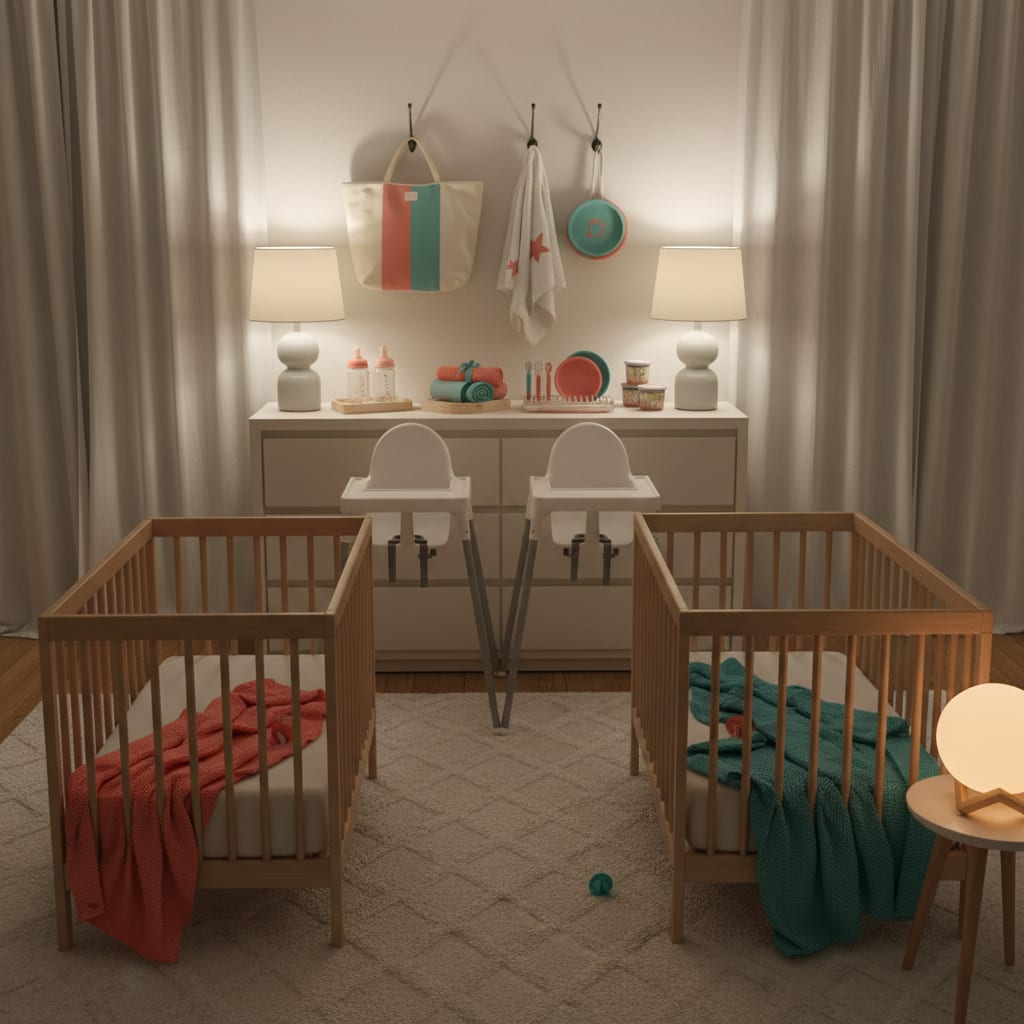
With one baby, a night feed lights one baby. With twins in one room, it lights both.
- The sleeping twin gets your light too. An overhead white light for Twin A’s feed shines on Twin B’s crib as well. A low lamp that faces away from the cribs mostly reaches the twin you are holding.
- The light stays on for longer. A double round with burping can run 30 to 40 minutes (bottle-feeding twins alone covers the setups), and feeding one twin at a time takes longer still. The more of the night your light is on, the more its brightness matters.
- Feeding outside the room helps most. Moving the feed out of the room is the fix in twins waking each other up, and a warm, dim light works there too.
A night-feed lighting setup for twins
| Light | Where | What it is for |
|---|---|---|
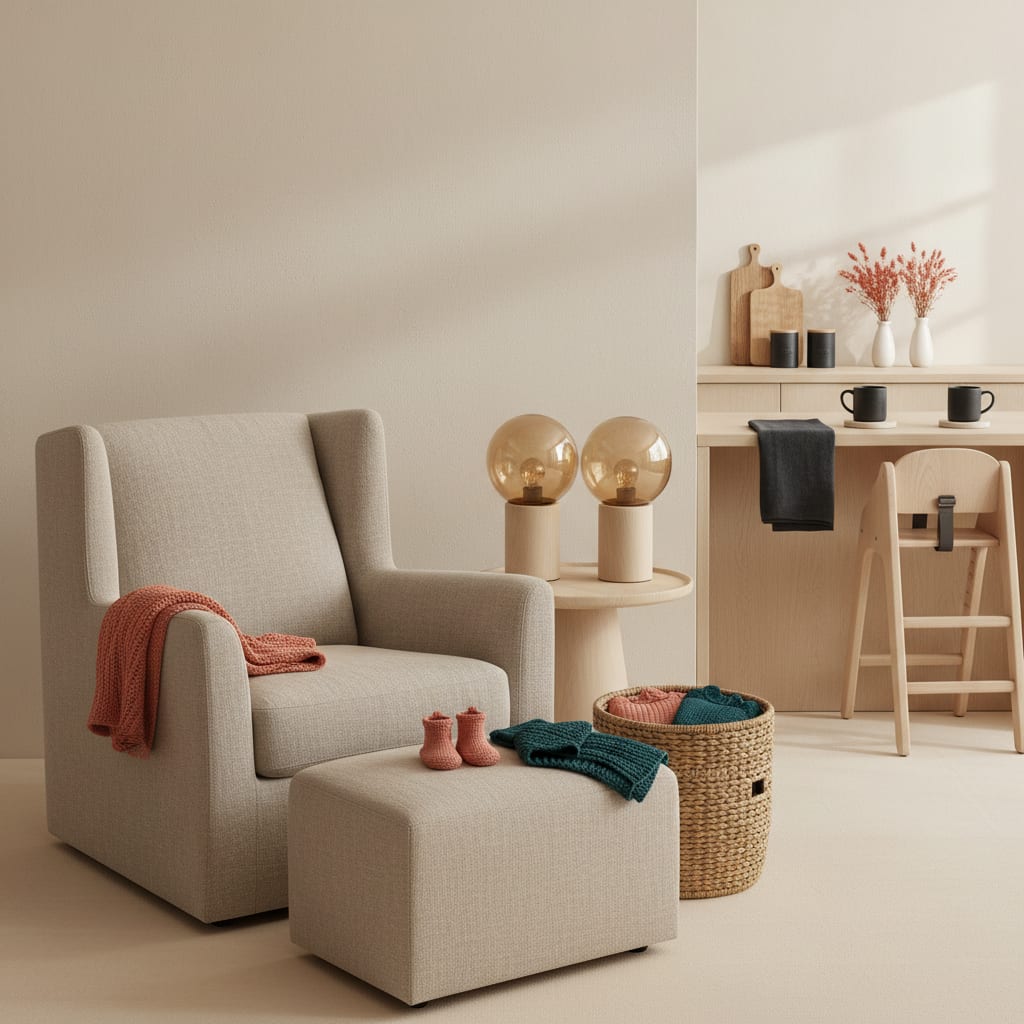
| One warm, dim light (amber or red) | Low, beside or behind the feeding chair, facing away from the cribs | The whole feed: latch or bottle, burping, settling back down |
| A normal white light, briefly | Kitchen or hallway, not over the cribs | Measuring formula, reading a medicine label, checking a rash or a dirty diaper |
| Daylight | Curtains open in the morning | The contrast that teaches day from night |
A plug-in amber night light like the GE SleepLite covers the first row: it is sold as a warm amber light with a dusk-to-dawn sensor. A red bulb in a low lamp does the same job.
The third row matters most of the three. Betteroo’s guide puts it bluntly: “Bright natural light during awake windows is the strongest cue for the developing body clock.” No night light can make up for dim days.
Enough light to see both babies
Dim has a floor, and with twins you hit it sooner than you would with one baby.
- You need to see two faces. In a double feed you are watching two latches or two bottles, and you need to see when either baby needs a break. If you are squinting, the light is too dim for the job.
- Red light hides colour. Under deep red light, colours are hard to tell apart, so you cannot judge a baby’s skin colour by it. If either twin seems unwell or a strange colour, switch on a normal light straight away.
- Measure formula under normal light. A scoop you misread by red light ends up as a wrong-strength bottle. Make up bottles in the kitchen, or before bed, and bring them to the feeding spot.
- Light the logging spot too. Night rows on a twin feeding and sleep log go missing when you cannot see the page.
The adult in the chair
In the Figueiro study, red light raised alertness, so it is no sedative for you either. The real danger at a 3 a.m. feed is a dark room, a soft chair and an exhausted adult holding two babies.
The AAP’s parent’s guide to safe sleep says the risk of sleep-related infant death is “up to 67 times higher when infants sleep with someone on a couch, soft armchair or cushion.” If you might fall asleep, it advises clearing pillows and blankets from the bed and moving the baby “back to their own sleep space as soon as you wake up”. With twins, that rule covers two babies, and both go back to their own sleep spaces.
If two adults are on the night shift, decide who does what before bedtime rather than at 3 a.m.:
- One adult feeds both twins while the other sleeps somewhere the light and noise do not reach. This works well once the twins are on one feeding clock.
- Each adult takes a twin, both fully awake.
- Avoid the third version, where one adult feeds while the other dozes in the chair “to help”.
What a red light will not change
A warm light makes the feed itself calmer. It does not change why a twin wakes. If one twin wakes at the same hour every night, the cause is usually hunger, a sleep-cycle wake or a habit feed, and sorting out which is in twins waking at the same time every night. Betteroo builds a sleep plan around one child’s age and temperament, so each twin can have their own. It is a planning tool, not a medical one.

FAQ: red light and white light for night feeds
Is red light better than white light for night feeds?
Probably a little, mostly because it is dimmer and contains no blue light. In small adult studies, blue light suppressed melatonin most and red light did not suppress it, and children are more sensitive to evening light than adults. No study has tested this in babies, so keep the light dim whatever its colour.
Should a night light stay on all night in the twins’ room?
It does not have to. If your twins sleep well in the dark, keep the light at the feeding spot and turn it on only for feeds. If you use a light that stays on, keep it low, warm and pointed away from both cribs.
What colour night light is best for a baby?
Warm colours such as red or amber, at the lowest brightness that still lets you see what you are doing. Avoid blue, cool white and bright overhead lights during night feeds, and get your twins into bright daylight during the day.