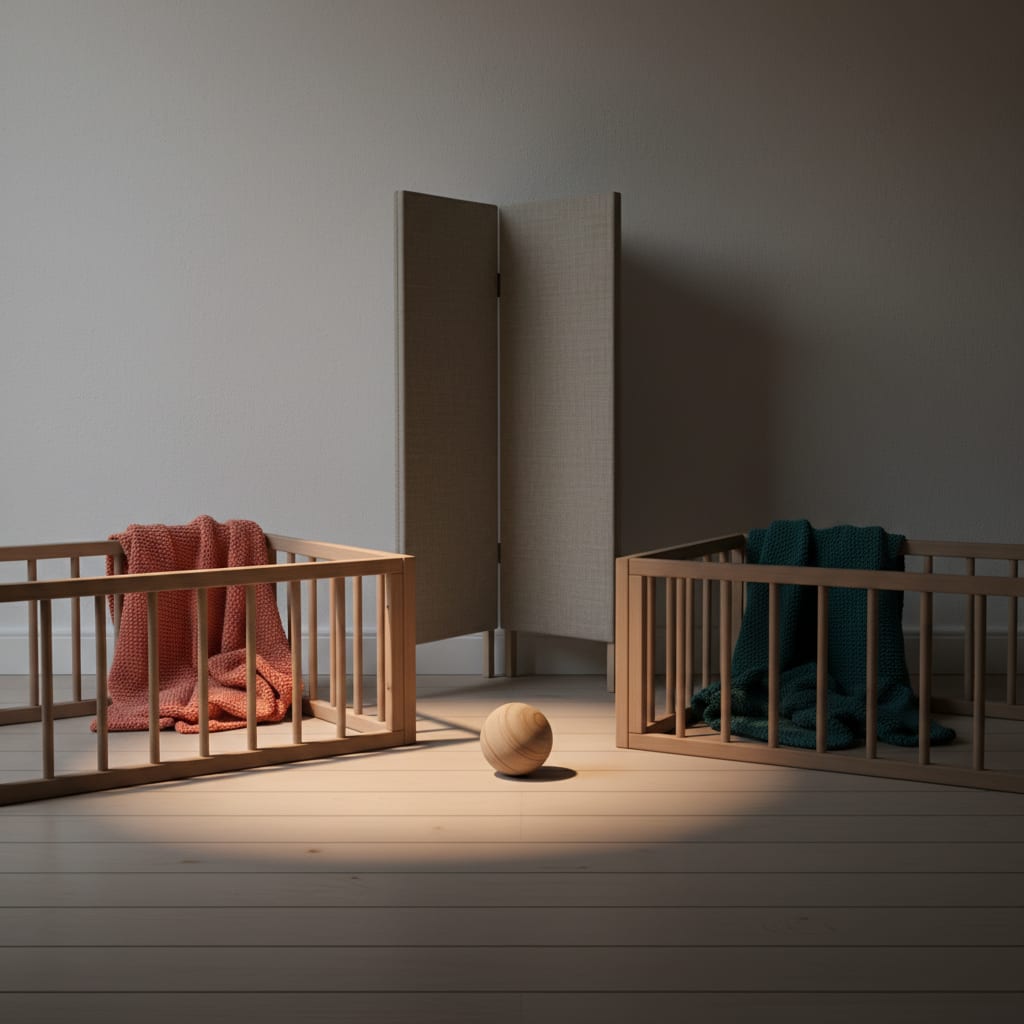
Twin toddlers who chat and giggle after lights-out are doing something very normal, and often it does no harm. The test is not whether they talk. It is whether both fall asleep within a window you can live with and wake up rested. If they do, leave it alone. If the party runs long, fix it in this order: check that bedtime is not too early or too late for either twin, trim a late nap, make the last half hour quieter, give one boring response to the noise every time, and change what they can see and hear of each other. Splitting rooms comes last, as a short trial.
Is the crib chatter actually a problem?
Most of the time, no. Two toddlers in one room have an audience the moment the light goes off. Some pairs talk themselves to sleep within a few minutes.
It becomes a problem when it costs sleep. Betteroo’s guide to how much sleep children need by age, which follows the American Academy of Sleep Medicine ranges endorsed by the AAP, puts 1 to 2 year olds at 11 to 14 hours in 24, including naps, and 3 to 5 year olds at 10 to 13. Do the arithmetic per twin:
- Both twins still inside the range, waking cheerful? The chatter is costing you a quiet evening, not costing them sleep. Leave it.
- One or both short, cranky by late morning, or the nap now falling apart? It is eating their night. Work through the fixes below.
Pick a window before you start judging nights. Ours is about twenty minutes from lights-out. Inside that, nobody goes in. Write down how long it actually runs for a week before changing anything, because one wild night is not a pattern.
Not the same as one twin waking the other
Check which problem you have, because they need different fixes. A twin who waits until the other is asleep and then calls, bangs or throws to wake them up is after a reaction, and that has its own playbook in when one twin wakes the other on purpose. This post is about two children who are both awake at bedtime and enjoying each other. Nobody is being woken. They just haven’t gone to sleep yet.
Fix one: check the clock for each twin
Most long crib parties are timing problems. Betteroo’s guide on stalling at bedtime puts it plainly: a child put down before they are sleepy “has nothing to do but call for you”, and an overtired child “can get wired instead of drowsy.” With twins in one room, a child who isn’t sleepy has something better to do than call for you. The other twin is right there.
So check both directions, one twin at a time:
- Too early. If they are bright and chatty for half an hour and then drop off easily, try a later lights-out by 15 minutes for a week.
- Too late. If the giggling turns manic and ends in tears, they are overtired. Try 15 minutes earlier instead.
- The nap. The same guide calls a late or long nap “a common hidden cause” of bedtime trouble. If one twin naps longer or later than the other, that twin is often the one starting the conversation.
Twins are two children with two body clocks, and a shared bedtime that suits one may not suit the other. If the answer turns out to be different times, the mechanics of running two bedtimes in one house are in split twin bedtimes.
Fix two: make the last half hour quiet
Whatever energy they bring into the cribs, they spend on each other. The Betteroo stalling guide cites the AAP’s advice on a quiet routine (a story, soft music or a bath) and its warning that active play right before bed can leave a child too excited to sleep. It also cites a CHOC pediatrician’s suggestion to start quiet time 20 to 30 minutes before bedtime.
With twins, the usual leak is the last ten minutes: one twin is still in the bath while the other runs laps, and the runner arrives at the crib ready to play. Bring both into the quiet part together, even if that means one waits on your lap with a book.
Fix three: one boring response, every time
If you go in, go in the same way every night. Walk in without the overhead light, say one short line you will always say (“It’s sleep time, goodnight”), lay down anyone standing, and leave. Don’t scold, don’t negotiate, and don’t do the funny voice that got a laugh on Tuesday.
Two things decide whether this works. Both adults do the identical version, and you go in only when the window you picked has run out, not at the first giggle. Turning up at the first giggle makes the giggling worth it.
Fix four: change what they can see and hear
Two cribs facing each other across a small room are a stage. Turn them so the twins cannot see each other’s faces: along one wall, at right angles, or end to end. If the room won’t allow that, a freestanding screen well out of reach of both cribs works too, with nothing hung on or over a crib.
A steady sound floor helps on top of that. A fan-based machine like the Yogasleep Dohm Classic, placed between the cribs, softens the small sounds that start a round of giggles. It won’t stop a determined conversation, but it takes the whispers out of it.
One safety check: a twin who stands at the rail to chat can reach things, such as a curtain cord or a shelf. Move anything within reach.
Fix five: stagger who falls asleep first
If both are tired and the room is set up well and they still keep each other going, take away the overlap. Put one twin down 10 to 15 minutes before the other, and bring the second in once the first is asleep. Try the chattier twin first for a week, then the other way round if that doesn’t help. Which order works depends on the pair.
Fix six: a short split, if you have the room
If a few weeks of all the above haven’t moved it, separate them for a week. Present it as a calm change of rooms, not a punishment. Then bring them back together and expect a test night or two. Some pairs settle straight back into sleeping. Others show you that sharing a room isn’t working right now. That bigger decision, and the reasons that do and don’t justify it, are in when to separate twins for sleep.
If this is starting around the second birthday along with every other bedtime battle, it may be part of the wider shift covered in two-year-old twins not sleeping.
 One room, two body clocks
If one twin simply isn't sleepy at bedtime, timing is the fix. Betteroo's quiz builds a plan around one child's age and schedule, so run it once for each twin and compare.
Take the sleep quiz →
FAQ: twins talking and laughing at bedtime
Is it OK to let twins talk in their cribs at night?
Usually, yes. If both fall asleep within a reasonable window and get enough sleep for their age, the chatter is harmless. It only needs fixing when it cuts into how much they sleep.
Why do my twins get hyper at bedtime?
Often one or both is overtired, or one is not tired yet and keeps the other entertained. Check each twin’s nap and bedtime separately before you blame the room.
Should I separate twins who keep each other awake?
Not first. Timing, a quieter run-up, a consistent response, crib placement and a staggered bedtime fix most cases. A week apart is a reasonable step if those haven’t, and it is a trial, not a permanent move.
Will they grow out of it?
Some pairs keep chatting at bedtime as they grow, and that is fine as long as both still get enough sleep. Judge it by how they sleep, not by whether you can hear them.