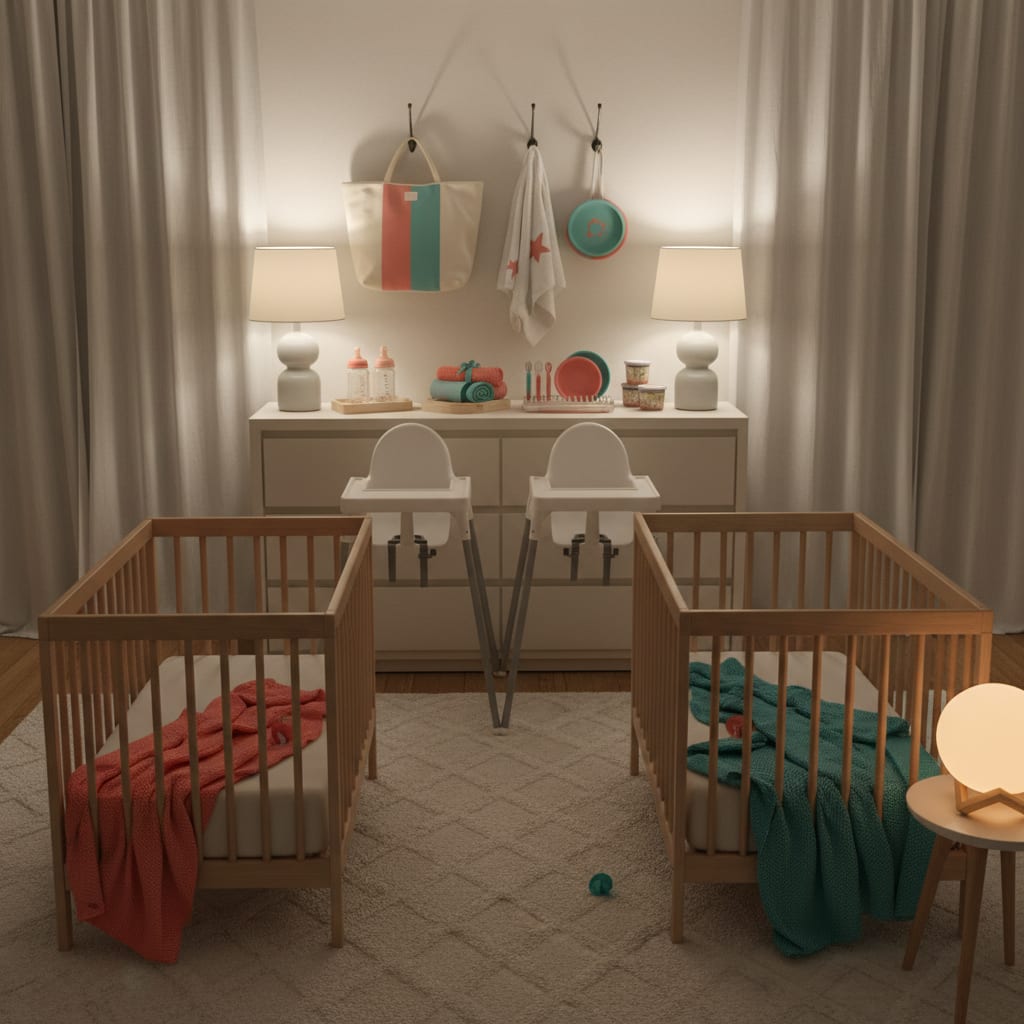
Split Twin Bedtimes: When Separate Rooms Help
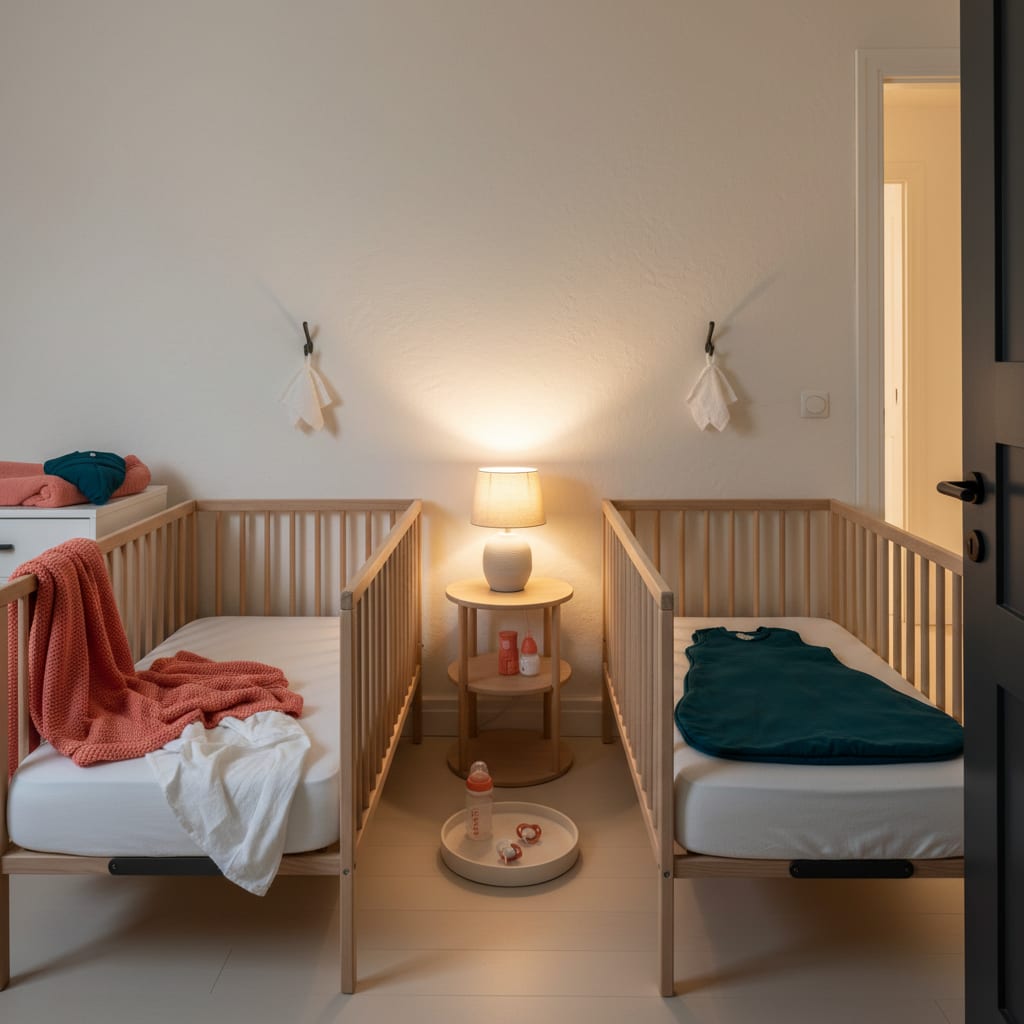
Splitting twin bedtimes means putting your twins down at different times — usually 15 to 30 minutes apart — rather than in different rooms. The two get confused constantly, and they are separate decisions: most twins in one room can run a split bedtime, and most twins in two rooms still go down together. A split is worth trying in three situations: a genuine wake-window gap between the babies, one twin whose wind-down is much longer, and solo evenings where two simultaneous bedtimes cannot physically be done by one adult. Outside those, a shared bedtime is faster and more stable.
What splitting a bedtime actually means
Three different things travel under the same phrase, and they cost very different amounts of your evening.
The offset lights-out. One shared routine — bath, feed, books, room — then one twin goes into the cot first while the other gets a few extra minutes with you. Cheapest version, and the one most families mean. Adds five to ten minutes.
Sequential routines. Two separate wind-downs back to back, each with its own bath-to-cot sequence. Honest about the cost: this turns a 30-minute bedtime into an hour, needs a second safe place for the waiting baby, and is the version families abandon by week two.
Independent clocks. Each twin’s bedtime derived from their own naps and their own last wake window. This is the one that usually implies separate rooms, and the one that genuinely drifts the babies apart.
Only the third is really about rooms, and that decision has its own criteria and trial structure in when to separate twins for sleep. Under six months it is constrained anyway: the recommendation is both babies in the parents’ room, each on their own firm flat surface.
When splitting genuinely helps
A real wake-window gap. Not a mood difference — a measured one. If Twin A reliably needs a shorter last wake window than Twin B, a shared bedtime puts one baby down overtired and the other down under-tired, every night. Two babies who need lights-out 25 minutes apart fight bedtime in two completely different ways, and no compromise time fixes both.
A much longer wind-down for one baby. Some babies need eight minutes and some need twenty-five. Compressing the slow twin into the fast twin’s routine produces the exact protest bedtime you are trying to avoid, and an offset costs almost nothing.
Solo evenings. One adult, two babies, one of whom needs holding to settle. A staggered bedtime here is not an optimisation, it is the only physically available option — and admitting that early beats discovering it at 7:40pm. The wider version of that problem is in the solo-day playbook.
A short, defined training window. If one twin’s settling plan needs quiet, an offset buys that baby ten minutes of a room to themselves.
The test for all four is the same: log a week — time down, time asleep, minutes of protest, per baby. If the two columns differ in a consistent direction, a split has something to fix. If they look the same, you are about to spend twenty minutes a night solving nothing.
Where it backfires
Drift. Independent clocks pull twins apart, and a pair on different schedules is a household with no gap in it at all. Hold the morning wake time as the anchor — same wake-up for both babies, every day, regardless of how the night went. That single rule stops a 20-minute offset becoming a 90-minute one by Friday, and the mechanics are in getting twins on the same schedule.
Solving a nap problem at bedtime. If one twin is melting down at 6:45 because their afternoon nap was 25 minutes, the bedtime is not the broken part. Short, unpredictable naps produce exactly the symptoms that look like a wake-window mismatch, and fixing the day is more durable than moving the evening — nap training is the lever there, and it works per baby, which is convenient here.
Changing two things at once. Splitting the bedtime and moving a twin to a new room in the same week means you learn nothing from either.
Running a split with one pair of hands
- Front-load the harder baby. Last cuddle, first down — the steadier twin will wait and the harder one will not. This is the opposite of what most people do instinctively.
- Keep the shared parts shared. Bath together, feed together, books together; split only the last step. Two sets of cues teaches two separate things.
- Give the waiting twin somewhere legitimate to be. A safe, boring spot in the room with you, not a second wind in the living room. If they fall asleep waiting, they go onto their own flat sleep surface — never a bouncer, a lap or a sofa.
- Keep the offset small and fixed. Twenty minutes, the same twenty minutes every night. A variable offset is not a plan, it is a mood.
- Judge at two weeks. Nights one to three are noise.
Separate rooms, same bedtime
Worth saying plainly, because it is the setup most families end up in: twins in two rooms very often keep one shared bedtime. Rooms solve a noise problem, bedtimes solve a timing problem, and solving one does not oblige you to solve the other.
If your twins are in separate rooms and bedtime got harder rather than easier, the usual cause is that one adult is now doing two goodbyes in two places — a logistics regression dressed up as a sleep regression. The fix is normally to run the wind-down together in one room and move the second baby at the end, already drowsy, rather than to build two independent evenings.
Where a per-child plan earns its money
The difficulty here is writing two different bedtime plans, for two babies at two developmental points, at 9pm, from memory. That is the job Betteroo’s quiz-built plans do well: a short quiz about one baby’s age, temperament, schedule and your tolerance for crying returns a day-by-day plan for that child, and you run it twice rather than averaging two babies into one compromise. Balanced verdict: a planning tool at around $20 a month, it will not tell you whether your two should share a room, and a baby whose waking is driven by teeth, illness or reflux needs a pediatrician rather than an app.

Adjusted age, and when to ask someone qualified
Twins are more often born preterm, so read every timing statement here on adjusted age, counted from your due date. Wake windows and readiness for any settling plan move with it, and a pair born early looks “behind” on a calendar that was never theirs.
Take it to your pediatrician if either twin’s bedtime distress escalates over weeks instead of settling, if there is feeding or weight-gain worry alongside it, or if one baby’s sleep changed suddenly with nothing behind it. And whatever the bedtime looks like, the sleep setup does not move: own surface each, on the back, nothing in the cot — the full ruleset is in safe sleep for twins.
FAQ: splitting twin bedtimes
Should twins go to bed at the same time?
Usually yes — one shared bedtime is faster, steadier and much easier for one adult to run. Split it when you have logged a real difference in the two babies’ last wake window or wind-down length, not because bedtime was hard on Tuesday.
Do twins need separate rooms to have different bedtimes?
No. An offset of 15 to 30 minutes works fine in a shared room, and it is how most families run it. Fully independent bedtimes are the version that usually needs two rooms.
How far apart should staggered twin bedtimes be?
Start at 15 to 20 minutes and keep it fixed. Bigger gaps mean a longer evening and more drift; a variable gap teaches neither baby anything.
Will separate bedtimes put my twins on different schedules?
Only if you let the mornings drift. Hold one shared wake time every day and the two days re-converge on their own; let each baby wake when they like and a 20-minute split becomes a two-schedule household within a fortnight.
My twins are in separate rooms and bedtime got worse — why?
Usually because one adult is now doing two goodbyes in two places. Run the wind-down together and move the second twin at the end, already drowsy, before concluding their sleep changed.