Twin Separation Anxiety at Bedtime: 8-18 Months
Separation anxiety at bedtime typically shows up between 8 and 18 months, and with twins it almost never arrives for both babies at once — one twin hits the wall while the other carries on going down like nothing happened. That staggering is the whole twin problem: a protest bedtime and a normal bedtime, same room, same hour, one pair of hands. The fix is not a different room. It’s a short, identical, absolutely predictable goodbye for both babies, calm check-ins for the twin who needs them, and daytime practice at separating.
What it actually looks like at bedtime
Separation anxiety is a developmental gain, not a setback: your baby has worked out that you continue to exist when you leave the room, and has strong feelings about it. At bedtime it shows up as a baby who was fine at 6:45 and screams the second your hand leaves the crib rail, who settles instantly when you return and restarts the moment you go. Night wakings that used to resettle now want you specifically — not a feed, not a diaper, you.
The tells that separate it from other 8-to-18-month sleep chaos: it’s tied to your leaving, not to lying down; it stops the instant you appear; and it shows up in daylight too, at drop-off or when you walk to the kitchen. Teething pain doesn’t switch off when you walk in the door. For the general developmental picture underneath it, separation anxiety and baby sleep is the primer.
Do twins comfort each other, or wind each other up?
Both — and which one you get depends on whether the second twin is also in the phase.
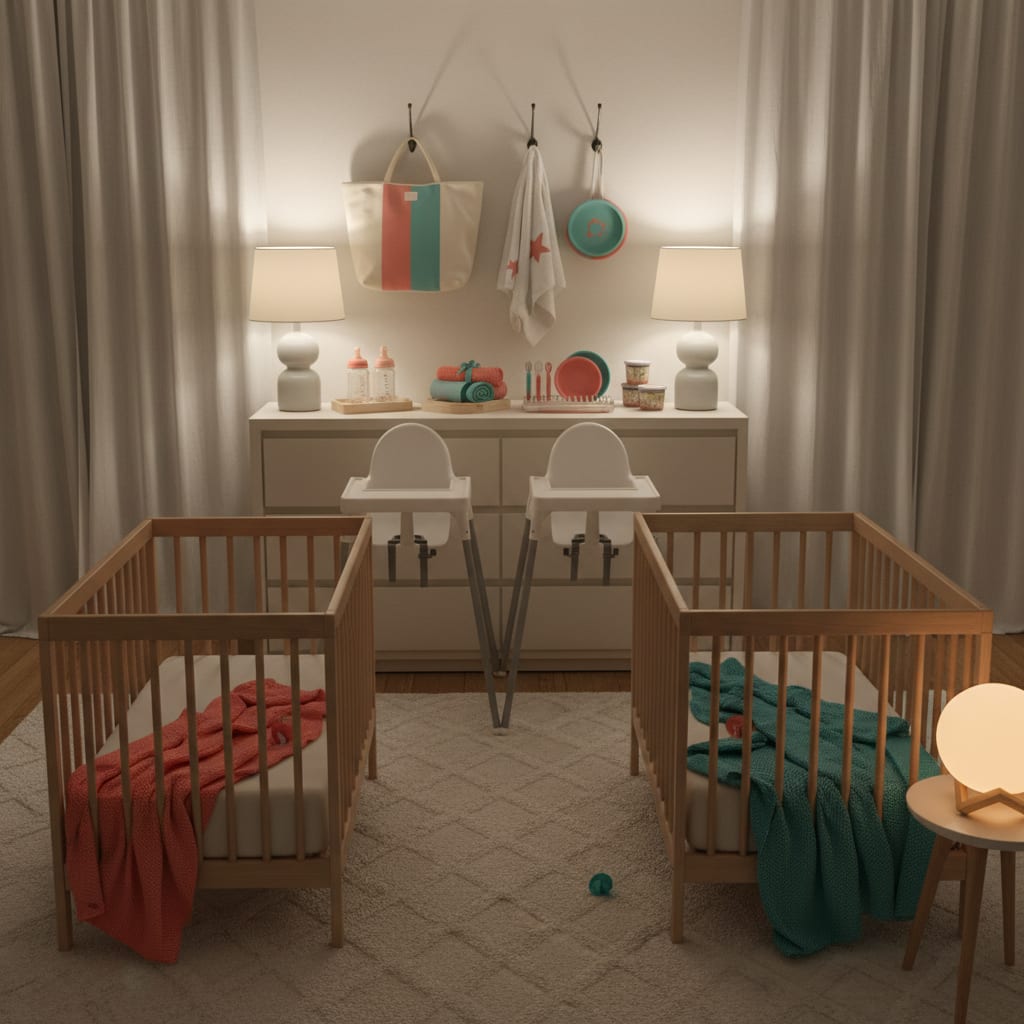
When only one twin is affected, the co-twin is usually a stabiliser. The unbothered twin lies down, goes quiet, and their presence does something a parent can’t: it makes the room ordinary. Plenty of twin families find the anxious baby settles faster in the shared room than in a trial separation, because “alone” is the actual trigger and, in a shared room, they aren’t.
When both twins are in it at once, you get amplification — not because they’re waking each other, but because the sight of a parent picking up the other baby is the most reliable protest trigger in the house. It’s not noise contagion, it’s queueing.
Two consequences. Do your check-ins from a spot where both babies can see you rather than crouched at one crib — a hand on one chest while your voice reaches both. And alternate who you go to first across nights, so neither baby learns that screaming louder buys priority.
When only one twin is affected
This is the common case, and the temptation is to move the anxious twin out. Resist it — you’d be removing the co-twin, who is doing free work for you, and adding “alone in a strange room” to a baby whose entire problem is being alone.
What to do instead:
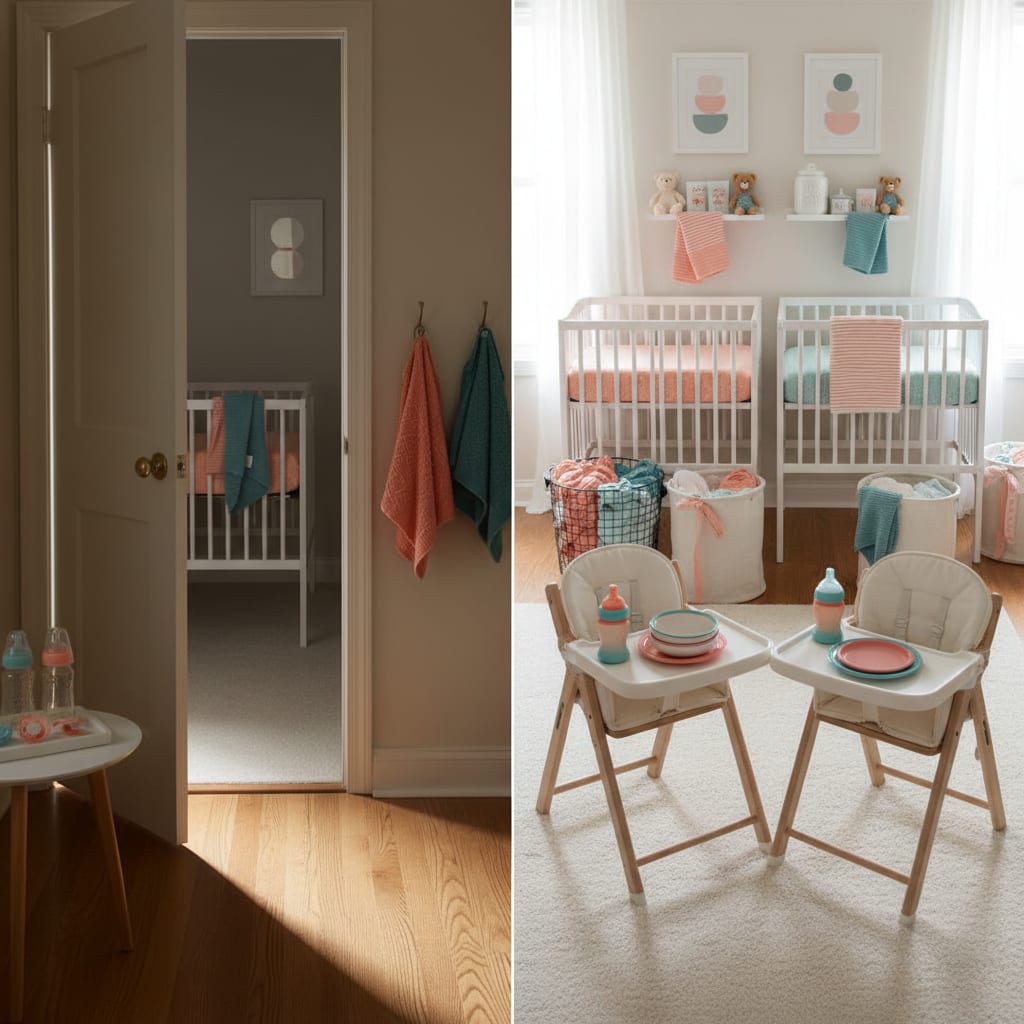
- Keep the shared bedtime, split the response. Same room, same routine, same lights-out. The calm twin gets the old two-second goodbye. The anxious twin gets the goodbye plus a defined check-in ladder. Two playbooks, one bedtime — the general version of this move is in one twin sleeps, one doesn’t.
- Front-load the anxious twin. Last cuddle, last down. The steady baby will wait; the anxious one won’t.
- Give it a schedule sanity check first. An 11-month-old fighting bedtime for 40 minutes may be under-tired rather than anxious, especially mid-way through a nap transition. Check the day’s numbers before you diagnose anything emotional.
- Don’t relabel the twins. “The clingy one” is a phrase with a very long shelf life. This phase ends; the label doesn’t.
The bedtime protocol that actually works
- Practise separations in daylight. Leave the room for ten seconds, narrating from the hallway, and come back. Then thirty seconds. Then a minute. You’re teaching the thing bedtime is testing, at a time when nobody is tired — and with twins you do it once, for both.
- Make the goodbye identical every night. The same six words, the same order, the same exit. Predictability is the active ingredient; length is not. A long, elaborate goodbye is a longer runway for anxiety, not a kindness.
- Never sneak out. A parent who vanishes when the baby looks away turns the crib into a place where you have to stay vigilant.
- Check in on a fixed ladder, not on feel. Two minutes, four, six, and so on — voice and a hand, lights stay off, no pick-up unless something’s actually wrong. Being boring is doing the work.
- Keep the room a two-surface room. Whatever settling logic your tired brain offers at 1am, the twins don’t go in one crib. Same room, own firm flat surface each, on their backs — the whole ruleset is in safe sleep for twins.
- A comfort object, once it’s safe. From around 12 months, and only once your pediatrician agrees your twins are ready for soft items in the crib (preterm twins: adjusted age), a small flat lovey gives an anxious toddler something that stays when you don’t. Buy in threes — a set like the Angel Dear “pair and a spare” exists because one per twin plus a backup in the wash is the real twin requirement. Under 12 months, the crib stays bare.
Where a per-baby plan earns its money
The specific pain of this phase with twins is needing two different bedtime plans, at the same hour, for two babies at two different developmental points — and writing them yourself, accurately, at 9pm.
That’s the narrow job a per-child plan from Betteroo does well: a quiz about one baby’s age, temperament, schedule and your tolerance for crying returns a day-by-day plan for that child. Run it twice, once per twin, and you get two plans instead of one compromise. Balanced verdict: it’s a planning tool, around $20 a month, and it won’t do the check-ins for you — a twin whose waking is driven by teeth, illness or reflux needs a pediatrician, not an app. For two babies who genuinely need two different ladders this month, per-child is the right shape.

Adjusted age, and when to ask someone qualified
Twins are more often born preterm, so read the 8-to-18-month window on adjusted age, counted from your due date. A pair born two months early may hit this phase closer to 10 months of life than 8, and a family expecting it on the calendar will misread ordinary bedtime resistance as anxiety.
Take it to your pediatrician if bedtime distress escalates rather than plateaus after several weeks, if either twin is feeding poorly or losing weight alongside it, or if there’s inconsolable crying you can’t settle at all. Sleep advice on the internet is for patterns; your two babies are not a pattern.
FAQ: separation anxiety with twins
Do both twins get separation anxiety at the same time?
Usually not. Staggered onset — weeks or even a couple of months apart — is the common twin experience, because the developmental clock runs per baby.
Should I separate twins during a separation-anxiety phase?
Generally no. Moving the anxious twin into a room alone adds the exact trigger you’re trying to defuse, and the calm co-twin is often the reason bedtime is survivable. If night wakings become genuinely contagious, read when to separate twins for sleep and treat it as a time-boxed trial with a reunion plan.
How long does bedtime separation anxiety last with twins?
Expect weeks rather than nights, with the peak passing and returning in smaller waves around new milestones. With twins you’ll often run the phase twice, back to back, which feels much longer than it is.
My twins wake each other during this phase — is that separation anxiety?
Sometimes it’s just noise transmission wearing a costume. Run the three-night audit in twins waking each other up first: if the second twin wakes when you walk in rather than when the first twin cries, the variable is you, and the fix is a quieter check-in, not a new bedtime plan.