Pumping for Twins: Output, Schedules, Sanity
Pumping for twins is a scheduling problem before it is anything else. The variables you actually control are how many sessions fit in a day, where they sit relative to two babies’ feeds, and how fast you can start one — not what comes out, which is between you, your body and a lactation consultant. So this page is the logistics half: session counts, two sample day-shapes, the setup that makes a session startable in ninety seconds, and the minutes nobody budgets for. Targets, supply questions and anything that feels wrong belong with an IBCLC or your OB, not with a blog.
The three pumping situations with twins
Almost every twin family pumping at all is in one of three situations, and they have completely different day-shapes.
Exclusively pumping. No nursing, all bottles, everything from the pump. This is the most common twin pumping situation and the most schedule-intensive, because every session is additional to two babies’ feeds rather than replacing one.
Pumping alongside nursing. Nursing one or both babies for some feeds and pumping around them — often to build a stash, to cover the feeds someone else does, or because one twin latches and the other doesn’t yet. Sessions are fewer and land in the gaps.
Top-up pumping. A small number of sessions with a specific job: the overnight bottle someone else gives, the daycare stash, the return-to-work runway. This one is a habit, not a schedule.
Naming which of the three you’re in matters, because advice written for one is unusable in another — and twin parents get handed exclusive-pumping schedules when they’re actually in situation three. If you’re still deciding, the trade-offs across all the feeding routes are laid out in feeding twins: every method compared.
Session counts and where they land
The number lactation professionals most often discuss in the early weeks is around eight sessions in 24 hours for someone exclusively pumping, dropping as things establish — but the right number for you is a conversation with an IBCLC, especially with twins, especially if either baby was preterm. What a blog can usefully give you is the shape of the day.
Two sample day-shapes, the same way we do everything else here — Baby A in one column, Baby B in the other, and pumping written in where it physically fits.
| Clock | Exclusively pumping | Alongside nursing |
|---|---|---|
| 7:00 | Pump, then bottle both | Nurse A, bottle B |
| 9:00 | — | Pump |
| 10:00 | Pump during their morning nap | — |
| 12:30 | — | Nurse both, tandem |
| 1:00 | Pump during nap two | — |
| 4:00 | Pump | Pump |
| 7:00 | Bedtime bottles, then pump | Nurse both, then pump |
| 10:30 | Pump before bed | — |
| ~3:00am | Pump at the night feed | Nurse whoever wakes |
The twin-specific rule inside both columns: pump during the overlap, not during the stagger. A session started while one baby is awake and one is asleep gets interrupted; a session started when both are down usually finishes. That is the entire reason getting twins on the same schedule matters more to a pumping parent than to anyone else in the house — synchronised naps are what a pumping schedule is built out of.
The minutes nobody budgets for
Pump sessions are quoted in pumping time. The day is spent in total time, and with twins the gap between the two is where the plan quietly fails.
| Step | Roughly | Can it overlap? |
|---|---|---|
| Setup, parts on, seated | 2–3 min | No — this is the bit to shorten |
| The session itself | 15–20 min | Yes, with a hands-free bra |
| Transfer, label, fridge | 3–5 min | No |
| Washing parts | 3–5 min | Yes — batch it with a second set |
Call it half an hour of real time per session. At six sessions that is three hours, on top of feeding two babies eight to twelve times between them. Nobody finds that time; you take it from something, and the honest move is to decide what in advance rather than discovering it at 4pm.
Two levers cut it meaningfully. A second full set of pump parts turns four wash-ups into one, and is the single best value purchase in this whole category. A hands-free setup turns pumping from a task into a background process: a pumping bra like the Simple Wishes plus a pump you can walk with — the Spectra S1 Plus is the standard worked example because it has a battery, so a session can happen next to a play mat instead of next to an outlet.
Setting up so a session starts in ninety seconds
The reason sessions get skipped is almost never motivation. It’s that starting one requires walking somewhere, finding parts and sitting down, and with twins there is no reliable window in which all three of those happen.
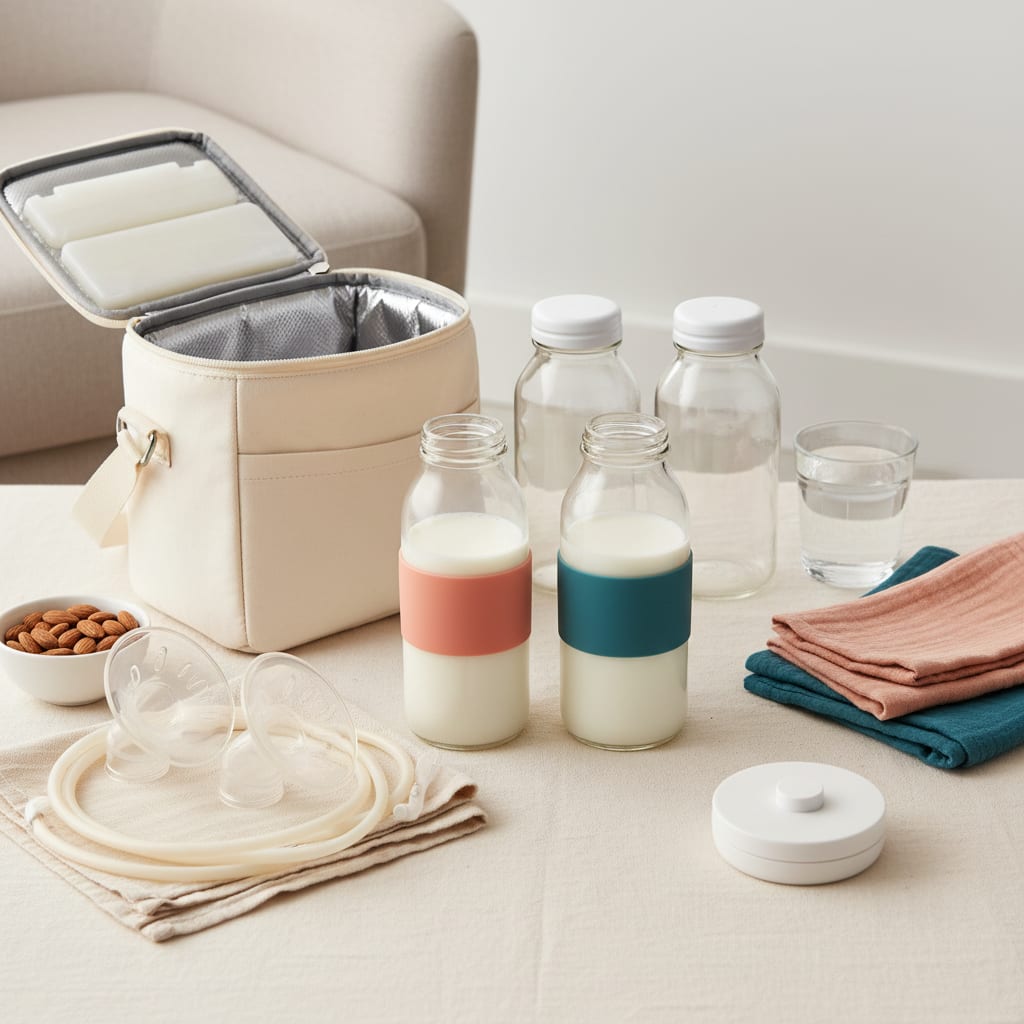
- One station, fully stocked, where you already sit. Parts, bottles, a water bottle, a snack, chargers. If you have two floors, two stations.
- Everything pre-assembled. Flanges attached to bottles, ready to lift and go.
- A put-down spot per baby within sight. Two safe places to park two babies is what makes a session possible at all, and it’s the same constraint that governs every other solo hour of a twin day.
- A shortcut for interruptions. Decide in advance what happens when one twin melts down at minute six: stop and restart later, or one-hand a pacifier and keep going. Deciding it once beats deciding it every time.
Storage, labeling and the A|B system
Twin milk logistics has one extra rule: with two babies feeding on possibly different volumes and schedules, “which bottle, whose, from when” has to be answerable without thinking.
Store in the smallest sensible portions rather than one large one — thawed milk that goes unfinished is the most demoralising loss in this entire process, and with twins you’re dividing every batch anyway. Lansinoh storage bags are the common worked example; write the date on the bag before it’s full, freeze flat, and rotate oldest-first from a bin rather than a pile. Follow your pediatrician’s or milk bank’s storage timings rather than a chart you half-remember.
For tracking, the paper version is our printable A|B feeding and sleep log; the phone version is any of the apps that log two babies separately — the only feature that matters is separate profiles, because a shared log between two babies is worse than no log.
When to call an IBCLC, not the internet
Twins add reasons to get professional eyes on this early rather than late: preterm birth is more common, latch problems in one baby are common, and the pump becomes load-bearing fast. Call an IBCLC — or your OB or the babies’ pediatrician — for anything about supply, pain, damage, flange fit, weight gain in either baby, or a plan that isn’t working after a couple of weeks. Flange sizing alone is worth one appointment; it is the most commonly wrong variable in the setup and nothing on the internet can measure you.
FAQ: pumping for twins
How often do you have to pump for twins?
There isn’t a twin-specific number, and the honest answer is that it depends on which of the three situations above you’re in and what you and an IBCLC are aiming for. Around eight sessions in 24 hours is the figure most often discussed for exclusive pumping early on; families pumping alongside nursing run far fewer.
Can you pump while feeding twins?
Often yes, if the babies are bottle-feeding in a twin pillow and you’re in a hands-free bra — awkward for the first week, then routine. During tandem nursing it isn’t practical; pump after that feed instead.
Do you need a hospital-grade pump for twins?
Not automatically. Many twin parents use a good double electric pump throughout; some rent a hospital-grade pump for the early weeks, particularly after a NICU stay. It’s a question for your IBCLC and your insurance, and the answer is more about your situation than about the number of babies.
Is combo feeding easier than exclusively pumping with twins?
For many twin families, yes — it removes the requirement that every ounce come from you and keeps the pump from setting the timetable. It’s a legitimate plan rather than a failure of one, and the whole route is mapped in combo feeding twins.