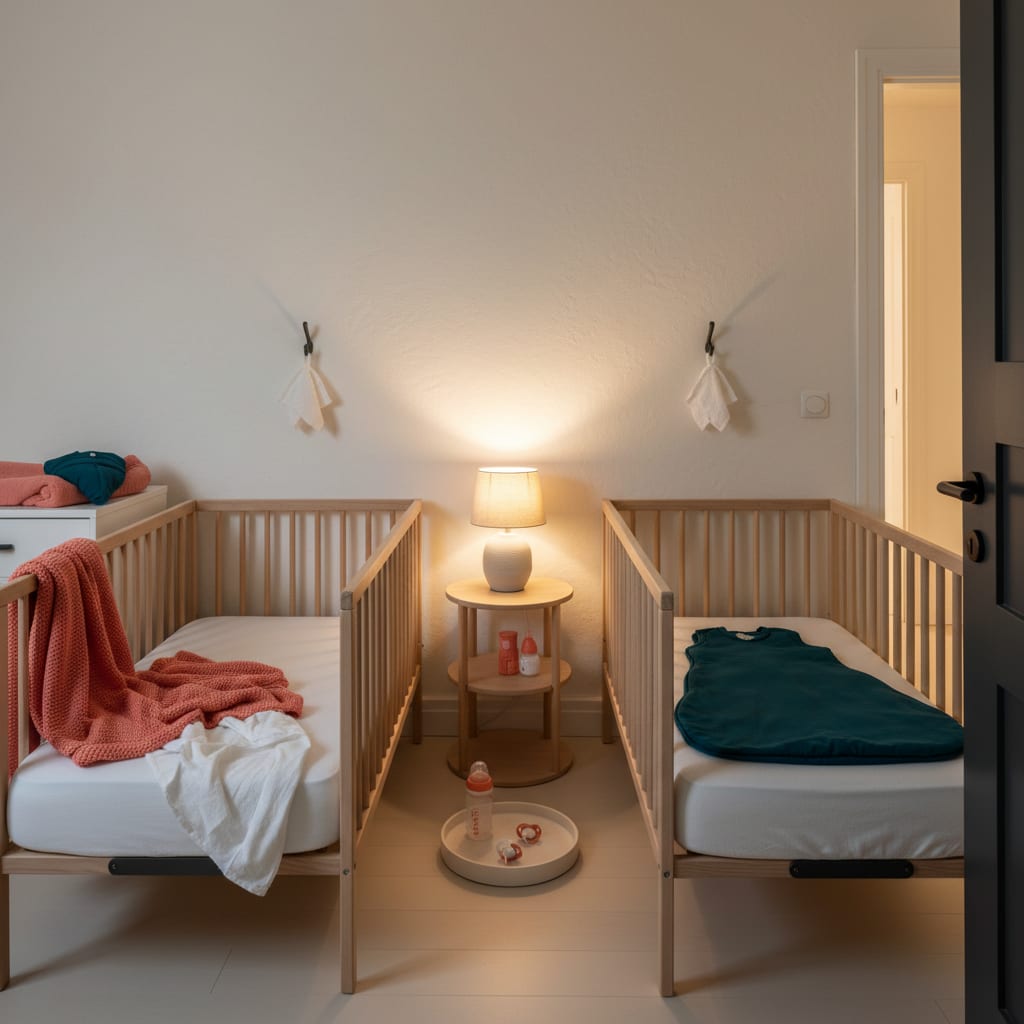
Both Twins Crying at Night: Which One Do You Go To First?
When both twins are crying at night, go first to any baby who might be unsafe or unwell. After that, age decides. In the first few months, the AAP says to respond promptly, so go to the twin whose cry sounds like hunger or pain, and usually feed the other one in the same round. From about four months, pause for a moment, because many night cries settle on their own, and go to the twin whose crying keeps building. If it is a genuine tie, go to the twin you did not go to first last time. Do not just go to the loudest.
The 3 a.m. order, in one list
Decide this in daylight, not with two babies crying:
- Anything that could be a safety problem or illness. A twin who has rolled into a corner of the crib, who sounds unwell, or whose cry has a sudden shrieking, panicked edge goes first. The AAP’s page on responding to your baby’s cries suggests checking for a strand of hair “caught around a finger or toe” when a cry sounds like that. Its page on calming a fussy baby says that if your baby is younger than 2 months and has a fever, “call your child’s doctor right away.”
- Under about four months: the twin who is hungry. The AAP says “the best way to handle crying is to respond promptly during their first few months” and that “you cannot spoil a young baby with attention.” It also notes that newborns “generally wake up hungry”, and that a hunger cry left too long “may turn to a wail of rage”. Then meet the most pressing need first: the AAP’s own example is a cold, wet, hungry baby who gets warmed, changed and then fed.
- From about four months: the twin whose cry is building. Here the AAP’s advice changes. On its page about getting your baby to sleep, for babies 4 months and older, it says “Do not rush in to soothe a crying baby” and that “it is normal for a 6-month-old to wake up during the night and then go back to sleep after a few minutes.” Both crying does not mean both are awake.
- On a tie: the twin who waited last time. Alternating keeps one baby from always coming second.
Why “both crying” is often one awake and one not
Betteroo’s guide to how to tell a sleep cry from a genuine wake is useful at 3 a.m. It describes sleep cries as “short, intermittent, and not escalating”, while a true wake “usually builds: the crying gets louder, more rhythmic, and more insistent.” Its advice, for a baby past the newborn stage who is safe in a bare crib, is to “wait a minute or two before intervening”, and to go straight in if a cry sounds like pain or distress.
With twins in one room, it matters twice over: one twin may be properly awake while the other is only stirring at the noise. If both are safe and past the newborn months, listen for a minute before you move, and go to the twin whose cry is getting louder and more regular.
Why the loudest twin is the wrong default
Loud is not the same as urgent, and a quieter twin can be the one with a hair tourniquet or a fever. Going to the loudest also drifts into a pattern where one twin always comes second. Keep a quick note of who you went to first each night, and switch. A few nights of notes also show whether one twin is driving every waking, which is a different problem with its own fixes.
The newborn version: one wakes, both feed
In the early months, the choice often disappears into the feed. Many twin families run one clock at night: when one baby wakes hungry, both are fed in the same round. That only works safely if the setup is right. Both babies are supported semi-upright, an adult holds both bottles the whole time and no bottle is ever propped. The full setup is in bottle-feeding twins alone. If feeding both at once is not possible, feed the hungrier twin first and alternate who goes first across the night.
Two adults, or one
With two adults awake, assign a twin each before bedtime. “You take A, I take B” removes the 3 a.m. decision altogether. Better still, if you can, take the night in shifts, so one adult sleeps somewhere the crying does not reach while the other handles both.
Alone with both, you are working in sequence, not ignoring anyone. Pick up the twin from the list above and give the other your voice from where both can hear you. The daytime version of this triage is in a solo day with twins, and it holds at night too.
If both have been crying a long time and you feel yourself losing it, stop. The AAP’s abusive head trauma page says to put your baby “in a safe place, such as a crib or playpen without blankets and stuffed animals”, leave the room for about 10 to 15 minutes, and check on them without picking them up until you feel calm. With twins, that means two babies in two safe cribs while you breathe in the hall, which is a good outcome, not a failure. The same page is blunt: “it is never safe to shake, throw, hit, slam or jerk any child”.
Keep one cry from waking both
- Steady white noise at a safe distance. One machine placed away from both cribs covers the room. A fan-based machine like the Yogasleep Dohm gives a constant sound that softens the first cry before it reaches the second crib.
- Take the awake twin out. Feed or settle the waking twin in another room when you can.
- Keep it dim and dull. The AAP’s sleep page says to “try not to stimulate or wake babies when you feed or change them during the night.” Low light and few words help the twin in your arms and spare the one in the crib.
If both twins wake crying at about the same hour every night, the problem is the pattern, not which twin to choose. Twins waking at the same time every night covers the three usual causes.
When the real answer is two different plans
Sometimes the 3 a.m. scramble means two babies with different needs are on one plan: one needs a night feed, the other wakes from habit. Betteroo builds a sleep plan around one child’s age and temperament, so each twin can have a plan of their own. It is a planning tool, not a medical one. A cry that sounds like pain, or a twin who seems unwell, is a call to your pediatrician.
 Two cries, two different reasons
One twin is hungry, the other is surfacing between sleep cycles. Betteroo's quiz builds a plan around one baby's age and temperament.
Take the sleep quiz →
FAQ: both twins crying at night
Should I let one twin cry while I settle the other?
Briefly, if the waiting twin is safe on their back in a bare crib, yes. With two babies and one adult, sequence is unavoidable. In the first few months the AAP advises responding promptly, so keep the wait short and talk to the waiting twin. From about four months, the AAP says not to rush in, and a short wait often lets one twin settle on their own.
Will one twin’s crying wake the other?
Sometimes, and it is worth checking before you assume it. Note which twin woke first for a few nights; often only one is genuinely awake. White noise placed away from both cribs and moving the awake twin out of the room help most. If one twin truly wakes the other night after night, the room fixes are in our guide to twins waking each other up.
Should I always go to the same twin first?
No. Except for a safety or sickness concern, alternate who you go to first across nights so neither twin is always second. Two adults can sidestep the question entirely by each taking one twin.
What if both newborn twins are hungry at the same time?
Feed both in one round if you can do it safely, with both babies supported and you holding both bottles. If not, feed the hungrier twin first, keep your voice with the other, and switch who goes first at the next feed.