Starting Solids With Twins Without Losing It
Start each twin on solids when that baby is ready — around six months, and judged per baby rather than per pair. Readiness is the usual set of signs, your pediatrician’s sign-off, and adjusted age if your twins were early. Once both are going, the logistics simplify fast: feed them at the same time, in two separate seated spots, from one menu in two portions, with milk feeds continuing as the main event for the rest of the first year. Almost every twin solids problem is a seating problem or a batching problem wearing a nutrition costume.
Readiness runs per baby
Twins reach this at different times, sometimes weeks apart, and the twin who was heavier at birth is not automatically the one who gets there first. The signals your pediatrician will ask about are the standard ones — sitting with support and holding their head steady, interest in what you are eating, and losing the reflex that pushes food back out — and they arrive per baby.
If your twins were born preterm, which twins often are, the six-month marker runs on adjusted age counted from your due date, not the birthday. That single correction saves a lot of frustration, because a pair born two months early are physically not ready on the calendar date and it is not a feeding failure.
Practically, this means one twin may start a few weeks ahead. That is fine and it is common. The second twin sits in their chair with a spoon and no food, or with the tray, and watches — which turns out to be useful preparation rather than a consolation prize. What you do not do is start a baby because their co-twin started. Run the question past your pediatrician at the six-month visit, one baby at a time.
The two-chair setup
Both babies eat at the same time. Serial feeding two babies solids means an hour twice a day, and it does not survive contact with a normal week.
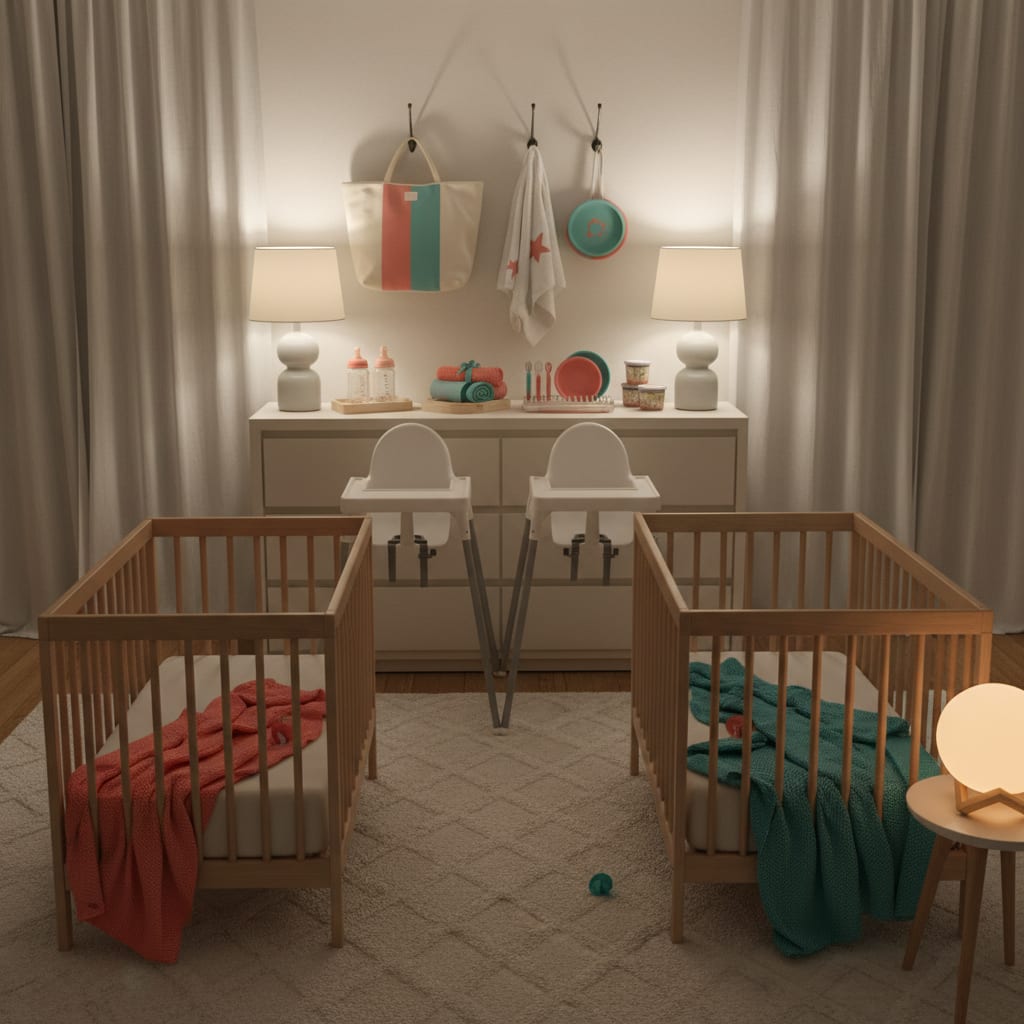
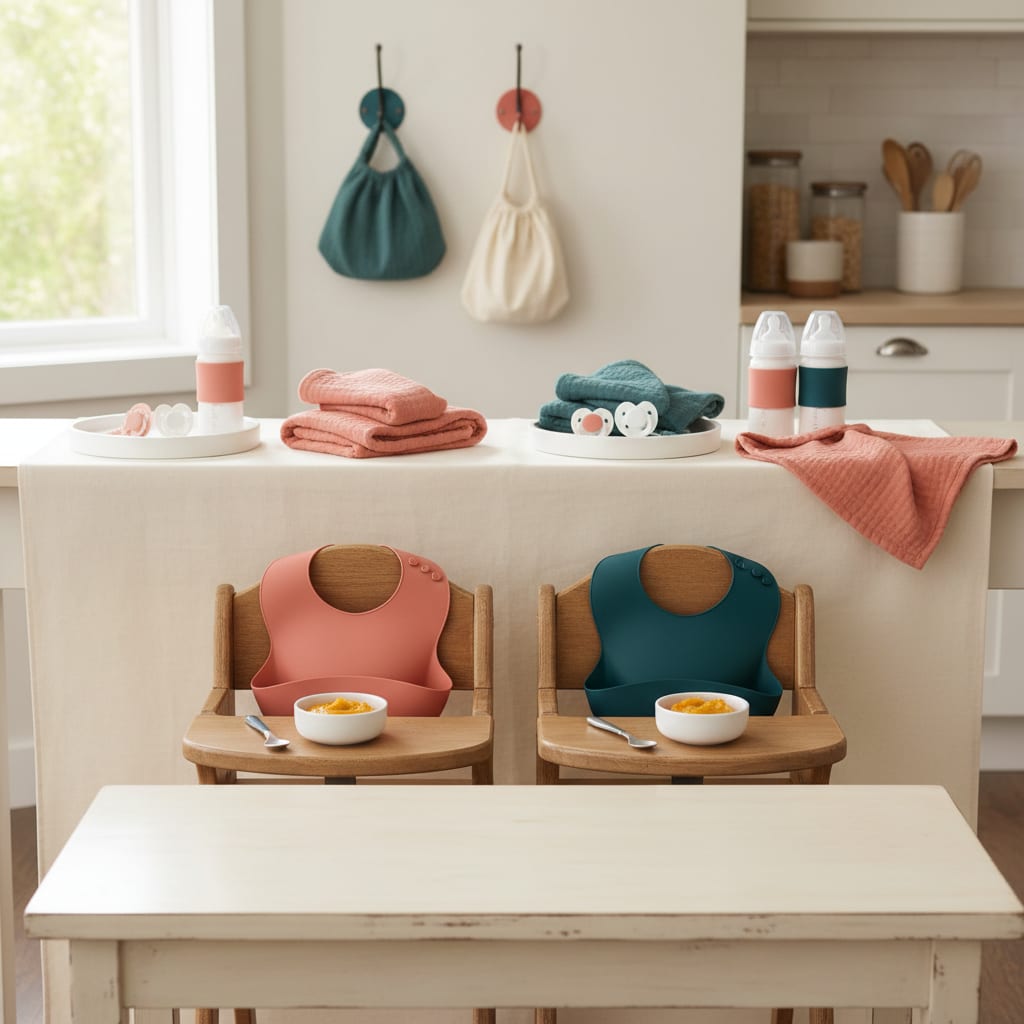
That means two seated, supported, safe spots from day one — a baby eats sitting upright and attended, never reclined, never in a car seat or bouncer, and never unattended with food. Two chairs is one of the genuinely-two-of items on the twin registry checklist, and the flexible answer for small kitchens is a chair that folds or converts, like the Cosco Simple Fold at the budget end. If your kitchen cannot take two full-size chairs, a convertible like the Ingenuity Beanstalk that later becomes a booster at the table buys you a longer runway from the same footprint.
Position the chairs so you can reach both trays without standing up, angled slightly toward each other rather than facing off, and pull them out of the traffic path — a twin who can reach the other twin’s tray will, and a twin who can reach the wall will paint it.
One menu, two portions
The batching principle is the entire twin advantage here: you are cooking once regardless, so cook once, portion twice, freeze the rest.
- Same food, both babies, unless your pediatrician has said otherwise for one of them. Two menus doubles the work for no gain.
- Portion into ice-cube trays or small pots and freeze. A single batch of anything covers a fortnight of one meal for two babies, which is the difference between this being a project and being a routine.
- Pre-load two spoons before you sit down, so you are not loading one while the other baby waits with an open mouth. Two spoons per baby, alternating, is the trick that halves the noise.
- Serve from a bowl you hold, not from the tray, in the early weeks. Suction bowls are excellent later and irresistible projectiles now.
Whether you go with purees, finger foods or both is a real fork in the road, and both work for twins: baby-led weaning means less spoon-juggling and considerably more floor, while a purees-first approach means more spoon work and a cleaner room. Plenty of twin families run both, and running a different approach for each twin is legitimate if one baby clearly prefers one — the food is the same either way.
Allergens, with two babies to watch
This is the part to take slowly and to run through your pediatrician, because guidance on introducing common allergens is specific and has changed within living memory. Ask at the six-month visit, before you start, and follow what they tell you for your two babies.
The twin-specific logistics point, which is not medical advice: you can only watch one baby closely at a time. Many twin families therefore offer a brand-new allergen to one twin at a time — in the morning, at home, on a day when nobody has anywhere to be — and give the co-twin the same food a day or two later. Slower, and considerably calmer than trying to observe two babies simultaneously.
Anything that looks like a reaction is a call to your pediatrician or emergency services, not a thing to search. That applies identically to both babies even if only one is affected.
The mess system
The honest number: two babies on solids produce more cleaning than two babies on milk, and the cleaning is what makes families quit doing it twice a day.
What is worth two of: bibs — full-coverage, long-sleeved, wipeable, four to six of them, because they cycle through the wash constantly. What is worth one of: a splat mat or an old sheet under both chairs, which is the single highest-value purchase in this entire post. What is worth zero of: anything with a “twin” premium attached to it.
The routine that keeps it to ten minutes — wipe trays before you unclip anyone, take both babies out and hose them down in one bath rather than two, then sweep. Do the babies before the floor, always, or you will do the floor twice.
Milk does not stop
For the rest of the first year, solids are added to milk rather than substituted for it. Breast milk or formula stays the main nutrition, and the first months of solids are mostly practice with texture, spoons and sitting up.
For twin households that is genuinely good news, because it means solids do not have to go well to be going fine. Whatever your milk pattern is — nursing, bottles, or the mix most twin families land on — it keeps running on its own schedule, and the honest comparison of those patterns is in the feeding twins guide and combo feeding twins. Slot the solids meal into the existing day rather than rebuilding the day around it; the sequencing logic is the same as in getting twins on the same schedule.
FAQ: starting solids with twins
Should twins start solids at the same time?
Not necessarily. Readiness is per baby, and twins commonly reach it weeks apart. Once both are ready, feeding them at the same time is by far the more sustainable routine — but start each baby when that baby is ready, with your pediatrician’s input.
Do twins need two high chairs?
Yes, once both are eating. Both babies eat at the same time, and one chair with two hungry babies is a stress test nobody needs. Two seated, supported, attended spots is also the safety requirement, not just a convenience.
Can I feed twins solids from the same bowl?
You can serve both babies from one bowl you are holding, and plenty of twin parents do. Once either baby is unwell, use separate bowls and separate spoons — and never re-dip a used spoon into a batch you plan to store.
How do I introduce allergens to twins?
Ask your pediatrician first and follow their guidance for your two babies. Practically, most twin families introduce a new allergen to one twin at a time so there is only one baby to watch closely, then repeat with the co-twin a day or two later.
Do preterm twins start solids later?
Timing runs on adjusted age, counted from your due date rather than the birthday, so preterm twins usually start later than the calendar suggests. Your pediatrician makes that call at the six-month visit.