Twin Nursing Pillows: Which Shape Actually Helps
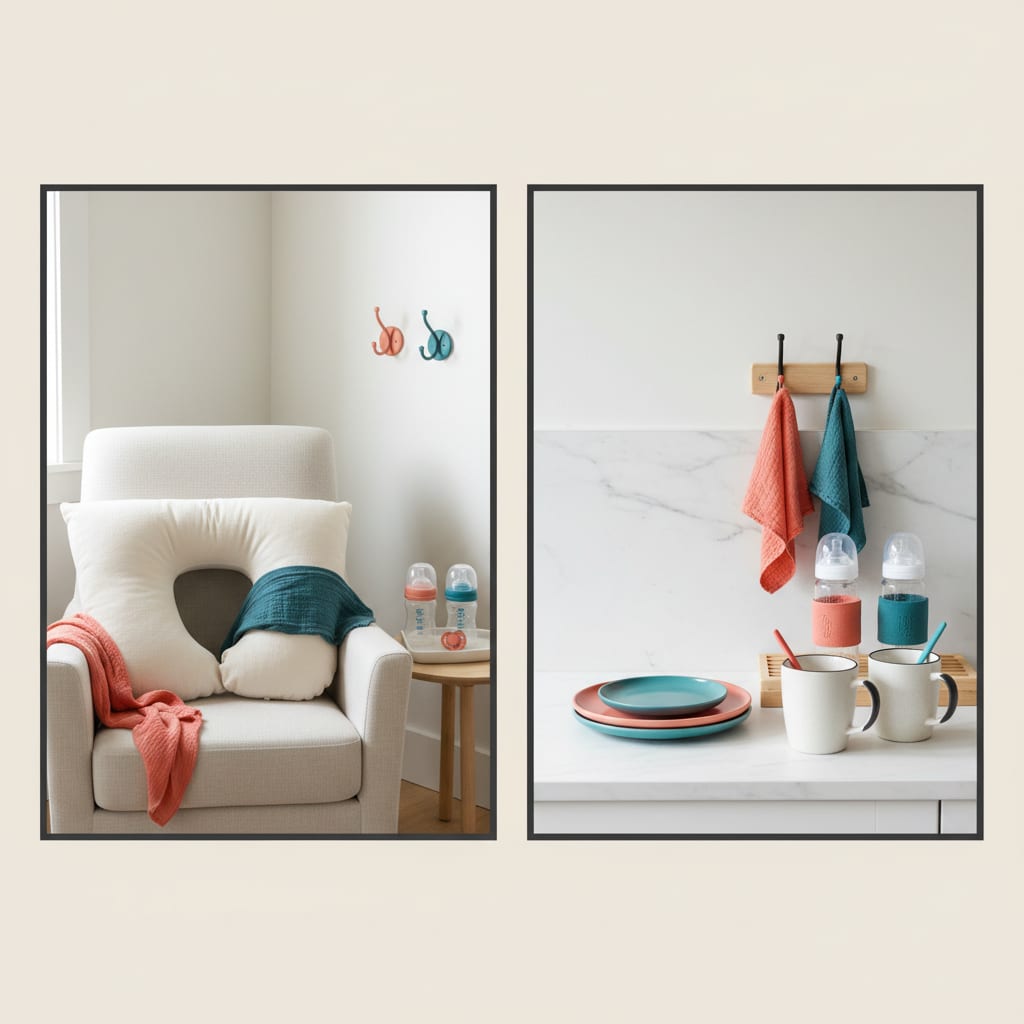
Twin nursing pillows come in three shapes, and the shape decides whether the thing works for you: the wrap-around U, which surrounds your whole torso and sits on the couch with you; the strapped tray, which buckles around your waist as a firm flat platform; and the two-singles workaround, which is what you use when the real pillow has not arrived yet. All three exist to do one job — hold two babies at feeding height with your hands free — and the deciding variables are your torso length, where you feed, and whether you are nursing, bottle-feeding or both. Rough bands below are planning ranges, not quotes.
The three shapes
| Shape | What it does | Suits | Rough band |
|---|---|---|---|
| Wrap-around U | Large foam U that surrounds you; babies lie along both arms of the U | Couch and bed feeding, longer torsos, doubling later as a propped-sitting support | ~$60–$110 |
| Strapped tray | Buckles at your waist as a firm, flat, level platform, often with a back rest | Upright chair feeding, shorter torsos, anyone who wants the platform to stay put when they shift | ~$60–$100 |
| Two single crescents | A stopgap: one baby at a time, or a second adult feeding alongside you | The first days home, travel, grandparents’ house | ~$35–$50 each |
The two standard worked examples are the Twin Z Pillow for the wrap-around U and the My Brest Friend Twins Plus for the strapped tray. This is a shapes roundup rather than a verdict between those two specific pillows — a head-to-head belongs on a review site, and honestly, the two of them lose to each other in different living rooms. A single crescent like the Boppy cannot hold two babies and is not trying to; it is the one-baby-at-a-time tool that most twin households end up owning anyway, because there are always feeds where one adult has one baby.
Fit checks that decide it for you
- Torso length beats brand. The pillow has to bring two mouths up to feeding height with zero hunching from you. Short torso plus a thick pillow means babies arrive above where you need them; long torso plus a thin one means you lean. Try it seated in the actual chair before the return window closes.
- Where you will actually feed. A wrap-around U wants a couch or a bed and a lot of horizontal room. A strapped tray goes where you go — including a dining chair, an armchair with narrow arms, and a hospital bed — because it is attached to you rather than to the furniture.
- C-section recovery. Twins mean a higher chance of a C-section, and a pillow that rests weight on your abdomen is a genuinely bad two weeks. Both twin shapes are designed to keep babies’ weight off you; check where the pillow’s lowest edge lands relative to an incision before you commit.
- Firmness, not softness. Two babies compress a soft pillow into a slope within a minute, and then you are holding heads again. Firm and flat is the entire mechanism.
- Storage. Twin pillows are big. If it will live in the corner of a small living room for six months, look at it with that in mind, because the one that gets put away is the one that stops getting used.
Bottle-feeding on a twin pillow
The twin pillow is not only a nursing tool — it is arguably more useful for bottles, because it is what makes feeding two bottles solo physically possible. Babies are propped in the pillow’s channels, semi-upright, one bottle in each of your hands.
Two rules apply and neither bends. You hold both bottles, always — no propping a bottle against the pillow, a rolled towel or anything else, not for thirty seconds. And both babies stay semi-upright rather than flat, with the bottle angled so the teat stays full. The full solo setup, including how to burp two babies in sequence without losing anyone, is in bottle feeding twins alone.
What the pillow does not fix
A twin pillow solves geometry and nothing else. Painful latch, a twin who consistently feeds worse than their co-twin, slow weight gain and supply questions are all IBCLC and pediatrician territory, and they do not improve because the equipment got better. The positions layer that sits on top of the pillow — double football, cradle-clutch, who latches first — is in tandem breastfeeding twins, and the honest comparison of feeding methods for two is in the feeding twins guide.
One more thing that is not the pillow’s job: sleep. Babies do not sleep on a nursing pillow, not for a nap, not while you close your eyes on the couch during the long cluster-feeding evenings. A baby who falls asleep mid-feed moves to a firm flat surface. Nursing pillows are feeding equipment with a raised, curved shape, which is the opposite of a sleep surface in every respect that matters.
How long you actually need one
The heavy-use window is roughly the first four to six months, when feeds are frequent, long, and involve babies who cannot hold their own heads. It tapers off from there: once both twins sit unsupported and feeds get short and efficient, the pillow starts living behind the couch.
That short window is why buying one pillow is the right call. A second twin pillow is not an upgrade — it is a second large object to store, and there is no feeding position in which one adult uses two of them. If a second adult regularly feeds alongside you, a single crescent is the cheaper and more useful thing to add. Where this sits against the rest of the two-of-versus-one-of decisions is in the twin registry checklist.
What we would skip
Twin pillow bundles sold with covers, straps and accessories at a premium over the pillow plus a spare cover bought separately. Inflatable travel versions, which trade away the firmness that is the entire point. And any pillow marketed with a sleep, lounging or “safe napping” claim attached to it — that claim is a marketing sentence, not a safe-sleep position, and the answer is the same as it is everywhere else on this site: firm, flat, bare, own surface.
FAQ: twin nursing pillows
Do you really need a twin nursing pillow?
For sustained tandem feeding, effectively yes. A single-baby crescent cannot hold two babies at feeding height, and holding two heads statically for hours a day is not something forearms do. It is one of the few genuinely twin-specific purchases that earns its money immediately.
Can you use a twin pillow for bottle feeding?
Yes, and it is one of the best uses for it — it is what makes feeding two bottles with one adult workable. You hold both bottles the whole time, both babies stay semi-upright, and nothing gets propped.
Which twin pillow shape is better?
Neither, universally. The wrap-around U suits couch and bed feeding and longer torsos; the strapped tray suits upright chairs, shorter torsos and moving around mid-feed. Sit in your actual feeding spot with it before the return window closes and let that decide.
Do you need two twin nursing pillows?
No. One pillow serves both babies simultaneously — that is its whole design. If another adult feeds alongside you, add an inexpensive single crescent rather than a second twin pillow.
When should you buy it?
Before the babies come home, and ideally by around 30 weeks, because twins arrive early often enough that late deliveries genuinely miss the birth. Keep the packaging and the receipt until you have fed in your own chair.