Twin Hospital Bag: What's Different With Two
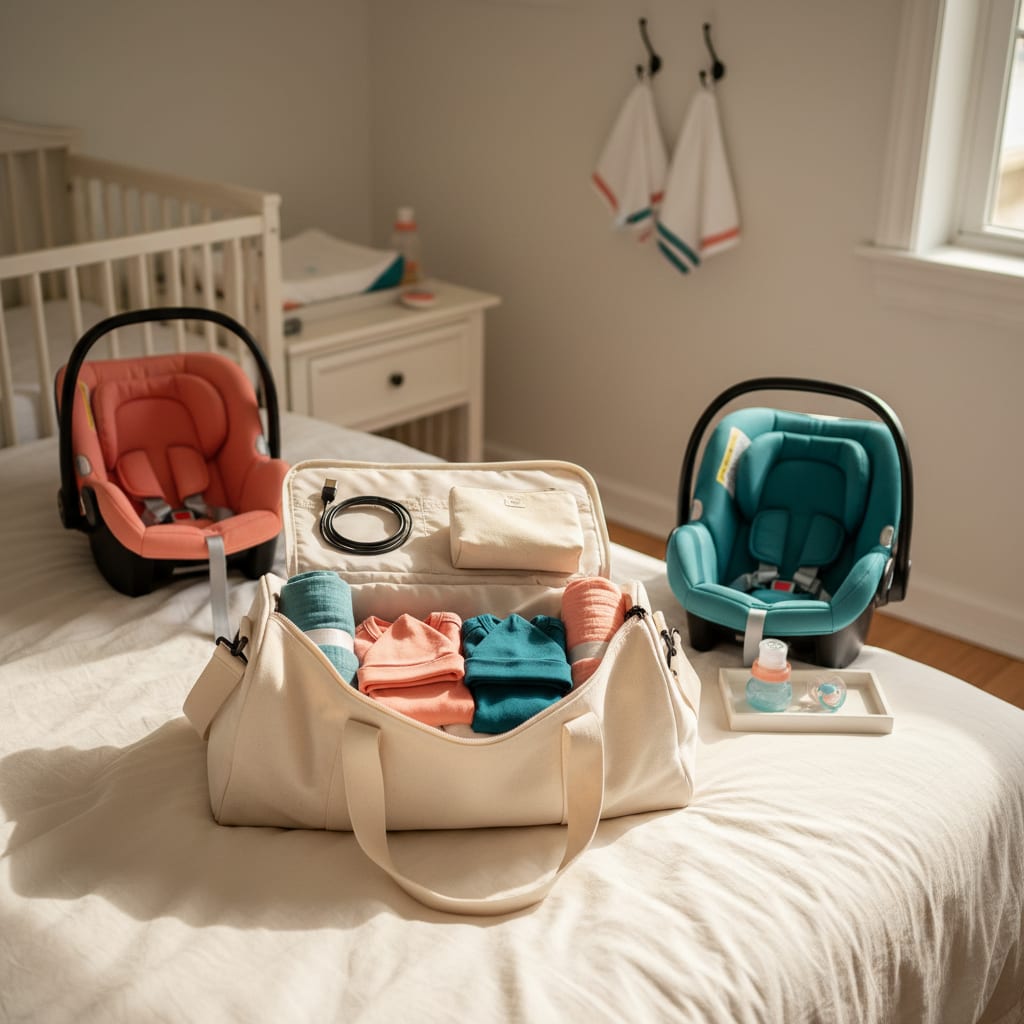
A twin hospital bag is a singleton hospital bag with four changes: it gets packed earlier, it gets packed for a longer stay, it holds two of exactly four things (going-home outfits, hats, sets of newborn mittens, and the car seats — installed, not packed), and it assumes you might be discharged on a different day than one or both babies. Everything else on a standard list stays the same. That’s the whole difference, and the reason to know it now is that a twin bag sitting by the door at 30 weeks is worth more than a perfect bag packed at 36.
Two hedges before the list, because this is a pregnancy page. Twin pregnancy is managed as a higher-risk pregnancy and the timing questions here — when to pack, how long a stay to plan for, what your hospital does with multiples — are questions for your OB or MFM, who knows your specific pregnancy. Nothing below is medical advice; it is packing.
Pack it earlier than a singleton bag
The standard singleton advice is to have a bag ready in the mid-to-late thirties. Twin parents are commonly told to have theirs done considerably earlier, because twins arrive earlier on average — ask your own OB where they want your line to be, and treat their number as the real one.
What that means practically: the bag is a third-trimester project, not a 36-week project. Get the boring parts done at the point in the pregnancy where you can still bend, stand and drive comfortably, because with twins the last stretch is physically shorter and heavier than the singleton version. Ours sat by the door for six weeks and did nothing, which is exactly what a hospital bag is supposed to do.
What actually goes in: the twin bag list
Print this page and use it as the checklist — the “two?” column is the only one that behaves differently from a singleton list.
| Item | Two? | Twin note |
|---|---|---|
| Going-home outfits | Two | Pack newborn and preemie size in both — twins are often smaller than expected |
| Hats and mittens | Two | Hospital ones are fine; matching is optional and nobody will judge |
| Swaddle blankets | Two | Or use the hospital’s and save the space |
| Infant car seats | Two, in the car | Installed and checked beforehand, never packed in a bag |
| Your own clothing | Singleton amounts, extra days | Plan for more days than a singleton stay, plus one |
| Toiletries and glasses | One set | Glasses, charger, lip balm — the three most-missed items |
| Long phone charging cable | Two cables | One for the bed, one for wherever you end up sitting |
| Nipple cream | One | If you plan to nurse, having your own is worth it from hour one |
| Snacks | Double | Two babies, two feeds, twice the 3am hunger |
| Nursing or feeding pillow | Leave at home | Bring it later if the stay is long; hospitals have pillows |
| Documents and IDs | One folder | Insurance, ID, hospital paperwork, birth preferences |
| Coming-home bag for the car | One | So the trunk isn’t full when two car seats go in |
Nipple cream is the one small item worth having in your own bag rather than hoping for: a Lansinoh lanolin tube is the standard version and takes up no room. Everything else on the list is either the hospital’s job or genuinely fine bought later.
The car and the second adult
Two things happen in the parking lot rather than the bag, and both are twin-specific.
Both car seats installed and checked before you pack. Two bases, two installs, and a back seat that has to accommodate them alongside anyone else who rides in that car — this is a measuring problem for some vehicles, and finding out at discharge is the worst possible time. Many fire departments and hospitals run free installation checks; book one.
Decide who drives and who stays. A twin discharge is a two-adult job in practice: two seats to buckle, bags, paperwork, and often a wheelchair. If your partner is also the one managing an older child at home, that’s a conversation to have now rather than in the hallway.
Pack for the possibility of separate discharge days
Twins are more likely than singletons to spend time in a NICU or special-care nursery, and one twin can be ready to leave before the other. This is a logistics fact rather than a prediction, and packing for it costs almost nothing.
- A bag that works when you’re not in the same building as your babies. Comfortable clothes for long days in a chair, a water bottle, your own pillow, and a charger with a long cable.
- Parking and access details for the unit, written down or in your phone before you need them.
- A plan for milk transport if you’ll be pumping and travelling between home and hospital — a small cooler in the car covers it.
- A sibling plan with two backups if you have older children, because a longer stay is the scenario that breaks the first plan.
Everything about your babies’ actual care in that situation belongs with your neonatal team, and the single most useful question to ask them is the discharge one: what happens at home, and what changes if one twin comes home first.
The stuff you can skip
Twin bags get overpacked because two babies feels like it should mean two of everything. It mostly doesn’t. Skip the bottles and formula (hospitals have both, and their supply is what you’ll be shown how to use), skip the diapers and wipes for the stay, skip the second pillow, skip anything you’d have to guard, and skip the elaborate photo props. The gear that actually matters for the first fortnight is at home already if you’ve worked through the twin registry checklist, and the rest of the third-trimester setup lives in preparing for twins.
FAQ: twin hospital bag
When should you pack a hospital bag with twins?
Earlier than the standard singleton advice — twin pregnancies more often end earlier, so the bag wants to be done well before the point where a singleton parent would start. Your OB’s number for your pregnancy beats any number from the internet, and it’s a question worth asking outright at an appointment rather than assuming.
Do you need two of everything in a twin hospital bag?
No. Two going-home outfits, two hats, two sets of mittens, two swaddles if you’re bringing your own — and two car seats installed in the car. Everything else is a singleton quantity, and the bag is easier to carry for it.
What should be in a twin hospital bag that isn’t in a singleton one?
Realistically: preemie-size going-home clothes as well as newborn, a longer stay’s worth of your own clothing, a second charging cable, and a small kit for the possibility of travelling back and forth to a special-care nursery. The rest is the same list.
How long do you stay in hospital with twins?
That depends entirely on how the birth goes and on both babies, so it’s a question for your care team rather than a number to plan around. Packing for a few days longer than a singleton stay is a reasonable default, and a partner can always bring more from home — which is the actual answer to most “did I pack enough” anxiety.
Should the car seats go in the bag?
Never. They go in the car, installed and checked, before the bag is finished — and with twins that install is a genuine measuring exercise. Get it done early enough that a different seat model is still an option if the two don’t fit your back seat side by side. What each seat should be is covered in expecting twins: what changes.