Twins Sharing a Room With an Older Sibling: Week One
Plan the move as a bad week rather than a bad night. Put the twins down in the new room first, in the dark, on their own separate surfaces; bring the older child in afterwards on quiet feet; run one sound source, one wake time, and keep every other variable — sacks, order, words, timings — exactly as it was the night before. Expect two or three genuinely broken nights. Judge the arrangement at day ten to fourteen, not day two. If somebody is still losing an hour a night by then, undo it for a month and try again.
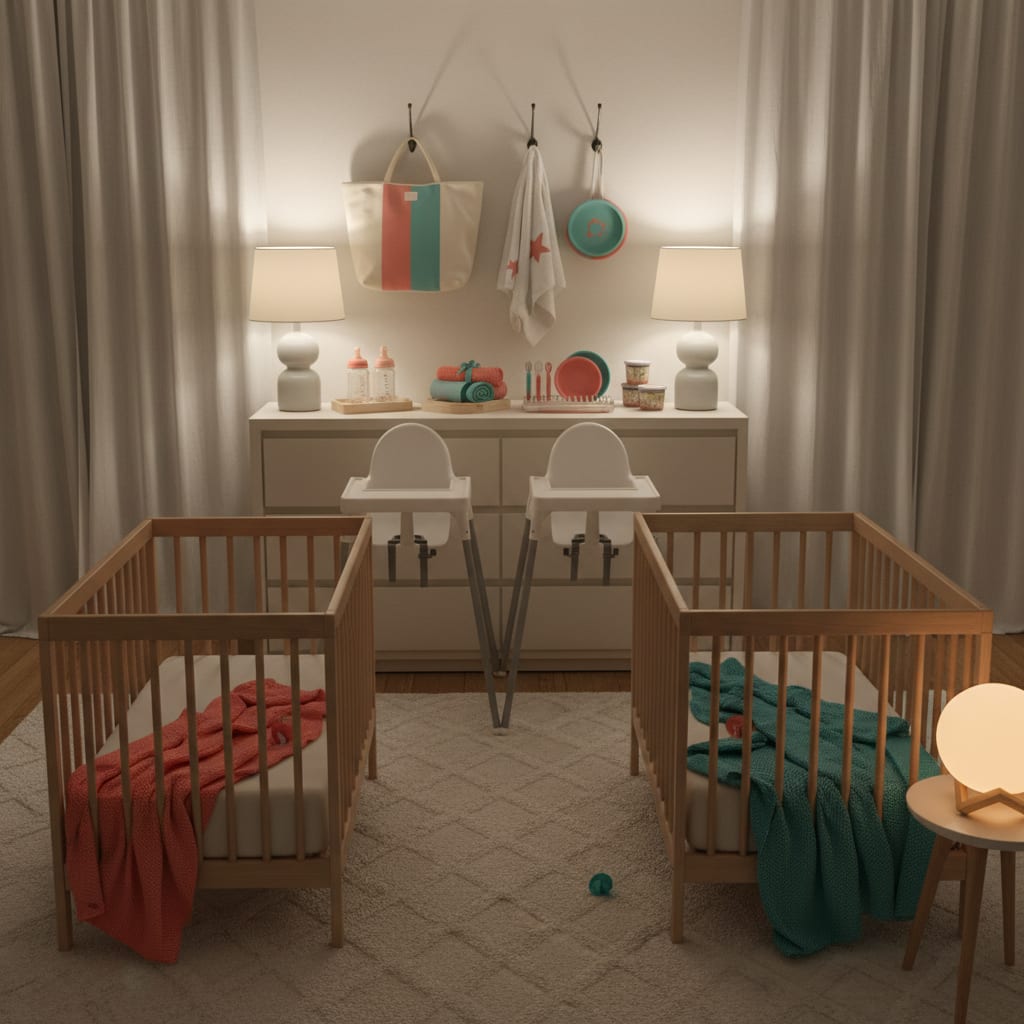
One thing up front, because it should change how you read this: my twins are my only children, so I have never run this move myself. What I can do is the twin half of it — the arithmetic and the staggering, the part that makes three-in-a-room different in kind from two.
Three sleepers, six ways to be woken
It is harder than adding a baby to a sibling’s room, and the reason is pairs, not effort. Two children in a room is one pair to manage. Three is three pairs, and because waking runs both ways, six paths — including the expensive one, where the big sibling wakes A or B. When a five-year-old gets up at 5:40am for the bathroom, a singleton family loses one child’s morning; you lose two at once, and the two you lose cannot be told to go back to bed.
Two of your three sleepers run on one clock and the third does not: the older child has a later bedtime, a longer routine, a reading light, and maybe a wake time somebody else sets. You are not merging two schedules — you are running both inside one set of walls.
Set the room up before anybody sleeps in it
Change the address and nothing else. Each item here removes a variable rather than adding a trick.
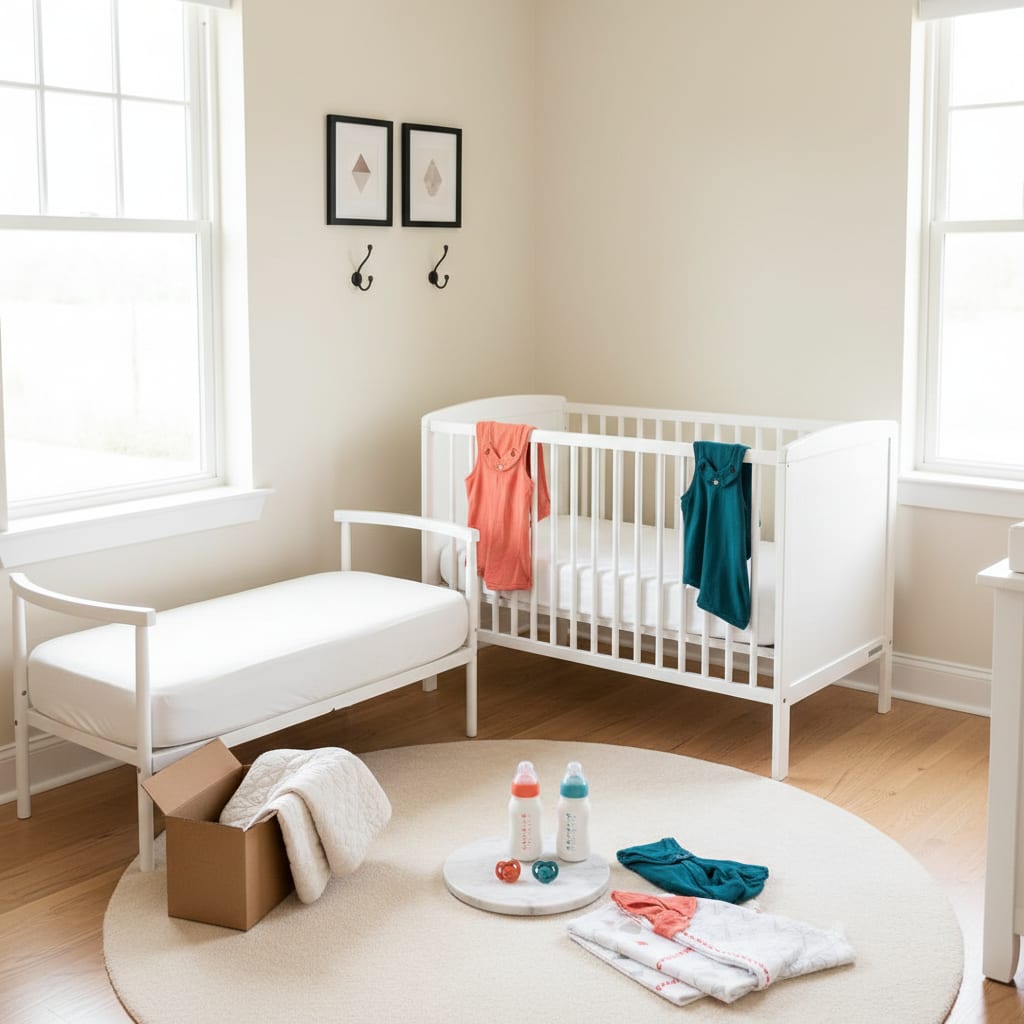
- Own sleep surface each. Three children in a room is three surfaces. The AAP’s parent guidance is blunt about the exception people ask for here: “The AAP recommends that parents avoid bed sharing with their baby under any circumstances, including with twins and other multiples.” The same page asks you to “share a room with your baby for at least the first 6 months of life” — a reason not to move a young baby down the hall at all yet. If the move is forced by the twins outgrowing what they sleep in now, the triggers and timing are in when twins outgrow the shared crib.
- One sound source, not three. A single white-noise machine roughly between the cribs and the big sibling’s bed — two machines means two volumes you keep raising against each other. We run a Yogasleep Dohm Classic: a fan in a box, so one broad sound rather than a loop with a seam in it, and nothing to adjust at 2am.
- Deal with the window, not just the lamp. The awkward hour is the one where a five-year-old wants light and two babies need dark. Fixing the window buys you that lamp; a portable blackout panel on suction mounts does it without drilling into a room you might undo in a fortnight.
- Sightlines beat distance. If the twins can see each other standing up they perform for each other, and a big sibling in a crib’s eyeline becomes the show. A bookcase turned end-on beats another two feet of floor.
- Spend one variable. Do not run this alongside a swaddle exit, a bed conversion or a nap drop.
The staggered-entry bedtime for week one
Babies in first: their bedtime is already fixed, and they cannot be reasoned with.
A worked evening: twins into the room at 7:00, dark, sound on, door shut. The older child’s whole routine — bath, books, the long negotiation — happens somewhere else, finishing about 7:35. They come in on quiet feet at 7:40, to a room already asleep, one whispered goodnight, no lamp. Around night four or five, once the babies settle in under ten minutes, move the tail of the routine back in: one book, low lamp, ordinary speaking voice. That is the arrangement you actually want, and it is worth arriving at slowly.
The inversion — older child settled first, twins carried in after — suits one family only: a big sibling who falls asleep fast and hard, with one parent doing bedtime alone.
The anchor that does not move
Keep the shared wake time exactly where it was, whatever the bedtime end does. That fixed point stops a bad week becoming a drifting fortnight, and it is the same anchor that contains an offset clock — that version of the problem is in split twin bedtimes. Paying for a bad night with a late morning buys you a second one.
What a normal bad week looks like
- Nights one and two: long settles, a full-room waking, and a strong feeling this was a mistake. That is novelty, not evidence.
- Nights three and four: usually the worst, and usually when somebody suggests a living-room mattress. Night four is when the room learns its rules.
- Nights five to seven: settles shorten and wakings stop being simultaneous, which means the room is no longer one organism.
- Days eight to fourteen: this is your data — total night wakings and morning mood per child, not how you feel at 5am.
You are now running three sleep plans in one room, which is where averaging them looks tempting. Betteroo’s quiz-built plans are built one child at a time from age, temperament and schedule, so you run it per baby rather than writing one compromise that suits neither. Honest limits: it is a planning tool, it cannot tell you whether these three should share a room, and waking driven by teeth, illness or reflux belongs with your pediatrician.
Undoing it is a setting, not a defeat
At day fourteen, undo the move if any of these hold: one child is consistently losing an hour or more against their own baseline, the older child is anxious about bedtime in a way they were not before, or somebody wakes somebody every night in a settled pattern.
Undo it for four to six weeks, not three days — a two-day retreat teaches everyone that crying relocates people. Then retry, changing exactly one thing. That reverse decision and the two-week trial that tests it are in when to separate twins for sleep; the same-room fundamentals your twins already rely on are in sleep training twins in the same room.
The child who was there first
None of the above decides whether this holds; the older child does. They are losing a private room to two people who cannot be negotiated with, usually told about it in the same sentence as “you’re such a big help”. Give them something concrete: a shelf that is theirs and out of reach, a veto over one item of the setup, the room to themselves by day.

FAQ: twins moving in with an older sibling
How old should twins be before they move in with an older sibling?
There is no correct age, but there is a floor: the AAP asks you to keep a baby sleeping in your room for at least the first six months, so a move before that is not the plan to be making. After that it depends less on the babies’ age than on the older child’s sleep, since they are the one who can be woken and cannot nap it off at 9am. For the one-baby version of the argument, Betteroo’s write-up on whether the room itself changes anything is a reasonable primer.
Do we need two white-noise machines now there are three of them?
No. One room, one sound source, placed between the sleepers.
Only one twin has settled in the new room. Is that normal?
Yes, and it is the most common outcome by a distance. Do not move the unsettled twin out on night three: give it the full fourteen days, change one variable at a time on that baby only, and keep the room’s shared elements fixed.
Should we put the twins back in one crib to save space?
No. Three children in a room is three separate surfaces, and the AAP guidance quoted above names multiples explicitly. If the room cannot take two cribs plus a bed, the answer is different furniture, not a shared surface.