RSV Season With Twins: Coughs, Stuffy Noses, Bad Nights
RSV usually behaves like a cold, but in young babies it can turn into a chest infection. Twins have two extra problems: they are more often born early, which raises the risk, and they share a room, so the second twin has usually been exposed by the time the first is coughing. Call your pediatrician right away for fast or labored breathing, pauses in breathing, grey or blue lips, or far fewer wet diapers. At home, clear noses before feeds, keep feeds small and frequent, and keep both babies sleeping flat on their backs in their own beds. This page is logistics, not diagnosis.
What RSV looks like in a baby
The AAP’s parent page, RSV: When It’s More Than Just a Cold, says almost all children catch RSV at least once before age 2, and that “for most healthy children, RSV is like a cold.” It starts as cough, congestion, runny nose, fussiness and poor feeding. In some babies it moves into the small airways (bronchiolitis): fast breathing, flaring nostrils, grunting, wheezing, or the skin between the ribs pulling in with each breath.
The AAP says symptoms are “typically at their worst on days 3 through 5” and last 7 to 14 days on average, and the NHS bronchiolitis page says the cough “usually gets better in 3 weeks.” A lingering cough is not on its own a bad sign. Harder breathing is.
The CDC’s page on RSV in infants and young children notes that under 6 months, symptoms can be just irritability, less activity, eating less or pauses in breathing, and “many infants will not have a fever.”
Why twins sit higher on the risk list
The CDC lists the children at greatest risk of severe RSV: the youngest infants (“the younger the age, the higher the risk”), children born prematurely, and children with chronic lung disease or heart disease present from birth. Twins tick the prematurity box far more often than singletons: ACOG’s multiple pregnancy FAQ says more than half of all twins are born preterm. If either twin spent time in the NICU or went home with a lung diagnosis, say so first whenever you call. And judge each twin separately: one may have needed far more NICU support than the other.
When to call, and when to go now
The AAP says to call your pediatrician right away if a child has signs of bronchiolitis, signs of dehydration (“fewer than 1 wet diaper every 8 hours”), pauses or difficulty breathing, pale, grey or blue skin, lips or nail beds, or is much less active and alert. Call too for a fever of 100.4°F or higher under 3 months, or symptoms not improving after 7 days.
Go now (911 or the emergency room) for the NHS’s emergency signs: grunting, the tummy sucking in under the ribs, pauses in breathing, blue or grey skin, tongue or lips, or a floppy baby who will not stay awake.
The twin trap: two babies with runny noses look the same from the doorway. Watch breathing and count wet diapers for each baby separately. A per-baby column in the A|B feeding and sleep log keeps one twin’s diapers from blurring into the other’s.
Feeding two stuffy babies
A blocked nose makes feeding hard, because babies breathe through their noses while they suck. The AAP’s comfort list is short:
- Saline and gentle suction before feeds. A few drops of sterile saline such as Little Remedies saline spray and drops, then a gentle aspirator like the NoseFrida. The AAP suggests suctioning “before trying to breast or bottle-feed.”
- A cool-mist humidifier in the room, which the AAP names to help break up mucus, such as the Crane ultrasonic cool-mist humidifier.
- Smaller feeds, more often. The NHS suggests “smaller feeds more often in babies.” The AAP says breastfed babies do not need extra water or formula, and that expressing milk into a cup or bottle is an option if nursing gets hard.
- No cough and cold medicines, and no aspirin. Any fever medicine, and the dose, comes from your pediatrician, because age limits apply and preterm twins are counted by adjusted age.
Tandem feeding can wait; the bottle-feeding twins alone setups work one baby at a time. Never prop a bottle, least of all for a coughing baby.
Sleep: flat, on the back, one baby per bed
Every instinct says to prop a stuffy baby up. Don’t. The AAP’s parent guide to safe sleep says “any surface that inclines more than 10 degrees isn’t safe for your baby to sleep on,” and that a baby who falls asleep in a car seat, swing or carrier should be moved to a firm, flat surface on their back as soon as possible. Betteroo’s note on keeping sleep safe through an illness makes the same point: the rules do not change because a baby is sick.
Upright time while awake is fine: the NHS advises keeping a child “upright as much as possible when they’re awake.” Put them down flat when sleep comes.
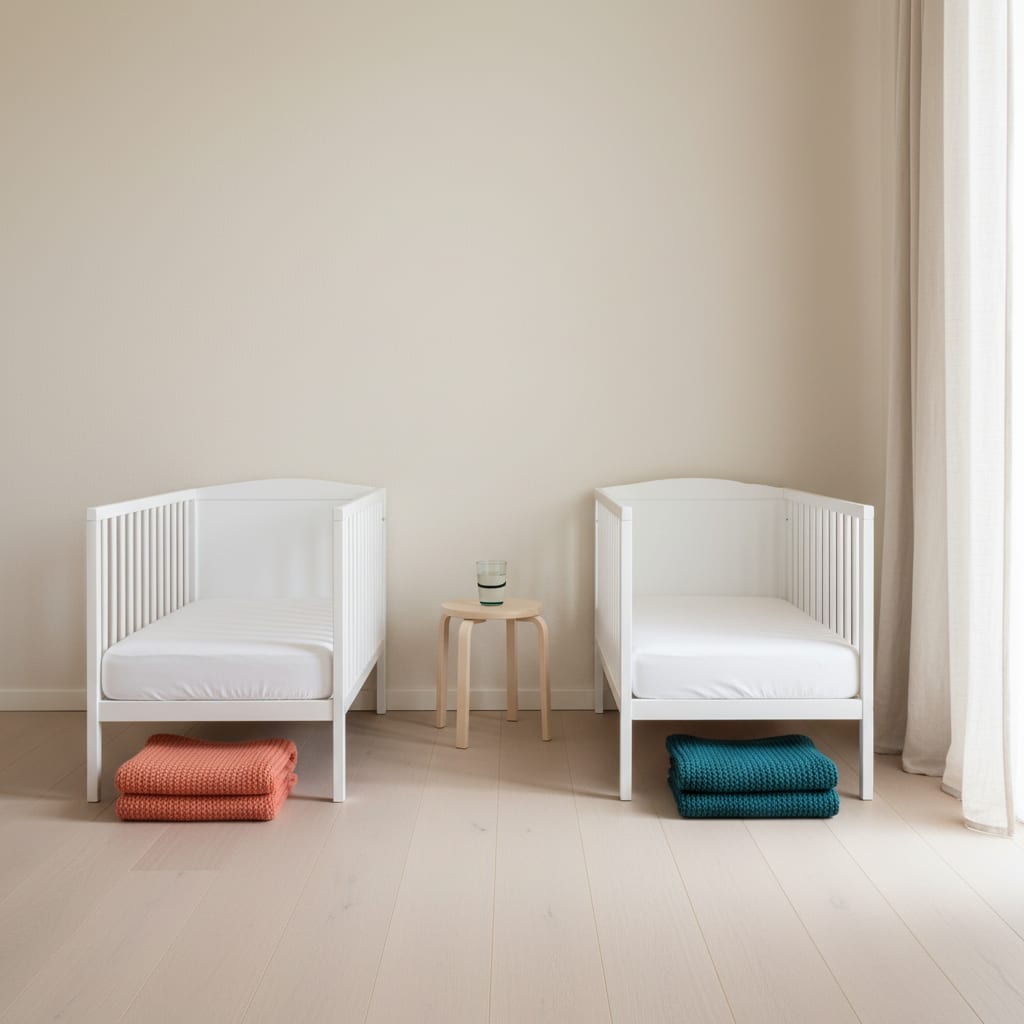
Twins already sleep one per bed under the AAP rule (the full set is in safe sleep for twins), and that matters more now. The CDC’s page on how RSV spreads says it “can survive for many hours on hard surfaces, such as tables and crib rails,” and that some infants can keep spreading it “for 4 weeks or longer.” You can still cut down on what passes back and forth:
- Space the cribs as far apart as the room allows, and keep shared toys out of both beds.
- Wash hands between babies, not just between diapers. The NHS lists washing hands often, wiping toys and surfaces, and not sharing cups and spoons.
- Keep each twin’s things separate: pacifiers, bottles, burp cloths and the saline tip, with coral for A and teal for B if you already colour-code.
- Moving the well twin into your room for a few nights is reasonable, as long as that baby keeps their own flat, bare sleep space.
The nights themselves
Expect wakes from both, out of sync, for about a week. With two adults, split the night by baby. Check on a sick baby regularly through the night, as the NHS advises, and write down what you see: “breathing faster since 2 a.m., one wet diaper since midnight” gets a twin seen quickly. Coughing that wakes the other twin is temporary; the fixes in twins waking each other up are for after both are well.
Once both are better, sleep can stay broken: extra night feeds that started while they were sick, and a twin who now expects to be held.

Betteroo costs about $20 a month and is a planning tool, not a medical one. Start it once the pediatrician is happy with both babies.
Prevention to ask about before the season
There are two ways to protect a baby from severe RSV, and the CDC’s page on protecting infants says “most babies do not need both”:
- A maternal RSV vaccine during pregnancy, given at 32 to 36 weeks, recommended in most of the US from September through January. Twins often come early, so ask about timing at your next prenatal visit.
- An infant RSV antibody (nirsevimab or clesrovimab). The CDC recommends it for all babies younger than 8 months whose mothers did not get the maternal vaccine, given shortly before the season or within a week of birth for babies born October through March. The AAP notes it can be given in the hospital at birth. Some higher-risk children aged 8 to 19 months, including those born prematurely with chronic lung disease, can get nirsevimab before a second season.
Ask your OB or pediatrician which fits, naming both twins, since a NICU stay can change the answer for one.
FAQ: RSV and twins
If one twin has RSV, will the other get it?
Often. Twins share a room, hands and toys, and the CDC says RSV survives for hours on hard surfaces like crib rails. Separate beds, handwashing between babies and separate bottles and pacifiers still help. Watch the second twin’s breathing and diapers from day one.
Can a congested baby sleep propped up?
No. The AAP says any sleep surface inclined more than 10 degrees is unsafe, and a baby who falls asleep in a seat or swing should be moved to a flat surface. Clear the nose before sleep instead.