When Twins Outgrow the Shared Crib (and What's Next)
There is no universal age at which twins outgrow a shared crib, and the honest starting point is that safe-sleep guidance never puts them in one: the AAP and the NICHD Safe to Sleep campaign both give every baby their own firm, flat, bare sleep surface, from the first night. If your twins are currently sharing a bassinet or crib — plenty of families do in the early weeks, most of them having arrived there at 4am rather than by decision — the hard stop is mobility. The moment either baby can roll, push up or reach across, the shared surface ends that night. The rest is timing, logistics, and the fact that with twins these triggers arrive twice.
What the guidance actually says
Short version, because the full ruleset lives in safe sleep for twins: one baby per surface, on the back, on a firm flat mattress with nothing in it but a fitted sheet, in the parents’ room for at least six months. The NICHD’s safe sleep environment — firm, flat, level, covered only with a fitted sheet — has no version that accommodates a second baby, and the AAP’s parent guide to safe sleep addresses multiples directly.
So the guidance answer is before it starts, and the practical answer — the one families already co-bedding need — is which specific thing says it has to end tonight. Nothing below replaces your pediatrician, and if your twins came home from a NICU that practised supervised co-bedding, that handover conversation belongs with your neonatal team.
The four triggers, in order of urgency
1. Mobility — the non-negotiable one. Rolling, pushing up on the arms, scooting, or a baby who can get a limb across the mattress. Two babies who can move are two babies who can end up face-down against each other, and “they’ve always been fine” doesn’t change what’s newly possible tonight. Most babies start rolling in the three-to-six-month range, with a wide normal spread and adjusted age for preterm twins — but the trigger is the first sign in either baby, not an age on a chart. The same signal ends swaddling, per baby; that timing is in swaddling twins.
2. Size and the manufacturer’s limits. Every bassinet, cradle and play yard states a weight limit and a “stop using when baby can push up on hands and knees” line, and those limits are written for one occupant. Read the actual manual for the product you own — the numbers vary genuinely between models, and this is not a spec to estimate.
3. The room-sharing window. Around six months (adjusted for preterm twins) the recommendation to keep babies in the parents’ room has been met, and many families reorganise everything at that moment. A checkpoint, not a deadline — plenty room-share for longer.
4. Sleep quality. Two babies waking each other in a shared surface is the trigger families notice first and act on last — and it’s an argument for two surfaces, not two rooms. The room question has a different threshold, covered in when to separate twins for sleep.
The twin-specific part: it happens per baby
Here’s what singleton advice can’t tell you. These triggers arrive per baby, and twins hit them weeks apart. Baby A rolls at nineteen weeks; Baby B is still a beautifully immobile loaf at twenty-four.
Two consequences. The earlier twin sets the deadline for both — if one baby can roll and they share a surface, that surface is over for both of them, tonight. And you’ll run the transition twice anyway: once out of the shared surface, then again when the second twin outgrows their own bassinet by size.
And the twin who moves first isn’t being punished; the one who stays isn’t favoured. Try not to let a five-week gap in rolling become a story about which baby is “ahead” — the label outlives the phase.
What the next setup looks like
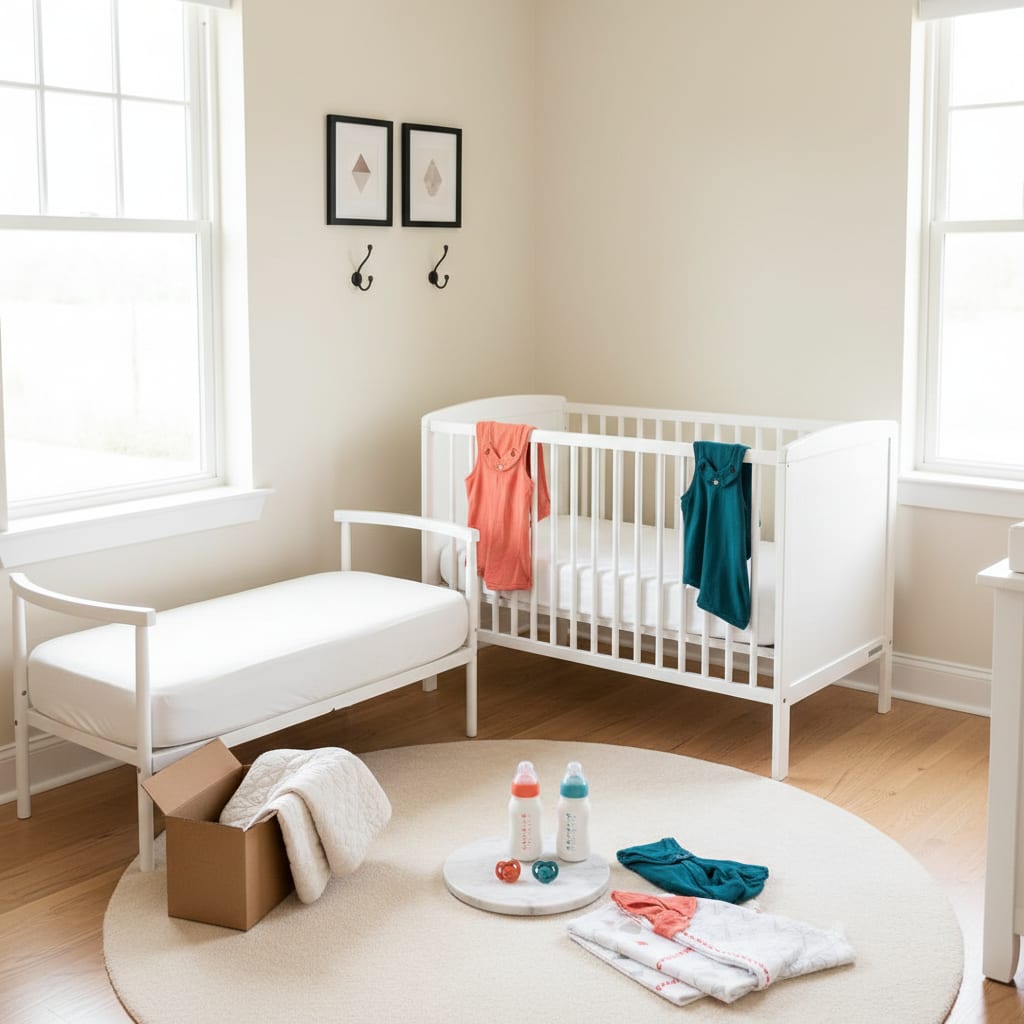
You need a second legitimate sleep surface, and it doesn’t have to match the first.
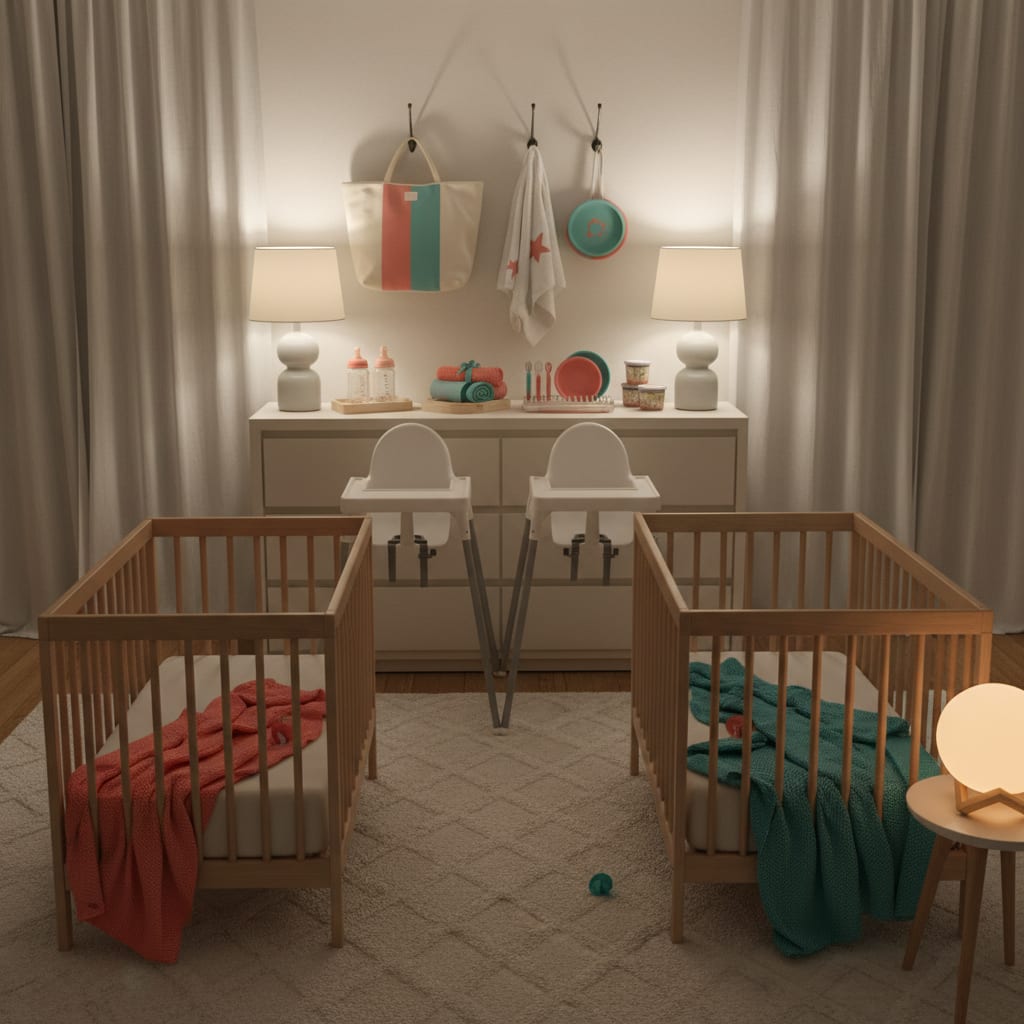
- Two cribs, if the floor space exists. Heads apart in a tight room buys noise separation for free.
- A crib plus a play yard — the cheapest real answer, and what most families reach for at short notice. A portable crib meeting current safety standards is a proper sleep surface, not a compromise: a Graco Pack ‘n Play is the common worked example.
- Two bassinets side by side, if you’re inside the room-sharing window and both babies are under the limits.
- A crib in your room. Unglamorous, and often the fastest route to two compliant surfaces tonight.
What doesn’t count, however it’s marketed: crib dividers, mesh separators, in-crib nests and any insert promising to make one crib into two. Nothing goes in the sleep space but a fitted sheet and one baby.
The three-night transition, run twice
Move it like any other sleep change — one variable, read the result late. Same room, same bedtime, same routine; only the surface changes. Do it at bedtime rather than at a 2am waking. Then give it three or four nights: nights one and two are noise, and many twin families find sleep improves once each baby has their own space, because there’s no second body to be jostled by.
If wakings look contagious afterwards, run the three-night audit in twins waking each other up before concluding they need separate rooms — the variable is often the adult walking in, not the co-twin.
Where a per-child plan actually earns its keep
The pain here is that the trigger fires for one baby and the plan has to change for two — two babies needing different things at the same bedtime, from one pair of hands. That’s the narrow problem a per-child sleep plan is shaped for: a short questionnaire about one baby’s age, temperament and schedule returns a day-by-day plan for that child, so you run it twice and get two plans rather than one average. Balanced take: it’s a planning tool at roughly $20 a month, it won’t do the 2am part, and a twin whose sleep is driven by reflux, illness or teeth needs a pediatrician instead.

Adjusted age, and when to ask someone qualified
Twins are more often born preterm, so read every age here on adjusted age, counted from your due date. A pair born at 33 weeks may reach the rolling window closer to six months of life than four, and a family watching the calendar rather than the baby looks in the wrong month.
Ask your pediatrician — not a blog — if either twin has reflux managed with positioning, came home on monitoring, is weight-checked, or has any breathing concern.
FAQ: twins outgrowing a shared crib
At what age do twins have to stop sharing a crib?
There isn’t one. Current guidance gives each twin their own surface from birth rather than setting an age to stop sharing. If twins are sharing, the practical hard stop is the first sign of rolling or pushing up in either baby — for most, somewhere in the three-to-six-month range on adjusted age.
Is it safe for newborn twins to share a bassinet?
It isn’t what the AAP or NICHD recommend. Each baby gets their own firm flat surface, even in the newborn weeks when two babies physically fit. Same room, separate surfaces.
Do twins sleep worse once they’re in two cribs?
Usually not, and often better — most families report a night or two of adjustment, then improvement, because neither baby is being nudged or startled by the other.
Can we keep twins in one crib if they’re not mobile yet?
The recommendation is one baby per surface regardless of mobility, so this isn’t an exception the guidance grants. Mobility is where the risk becomes most immediate, not where it starts.
What about co-bedding twins in the NICU — isn’t that the same thing?
No. Some units practise supervised co-bedding under continuous monitoring with staff present, for specific clinical reasons. That’s a monitored hospital setting, not a home instruction — ask your neonatal team what they recommend once you’re home.