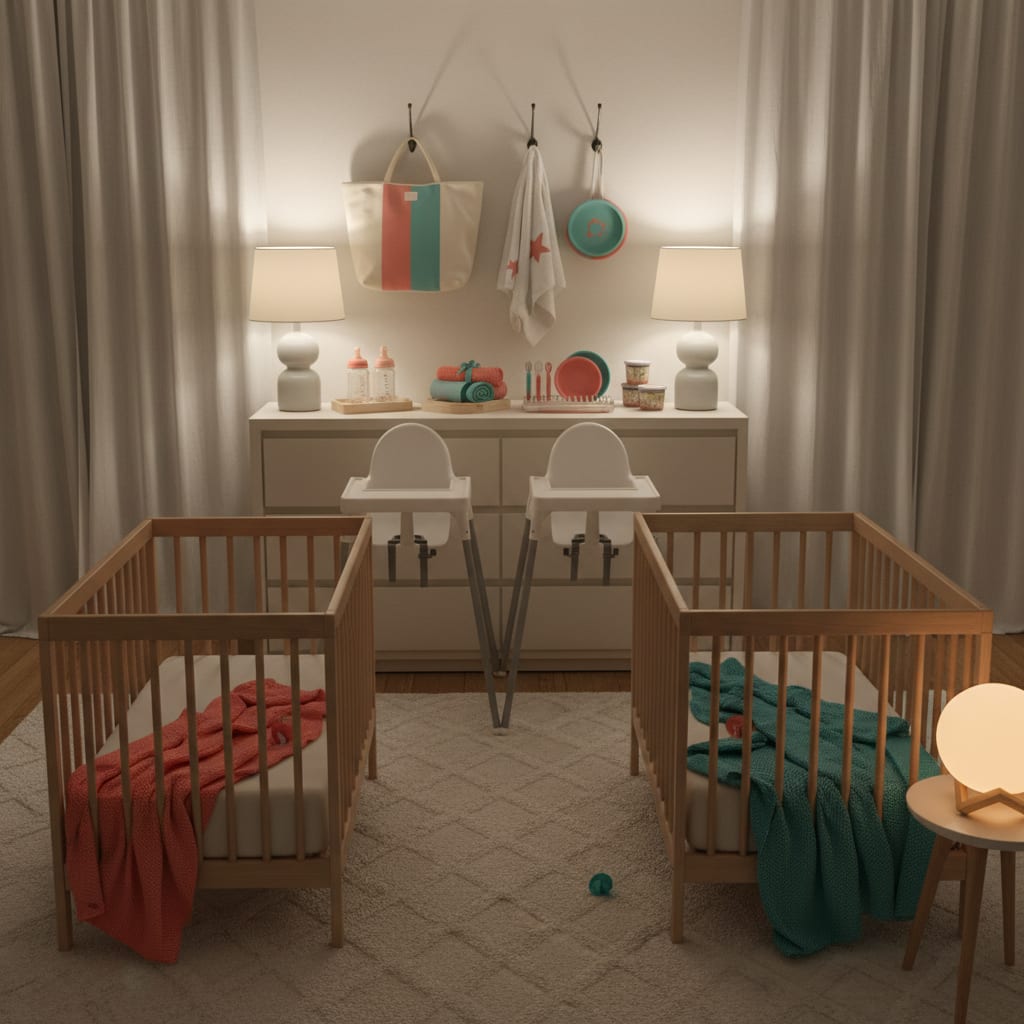
Twin Bassinets: Two Surfaces That Fit One Room
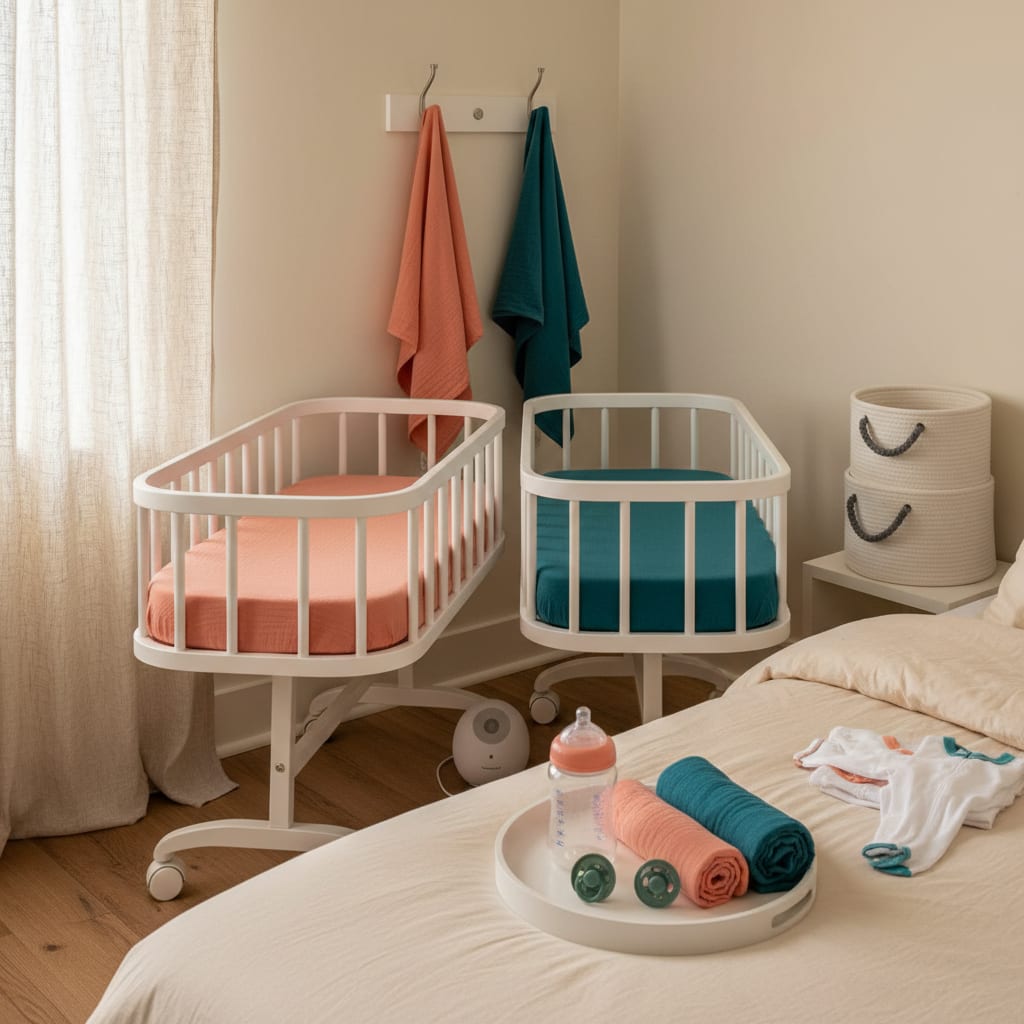
A twin bassinet setup is two sleep surfaces in one room — not one basket with two babies in it. That is the whole buying brief, and it rules out a surprising amount of what comes back when you search the term. What you are shopping for is two firm, flat, bare surfaces that both fit within arm’s reach of your bed for the first six months, that you can wheel or lift, and that you will outgrow embarrassingly fast. Below: what the product categories actually are, five setups that fit in a real bedroom, and the checks that matter before you pay for two of anything.
What “twin bassinet” means once you start shopping
Search the term and three genuinely different things come back, and only two of them are setups.
Two standalone bassinets. The plain answer. Two units, two surfaces, side by side or feet-to-feet. They do not have to match — a new bedside bassinet next to a hand-me-down that meets current standards is a completely legitimate twin nursery, and matching is a photo decision, not a safety one.
One frame with two divided compartments. A small category — the HALO BassiNest Twin is the model most people have seen — built as a double-wide bedside unit with a fixed divider down the middle. If you are considering one, the questions to answer before you buy are specific: is the divider permanent rather than removable, does the manufacturer’s own documentation state the product is intended for two occupants, and does your pediatrician agree it satisfies the one-baby-per-surface rule for your two babies. Get those answers from the manufacturer and your pediatrician rather than from a review, including this one.
One basket, two babies. Sold as a way to keep newborn twins together, and the thing current safe sleep guidance for twins rules out. So do crib dividers, wedges, nests and inserts marketed as a way to make one surface serve two. Nothing goes in a sleep space but a fitted sheet and one baby.
Five setups that fit beside a bed
Rough bands are planning ranges across budget-to-premium versions, not quotes, and they are per baby unless the row says otherwise.
| Setup | Footprint | Roughly lasts | Rough band |
|---|---|---|---|
| Two bedside bassinets | Smallest; the standard twin newborn answer | To roughly 15–20 lb or first push-up, per baby | ~$80–$300 each |
| Two playards with bassinet inserts | Larger, but folds and travels | Bassinet stage, then years as a playard | ~$70–$180 each |
| One bassinet + one playard | Mixed; useful when one side of the bed is tight | Same as each unit’s own limit | Whatever you already own, plus one |
| Two mini cribs | Wider than bassinets, much longer runway | Well past the bassinet stage | ~$100–$250 each |
| Two full-size cribs in your room | Biggest; needs a genuinely large bedroom | Years | ~$150–$500 each |
Bedside bassinets are what most twin families start with, and a wheeled, height-adjustable one like the Chicco Close to You is the shape that suits the six-month room-sharing window: small enough that two fit, light enough that you move them without help. Playards are the value play — a Graco Pack ‘n Play Close2Baby carries a bassinet level now and becomes a play yard later, which is two purchases for one price and one reason twin parents own more playards than anyone else. And if your bedroom can take the width, two mini cribs like the Dream On Me Aden skip a whole purchase cycle: they hold babies long past the point a bassinet gives up, at close to bassinet footprint.
The checks that actually matter
- Current standards, both surfaces. Anything you buy new meets them. Anything borrowed, inherited or bought secondhand needs its model checked against current federal safety standards and recall notices before a baby sleeps in it. Twins double the odds that one of your surfaces is a hand-me-down.
- Firm, flat, bare, and level. No incline, no padding, no positioners, no bumpers, no loose blankets. A twin who fights the flat surface is a settling problem to solve, not a reason to buy something inclined.
- The exit limits are per baby. Bassinets are outgrown at a stated weight or at the first sign of pushing up or rolling — whichever comes first, for that baby. Twins hit both at different times, so plan for one twin moving to a crib weeks before the other.
- Two mattresses, two sets of sheets, no extras. Use the mattress that came with each surface. Four to six fitted sheets total, because sheet failures at 3am do not politely happen one at a time.
- Height match to your bed. Bedside models adjust; playards do not. If you had a C-section — common with twins — the difference between reaching down and standing up is the difference between a manageable night and a miserable one.
- Measure the gap, not the room. Two bassinets need floor space plus a path between them and the door in the dark. Feet-to-feet orientation buys noise separation for free when the room is tight.
When they outgrow it — separately
The bassinet stage is short with any baby and shorter with twins, because the exit trigger fires per baby and you only need one twin to hit it for the setup to change. The usual sequence is one twin to a crib, a few weeks of mismatched furniture in one room, then the second twin follows.
Two things make that stretch easier. Buy the second surface knowing it may be used solo for a while, and decide in advance where a crib will physically go, because “we’ll work it out” at 11pm on the night a baby pushes up is how families end up improvising. The full trigger list — mobility, weight limits, the six-month room-sharing window and sleep quality — is in when twins outgrow the shared crib, and where the rest of the newborn sleep setup fits is in the newborn twin sleep guide.
What we would skip
Matching bassinet sets sold at a twin premium, when two of a cheaper single model do the same job. Aftermarket dividers and sleep positioners in any form. A second white noise machine, because one covers a room. And two bassinet-stage monitors — one camera holds both babies in frame right up until the day they sleep in different rooms. The rest of the two-of-versus-one-of sorting is in the twin registry checklist.
FAQ: twin bassinets
Can twins share one bassinet?
No. Each twin needs their own sleep surface, including in the newborn weeks when they physically fit together. Same room is the goal; same surface is not, and no swaddle, divider or insert converts one surface into two.
Is a double bassinet with a divider the same as two surfaces?
That is exactly the question to put to the manufacturer and your pediatrician before buying, rather than to a product page. Ask whether the divider is permanent and whether the manufacturer states the product is intended for two occupants. Two independent surfaces raise no question at all, which is why most twin families end up there.
How long do twins use bassinets?
Usually a few months, ending at the stated weight limit or the first push-up or roll for that baby — often somewhere around three to five months, and rarely on the same date for both twins. Preterm twins run on adjusted age for developmental milestones, so ask your pediatrician about your two.
Do twin bassinets have to match?
No. Nothing requires the two surfaces to be identical, and mixed setups — one bassinet, one playard — are extremely common. Both surfaces just have to independently meet current standards.
Is a playard bassinet insert safe for a twin to sleep in?
Yes, when it is the insert that came with that playard, installed as the manual describes, with nothing added. What is not safe is an insert from a different product, a second baby in the same level, or extra padding under a baby.