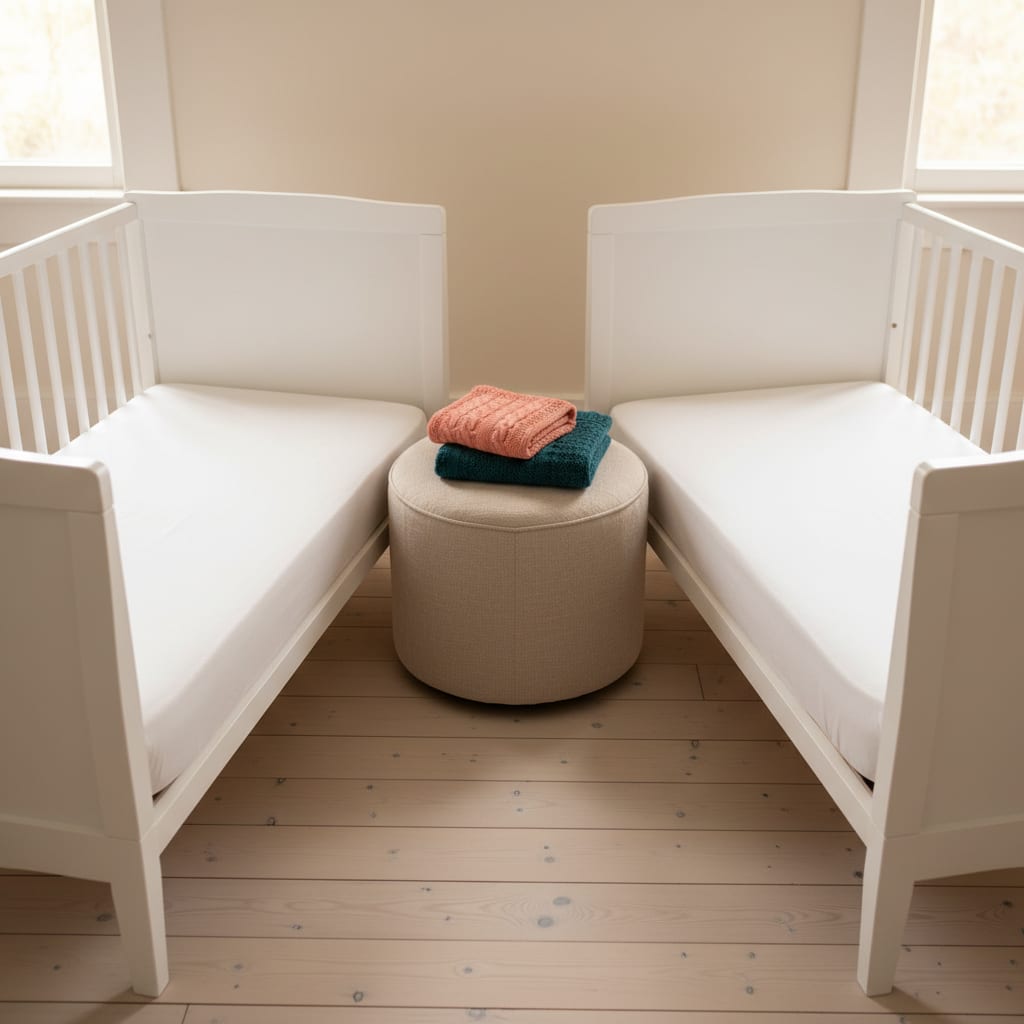
Twins sleeping in a hotel room or at a relative’s house need the same setup as at home: one crib or play yard each, both babies on their backs, a flat mattress with a fitted sheet and nothing else. Never two babies in one play yard, and never the adult bed “just for tonight”. Put the two cribs as far apart as the room allows, angled so the twins cannot see each other, away from curtains, cords and lamps. Then stagger bedtime: settle the harder sleeper first, and bring the second twin in once the first is asleep. On a short trip, stay on home time.
One travel crib per twin, even for one night
The rule does not change because the room is small or the trip is short. The AAP’s safe-sleep guidance on HealthyChildren.org says each baby should sleep in “a crib, bassinet, portable crib or play yard” that meets Consumer Product Safety Commission standards, and that parents should avoid bed sharing “under any circumstances, including with twins and other multiples” (AAP HealthyChildren). Two babies means two sleep spaces. Our full reasoning is in safe sleep for twins.
The second rule is about what goes inside. A play yard mattress feels thin and hard, and the temptation in a strange room is to soften it. Don’t. After a 2025 warning about a separately sold play yard mattress, the CPSC told parents to “use only the mattress provided with your play yard, or a mattress that specifically identifies the brand and model number of your play yard”, not to add “supplemental padding”, never to stack mattresses, and to “use a fitted sheet only” (CPSC, March 6, 2025). Hotel extras like a folded duvet under the sheet or a spare pillow at the end count as padding.
Getting two cribs into one room
Count cribs, not rooms, when you book: “a crib on request” can mean one. Ask for two in writing, then ask again at check-in.
Your options, roughly in order of how much control they give you:
- Bring both. Two travel play yards in the car is bulky but predictable. A standard model like the Graco Pack ‘n Play On the Go folds into its own bag; if you’re flying, a lighter fold like the Chicco Alfa Lite is easier to carry as the second one.
- Bring one, borrow one. Ask the hotel or your relatives for the other. Whichever twin settles more easily gets the borrowed crib, because the unfamiliar one is a bigger change.
- Borrow both. Possible, but check each one before it’s used.
Check every crib that isn’t yours. The AAP says not to use a crib “that doesn’t have instructions, is missing hardware or that’s broken”, and the mattress should be “designed for your specific crib” and fit “tightly”. Lock the sides, press on the floor of the play yard, and look for any pad other than the one it came with. At grandparents’ houses, the old crib from the attic is the one to look at hardest; the AAP suggests checking the CPSC website for recalls if a crib isn’t new.
Where to put two cribs in one room
A hotel room was laid out for adults, so you’re working around a bed, a desk and a window. In rough order of priority:
- Away from hazards. Curtain cords, blind cords, lamps, the coffee-maker shelf and the heater all decide where the cribs can’t go. Nothing should be reachable from inside either crib once a twin stands up.
- As far apart as you can. Twins a few feet apart in a strange room are likely to hear every whimper. Distance is the cheapest fix.
- Turned away from each other. End to end, or at right angles, so they can’t make eye contact over the rails. Two babies who can see each other in a new place tend to start a conversation.
- Your bed in the middle, if the room allows it. Room sharing is fine; bed sharing isn’t. A crib on each side of the adult bed is often the layout that gives the most distance.
Sound helps more in a hotel than at home, because corridors and ice machines are loud. A fan-based machine like the Yogasleep Dohm Classic packs easily. Keep it at low volume and away from both cribs, never inside one. If one twin waking the other is already a pattern at home, expect it to be stronger on night one, and use the fix order in twins waking each other up.
Stagger the settling
At home your twins may go down together. In one shared room on the first night, it’s often easier to take turns.
- Harder settler first. Put the twin who takes longer to fall asleep down first, in a dark room with the sound on, while the other stays out with the second adult. In a hotel that might be the corridor, the lobby or a bathroom with the door shut.
- Second twin in once the first is asleep. Usually a short wait. Do the second twin’s last steps (sleep sack, song) outside the room, so you walk in and lay them down without talking.
- Get yourselves ready in the bathroom. Once both are down, keep the main light off. A phone flashlight pointed at the floor is enough to find your toothbrush.
If your twins already run on different bedtimes at home, keep them. A holiday is not the week to merge two schedules. The mechanics of two bedtimes in one house work in a hotel too: split twin bedtimes.
The clock, the temperature, the party downstairs
Home time on short trips. Betteroo’s guide to keeping naps and nights on track away from home cites the CDC Yellow Book’s advice to keep home sleep hours on trips under about two days, and to switch to local time from the first full day on longer ones. For twins, pick one plan for both. Two babies on two different clocks in one room is the hardest version of this trip.
Room temperature. Hotel rooms and spare rooms can run warm. Aim for about 68 to 72°F (20 to 22°C), use sleep sacks instead of the hotel’s blankets, and check each twin separately, because two babies in the same room don’t always feel the same. The AAP’s rule is “only one layer more than you’re wearing”. The per-twin version is in one twin runs hot, one runs cold.
The car-seat nap. Twins who fall asleep on the drive in should come out and go into their cribs. The AAP says a baby who falls asleep in a car seat should be moved “to a firm sleep surface on their back as soon as possible”. That applies to both, even if it means waking one.
The party downstairs. At a relative’s house, the evening carries on below the room where the twins are sleeping. Use a monitor, agree in advance who checks on them, and make sure nobody “just pops a blanket over” a sleeping twin while you’re downstairs.
 Two cribs, two sleep plans
A holiday trip goes easier when you know each twin's usual timing. Betteroo's quiz builds a plan around one child's age and schedule, so run it once for each twin before you pack.
Take the sleep quiz →
FAQ: twins sleeping away from home
Can twins share one pack ‘n play while traveling?
No. Two babies in one play yard is co-bedding, and the AAP advises against bed sharing “under any circumstances, including with twins”. Each twin needs their own bare, flat sleep space. If you only have one, ask the hotel or your hosts for a second before you arrive.
Can I put a blanket or pad in the play yard to make it softer?
No. The CPSC says to use only the mattress that came with the play yard (or one made for that exact model), a fitted sheet, and nothing else: no extra padding, no stacked mattresses, no blankets or pillows. A sleep sack keeps a baby warm without anything loose.
What if the twins keep each other awake in the hotel room?
Move the cribs further apart and turn them away from each other, add steady sound at a low volume, and settle them one at a time. The first night is often the hardest; many pairs settle once the room feels familiar.