Bedtime With Twins and a Toddler: A One-Adult Plan
With one adult, twins and an older child under five, bedtime works as one sequence rather than three bedtimes. Run the front half together: dinner, a wash, pajamas, the last feed. Then put the twins down first, because their bedtime is the one that cannot slide. Give the older child a defined job and a safe place to wait while you do it. The last slot of the evening belongs to the older child, one to one. Water is the exception: nobody is in a bath that you cannot reach.
Said plainly: my twins are my only children, so I have never run a three-under-five evening myself. What I can offer is the twin half of it, worked out precisely enough to show where a third child changes the arithmetic, plus the safety rules that do not bend.
Why this is a different problem from triplets
Triplets are three babies on roughly one clock, which is why the triplet bedtime sequence rotates who goes down last. Here there are two clocks: the twins share an early bedtime and a short tolerance for waiting, while the older child runs later, winds down longer and has opinions. So there is no rotation. The twins go first every night, because a baby past their window falls apart in ways a preschooler mostly doesn’t, and the older child goes last, in a slot worth having.
The evening on paper
Here is a worked example, assuming twins around six to twelve months and an older child of three or four. Move the clock to suit your house. The order is the part that matters.
| Time | Twins | Older child | You |
|---|---|---|---|
| 5:15 | Dinner in high chairs | Dinner at the table | One meal, one sitting |
| 5:45 | Wash-up, pajamas, sleep sacks | Pajamas, teeth | Everyone dressed for bed before the last feed |
| 6:15 | Last feed, lights low | Their job (below) | Feed as a round, never propped |
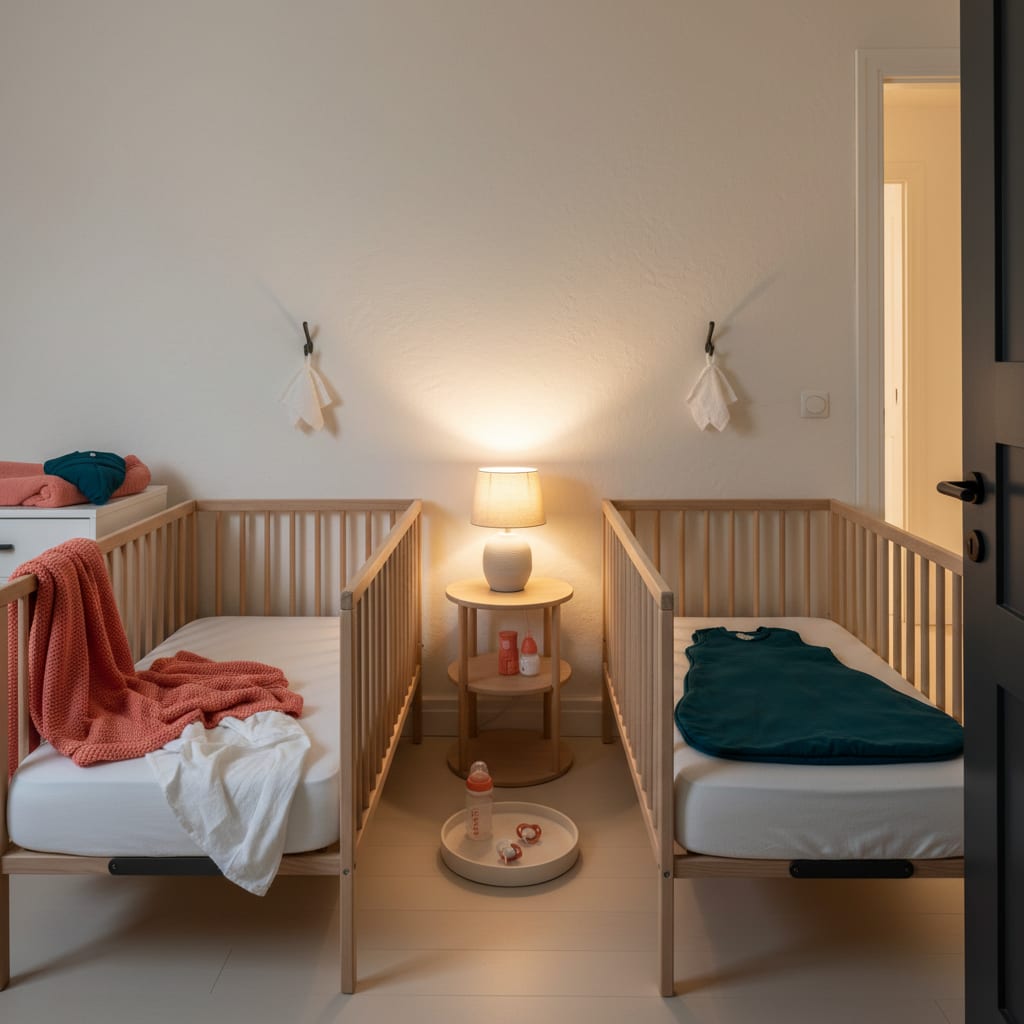
| 6:35 | Into the room, down calmer twin first | Waiting spot, in earshot | Stay for the harder twin |
| 6:55 | Asleep or settling | Their slot starts | Books, one song, lights out |
| 7:25 | — | Asleep or settling | Kitchen, finally |
Those times are an illustration, not a schedule. Every step that runs in parallel is time the older child gets back at the end.
For the older child’s end of it, Betteroo’s bedtime-by-wake-up table for preschoolers puts lights-out for a 3-to-5-year-old who no longer naps at about 6:45 to 7:45 p.m. for a 7:00 a.m. wake. It gives 10 to 13 hours in 24 as the range for that age, following the AASM. A last slot ending around 7:25 sits inside that.
The front half: everything you can do once
The rule from a solo day with twins holds with a third child too: anything you can do once, do once. One dinner sitting, and everyone into sleep clothes before the last feed so nobody gets woken to be dressed.
The bath is the one step that does not parallelize. The AAP’s bathing guidance is unambiguous: “Never leave a baby alone in the bath, even for an instant.” A 2012 CPSC bathtub warning adds the line that matters most in this house: “Don’t leave a baby or young child in a bathtub under the care of another child.” A four-year-old watching the twins in the tub while you fetch towels is that arrangement. On solo nights:
- Twins get a warm-flannel wash. Babies do not need a nightly bath.
- If the older child bathes, the twins wait somewhere safe that you can see, such as a playard by the bathroom door, and you do not leave the tub. Towels and pajamas are laid out before the water goes in. Full baths for everyone move to nights with a second adult.
The older child’s job while the twins go down
During the put-down your hands are full, and the older child is awake and unsupervised in a way they notice. Give them a real job with a beginning and an end, not just “be good”:
- A role in the twins’ routine that does not involve handling babies. Choosing tonight’s song, switching on the sound machine, saying the goodnight line from the doorway.
- A defined waiting spot. Within earshot, safe to be in alone for ten minutes, and dull: a beanbag in the hall with a basket of their own quiet toys, kept for this slot only so it stays special. Betteroo’s toddler-routine guidance is screens off at least an hour before bed, so this is not the moment for a tablet.
- A visible handover. “When the twins are down, it’s your turn.” A child who can trust the turn is coming waits far better than one who has to guess.
The calmer twin goes down first, freeing your hands for the one who needs them. If both are still wide awake when the older child’s slot is due, the twins’ bedtime is too late; the older child should not wait longer. Split twin bedtimes, 15 to 30 minutes apart, can shorten the put-down but lengthen the evening, so weigh one against the older child’s slot.
The last slot belongs to the older child
Protect this slot hardest. The older child spends the evening waiting for babies; if their own bedtime is also the rushed one, bedtime tends to get longer and louder. Keep it short and uninterrupted: twenty to thirty minutes, the same steps in the same order, ending with lights out in their room. If a twin cries during it, pause and listen. A baby fussing in a safe crib can usually wait while you finish the page; if you do go, come back to the same place in the routine. If the older child shares the twins’ room, the entry order is different again, and twins sharing a room with an older sibling covers the staggered entry.
When it all goes sideways
Some nights all three need you at once. Triage in this order, every time:
- Anything involving water, stairs or heights. A child in the bath or at the top of the stairs comes first, always.
- A baby who is not in a safe place. A twin asleep on a nursing pillow or in a bouncer moves to their own flat, empty crib, on their back.
- The baby whose bedtime is most fragile. Usually the harder settler, and usually the one past their window.
- Everyone else. A crying baby in a safe crib, and a preschooler crying in a safe hallway, can both wait a minute. That feels terrible and is fine.
Safe sleep does not loosen because the evening is hard. The AAP’s parent guide to safe sleep is explicit that it recommends avoiding bed sharing “under any circumstances, including with twins and other multiples.” That includes the older child “helping” by lying down in a twin’s crib, and both twins in one crib to save a minute.
Where a per-child plan helps
Three children on two clocks is too many wake windows and nap needs to hold in your head at 6:30. Betteroo builds a sleep plan around one child’s age and temperament, and its homepage says it works “for newborns through age 6,” which covers all three children in this house. It also offers unlimited caregiver sharing, so the adult who isn’t there tonight can see the same plan. Honest limits: it is a planning tool and it cannot add a pair of hands. A child whose sleep changes suddenly, or comes with feeding or breathing worries, belongs with your pediatrician.
 Three children, two clocks
Twins and an older sibling don't share one bedtime. Betteroo's quiz builds a plan around one child's age and temperament, so each clock gets its own.
Take the sleep quiz →
Three children, two clocks
Twins and an older sibling don't share one bedtime. Betteroo's quiz builds a plan around one child's age and temperament, so each clock gets its own.
Take the sleep quiz →
FAQ: bedtime with twins and an older child
Should the twins or the older child go to bed first?
The twins, in most houses: their window is less forgiving, and the older child gets the uninterrupted last slot. The exception is an older child who falls asleep fast and early.
Can my preschooler help with the twins at bedtime?
Yes, with jobs that don’t involve lifting, feeding or bathing a baby. Choosing the song, switching on the sound machine and saying goodnight are real jobs. Watching the twins in the bath is not one, for any child.
What if the older child keeps coming out while I settle the twins?
Make the waiting spot more specific, not the warnings louder. Give them a named place, a basket that only appears at this time, and a fixed signal that their turn is next. Most of the coming-out is checking that the turn still exists.