Triplet Bedtime: What the Twin Playbook Misses
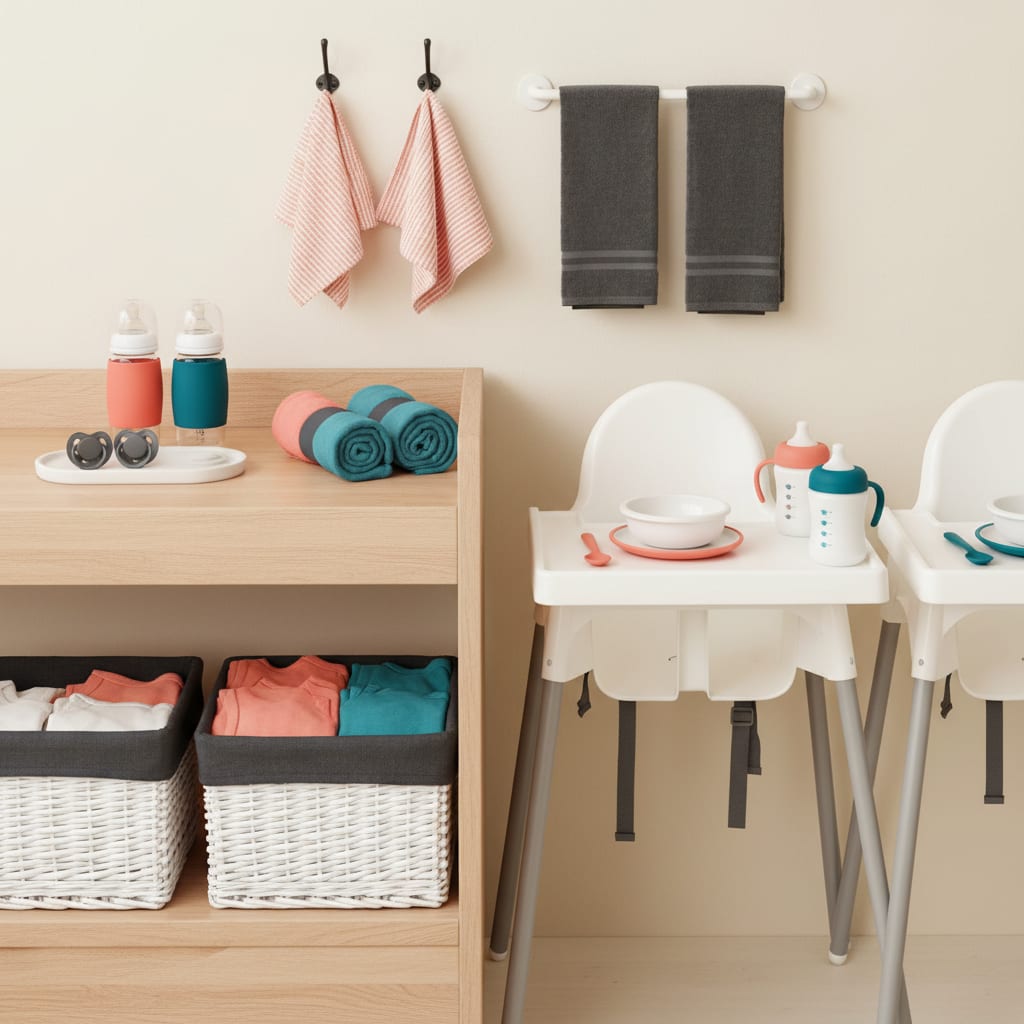
Most of the twin bedtime playbook survives the jump to three: one shared routine, one shared morning wake time, a separate sleep surface for every baby, and a written log because nobody remembers three babies’ evenings accurately. What does not survive is anything that assumed you had one pair of hands per baby. Every settling method that starts “hold your baby until drowsy” quietly assumed a second adult or a second arm, and at three, one baby is always waiting. Triplet bedtime is therefore a sequence, decided in advance, rather than a routine you run and adapt.
I parent twins, not triplets, and I am not going to pretend otherwise — what follows is the two-baby system stated precisely enough that you can see where it snaps. Triplet and higher-order births are genuinely uncommon: the CDC’s National Center for Health Statistics put the rate at roughly 74 per 100,000 US births in 2023, around 2,650 babies. That rarity is why so little written advice is built for three.
What still works exactly the same
One shared morning wake time. The single most load-bearing rule in multiples sleep, and it gets more important with three, not less. Wake everyone within the same 20-minute window regardless of how the night went, and the day re-converges on its own. Let each baby wake when they like and you have three schedules by Thursday and no gap in your day — the mechanics are the ones in getting twins on the same schedule, just with a third column.
One routine, not three. Bath, feed, dim room, same order, same cues, every night — a routine is a signal, and a signal only works if it is identical. Three separate wind-downs is an hour and a half of evening you will abandon inside two weeks.
One sound source for the room. Three babies do not need three machines — one steady source at moderate volume, placed away from the cots rather than beside a baby’s head, does the room. A mechanical-fan unit like the Yogasleep Dohm is the one I keep recommending: same sound all night, nothing to loop or time out.
Written logging. Feeds, times down, times asleep, wakes — per baby. With two you can just about hold it in your head; with three you cannot, and the difference between “the middle one is a worse sleeper” and “we have put the middle one down last for six weeks” only shows up on paper. The A|B log sheet takes a third column without any redesign.
Where the two-baby playbook breaks
The hands math. With twins, both babies can be held, fed or rocked simultaneously by two adults, and by one adult in a pinch. With triplets, there is no configuration in which every baby is attended at once by one person. That is arithmetic, not a mindset problem, and the only answers are a fixed sequence, a safe place for whoever is waiting, and — where it exists — a second adult at the specific 20 minutes that need one.
The rotation nobody sets up. With two babies, “whoever is fussier goes first” works. With three it produces a baby who is always last, for months, with a shorter and more chaotic wind-down than their siblings. Set a fixed rotation instead: the order shifts by one each night, so the last-down slot moves around the trio. Write it down rather than carrying it in your head at 7pm.
Tandem feeding does not extend. The two-babies-one-pillow positions that make twin feeding possible have no three-baby version. Triplet feeding is a 2+1 with a rotation, or bottles with an attended setup, and the planning question is who is in the “+1” slot tonight and who is holding them. Never propped, never unattended — that rule does not bend for logistics, ever.
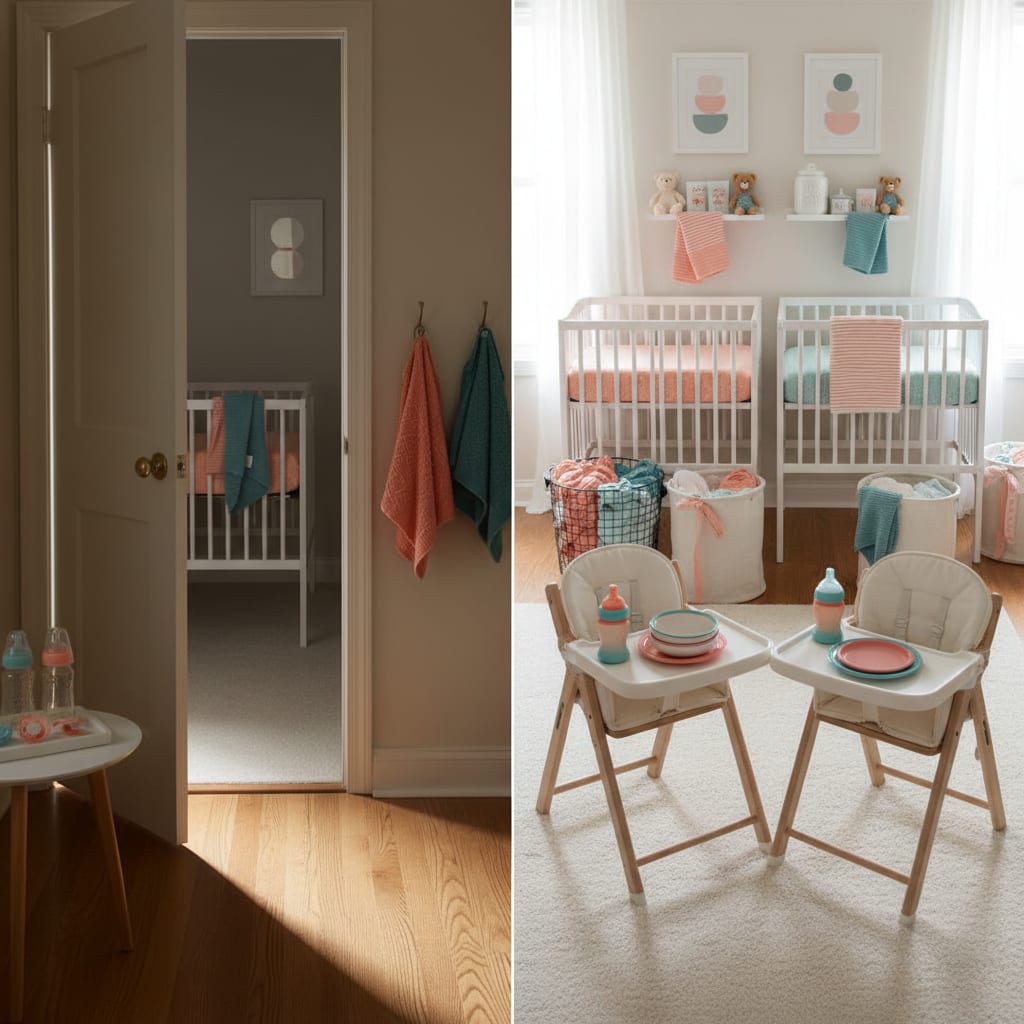
“They sleep through each other” becomes half-true. Babies in a shared room do habituate to routine noise, and with three there is more of it to habituate to. It is still not a plan: one baby awake for a real reason will wake the other two, and the fix is the cause, not tolerance.
Running a solo bedtime with three
The solo-evening problem is the same shape as the two-baby version in the solo-day playbook, scaled past the point where improvisation works:
- Decide the order before bath time, not at 7:15 with three babies escalating.
- Front-load the hardest settler. Last cuddle, first down. The steadier two will wait; the hardest one will not.
- Give the waiting babies a legitimate, safe place to be — in the room with you, boring, not a second wind in the living room. If a waiting baby falls asleep, they move to their own flat sleep surface. Not a bouncer, not a swing, not your lap.
- Keep the shared parts genuinely shared. Bath together, feed together, books together. Split only the final step.
- Judge at two weeks. With three babies one is always having a bad night, so a single night tells you nothing.
Speed matters more here, simply because the sequence is longer — the standard levers for settling a baby quickly are worth having sharp before you need them three times in a row.
Coming home on three different days
Higher-order multiples are more often born preterm, and discharge is frequently staggered — one baby home, two still in the NICU, then two and one.
Read every age-based timing as adjusted age, counted from the due date, and adjust per baby — triplets often differ in birth weight and readiness. And expect to rebuild the schedule twice: the routine that worked for the first baby home is not the routine for three, and the shared wake time only becomes the anchor once everyone is in the house. Rebuilding it is normal, not a failure.
Where a per-child plan earns its keep
The hard part is not knowing what to do. It is holding three plans, for three babies at three slightly different points, in your head, at 9pm. That is the job Betteroo’s one-baby-at-a-time sleep plans do well — a short quiz on one child’s age, temperament and schedule returns a day-by-day plan for that child, run three times rather than averaged into a compromise nobody fits. Balanced verdict: a planning tool at around $20 a month, it will not solve the hands problem, and a baby whose waking is driven by reflux, illness or feeding difficulty needs your pediatrician.

Safe sleep does not scale down
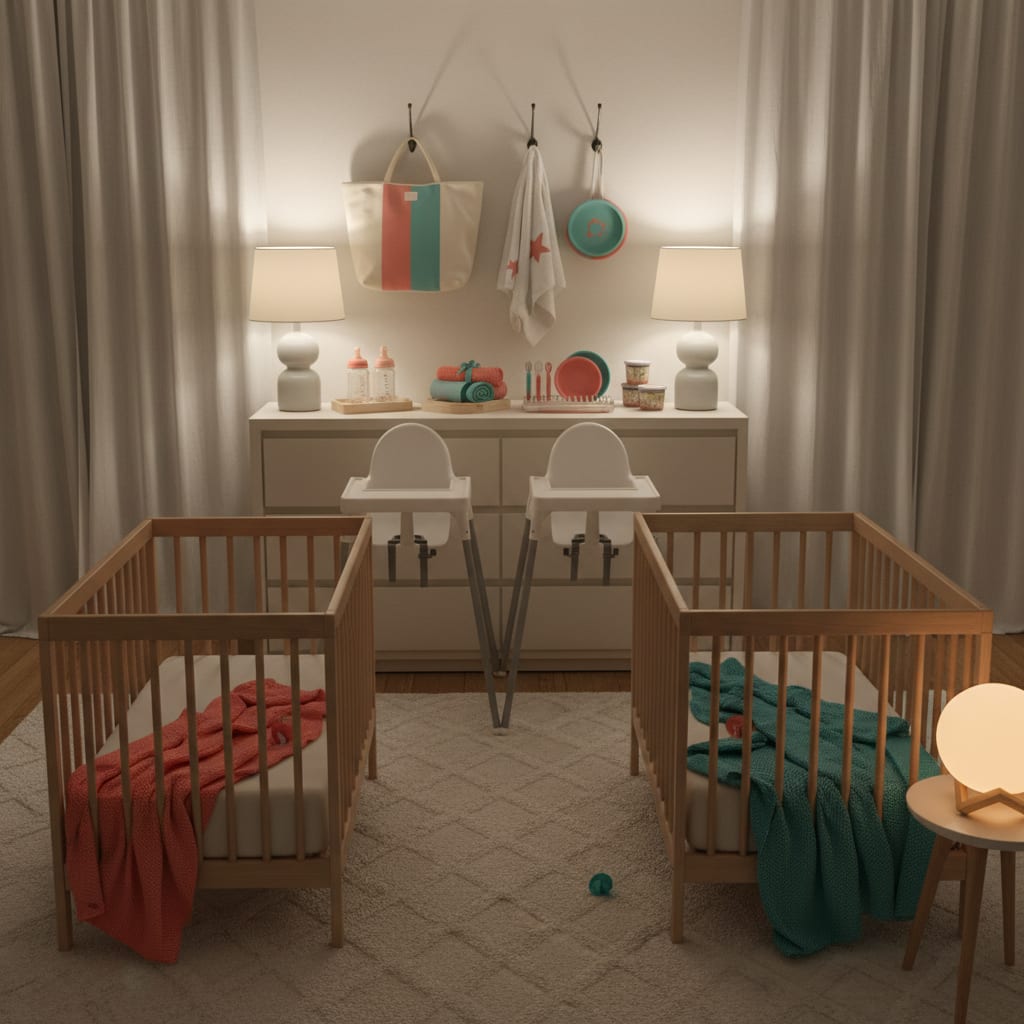
The rule that gets bent hardest when there are three babies and not enough room is the one that must not move: each baby on their own firm, flat sleep surface, on their back, with nothing in it. Three babies in one room is fine and normal. Two babies sharing a cot is not, at any age, however neatly they fit and however tightly they are swaddled — the AAP line is the same for triplets as for twins, and the reasoning is in why twins should not share a crib. Three surfaces in one room is a furniture problem to solve, not a rule to negotiate.
FAQ: bedtime with triplets
Should triplets go to bed at the same time?
Usually yes — one shared bedtime with a fixed put-down order is faster and steadier than three separate evenings. Offset the put-downs by a few minutes rather than running three routines.
Can triplets share a crib?
No. Each baby needs their own flat, firm sleep surface from night one. Sharing a room is fine; sharing a sleep surface is not, and that does not change because there are three.
Do triplets wake each other up?
Less than parents expect, and more than is convenient. Babies in a shared room habituate to routine noise, but a baby waking for a real reason will wake the others — so treat the cause rather than relying on tolerance.
How do you put three babies down alone?
A fixed sequence: hardest settler first, a safe boring spot for whoever waits, shared bath and feed, and a rotation so the same baby is not last every night.
When do triplets sleep through the night?
There is no triplet-specific answer, and any age you read should be adjusted from the due date, per baby — preterm birth is common with higher-order multiples. Expect three different timelines in one house, and ask your pediatrician about any baby whose sleep changes suddenly or comes with feeding or weight-gain worry.