First Babysitter for Twins: Handing Over a Two-Baby Bedtime

For a first babysitter with twins, hand bedtime over in writing and in person. Write one A|B sheet with each twin’s feed, settling steps and bedtime order. Run one practice bedtime while you are still home. Write three rules down word for word: each twin on their back in their own bare crib, no propped bottles, and no dozing on the couch with a baby. Then make the first night easy. Put both twins down yourself, leave once they are asleep, and hand over the full two-baby bedtime on a later night.
What makes a twin handoff harder
Three things change when there are two:
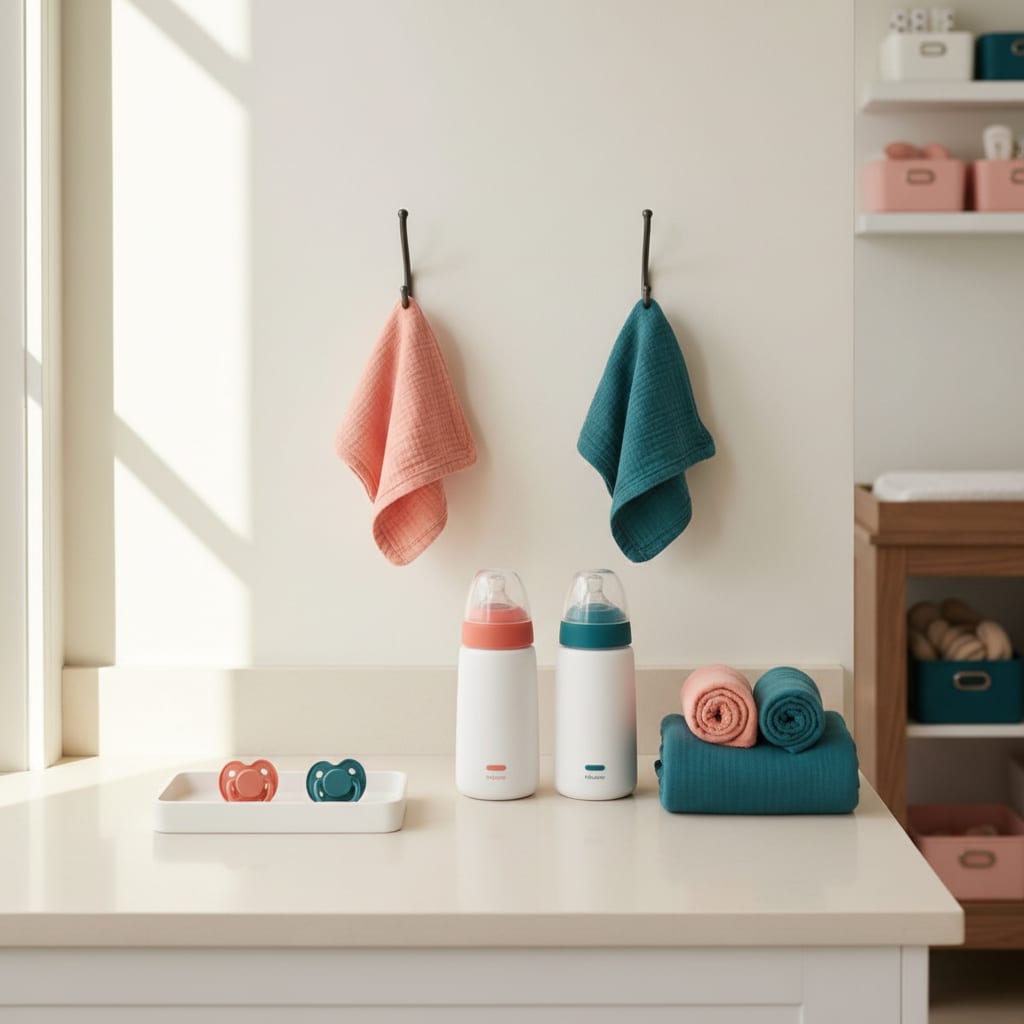
- The sitter cannot tell them apart. You know which twin is which in the dark; a sitter, especially with identical twins, may not, and it matters most for feeds and medicine. If you do not already run a color code, telling newborn twins apart sets one up: one color per twin, on everything.
- The routines look alike and are not. One twin settles with a hand on the chest. The other needs to be walked. One wakes at the first sound, the other sleeps through. None of that is visible to someone new.
- Two cries at once. Most sitters have never had two babies crying while their hands are full. They need a plan before it happens.
Start with the easy night: leave after lights-out
Build up in three steps.
- First night: you do bedtime, the sitter covers sleeping hours. Put both twins down, show the sitter the room, the monitor and the sheet, and go out for two or three hours. The sitter’s real job is a wake-up or two.
- Practice bedtime, with you home. The AAP’s babysitting checklist asks parents to “have the sitter spend time with you before babysitting to meet the children and learn their routines” (AAP HealthyChildren). For twins, the useful version is the sitter running a whole bedtime while you stay in the next room. They find the gaps, like where the second sleep sack lives, while you can still answer.
- Full bedtime, alone. Now the sitter runs both twins from bath to lights-out.
The A|B handoff sheet
Betteroo has a printable caregiver handoff sheet built around one child: wake time, naps, wind-down steps, how you soothe, safe-sleep rules, who to call. It also makes the point that matters here: the same steps in the same order count for more than which routine you pick. For twins, split every row into two columns, A and B.
| Row | Twin A (coral) | Twin B (teal) |
|---|---|---|
| How to tell them apart | Coral sleep sack, coral cup | Teal sleep sack, teal cup |
| Last feed | Time, amount, how they take it | Time, amount, how they take it |
| Settles with | The exact steps, in order | The exact steps, in order |
| Wakes easily? | Yes or no, and what wakes them | Yes or no, and what wakes them |
| Goes down | First or second | First or second |
| Medicine or allergies | Only what you have written here | Only what you have written here |
| Date of birth, weight | For emergency staff | For emergency staff |
Under the table, add safe sleep in full (see below) and the phone list the AAP checklist asks for: your numbers, a neighbor, the pediatrician, fire and police, the Poison Help line (1-800-222-1222), and your home address. The dates of birth and weights are there “in case these are needed by medical professionals”, in the checklist’s words.
The AAP also tells sitters to “never give the children any medicine or food unless instructed to do so by the parents.” With two babies, that instruction has to say which twin. A medicine meant for only one twin is the mix-up to guard against.
Bedtime order: who goes down first
Write the order down. The usual rule is the deeper sleeper first and the lighter sleeper last, so nothing happens in the room after the twin most likely to wake has settled: no second zip, no second lift. If your twins already go down at different times, say that plainly too, with both times.
Set the room up so the sitter needs no free hand. Have both sleep sacks open in the cribs, one dim light on, and the room at about 68 to 72°F (20 to 22°C). Leave the sound machine already running. A fan-based one like the Yogasleep Dohm Classic has one switch and nothing to program.
Feeding two: one at a time unless they have practiced
If a feed falls inside the sitter’s hours, the default should be one twin at a time, with the other safe in a seat on the floor or in their crib. Tandem bottle-feeding is a skill a first-night sitter should not be learning alone. Whichever way they do it, the rule is the one in bottle feeding twins alone: an adult holds every bottle for the whole feed, and nothing is ever propped. Write that on the sheet as well as saying it.
If you use pumped milk, mark each bottle with the twin’s color, and write the amount for each twin on the sheet.
When both twins cry at once
Give the sitter the order in advance. First, any twin who might be unsafe or unwell. Then the one whose need is real, like a feed that is due, over the one who is only protesting. Both twins crying at night goes through this order. Send it to the sitter beforehand.
The AAP checklist also gives sitters a release valve: “If a baby is crying and cannot be soothed, it is OK to put the baby in a safe place, like a crib, and walk away for a few minutes.” For twins, tell the sitter where that safe place is. It is that twin’s own crib, on their back. Not the couch, and not the other twin’s crib. The same list says to “never leave the children alone in the house - even for a minute”, so stepping out to the porch to calm down does not count as walking away.
Safe sleep, written word for word
Do not paraphrase this part on the sheet. Copy it:
- Each twin in their own crib or bassinet. The AAP advises against bed sharing “under any circumstances, including with twins and other multiples” (AAP HealthyChildren). Two twins never share one crib to help them settle.
- On the back, every sleep. NIH Safe to Sleep: “Place babies on their backs to sleep for naps and at night.”
- Nothing in the crib but a fitted sheet. NIH Safe to Sleep says to remove “everything from baby’s sleep area, except a fitted sheet covering the mattress” (NICHD).
- Asleep in a car seat, stroller or carrier? Move them to the crib. NIH says to move the baby to their regular sleep space “as soon as possible”.
- Never asleep on the couch with a baby. “Couches and armchairs are never safe places for babies to sleep,” NIH says, and it lists a caregiver other than a parent among the higher-risk situations for shared sleep. A tired sitter holding one twin on the sofa while the other sleeps is exactly the scene to rule out ahead of time.
Our safe sleep for twins post has the full two-crib setup if the sitter wants the reasons.
 Two babies, one sheet
A handoff only works if the routine underneath it is settled. Betteroo's quiz builds a sleep plan around one baby's age and temperament.
Take the sleep quiz →
FAQ: a first babysitter for twins
How old should a babysitter for twins be?
The AAP’s floor for any babysitter is at least 13, with first-aid training and CPR. That is a minimum. For two infants, look for someone who has cared for two small children at once and can carry both babies out of the house quickly if they ever need to.
Should I do bedtime or let the sitter do it?
Do it yourself the first time and leave once both twins are asleep. Hand over the full bedtime after the sitter has run one with you at home.
What if one twin will not settle for the sitter?
Expect it: a new face at bedtime often gets protest, sometimes from only one twin. Agree in advance on how long they try before they text you, and when you would rather come home.