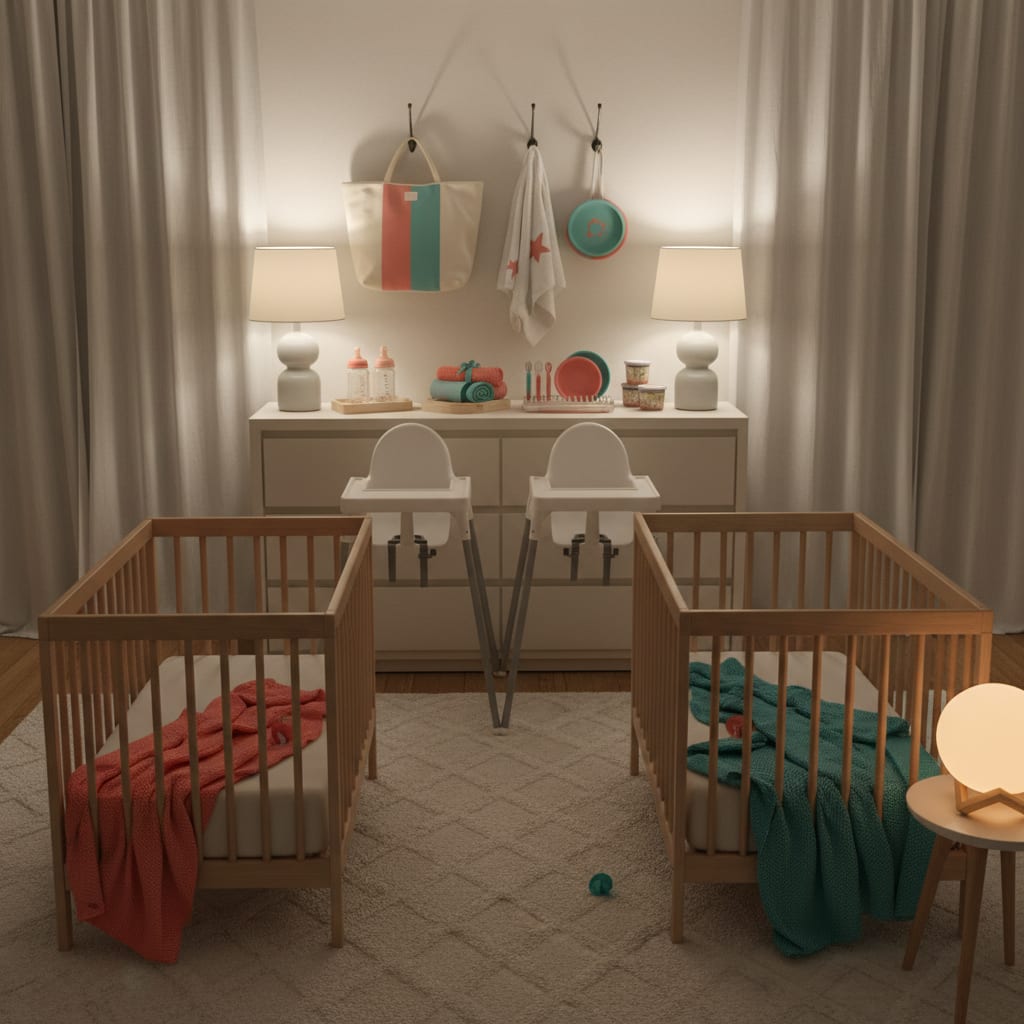
One Twin Is a Night Owl: Shared-Room Bedtime
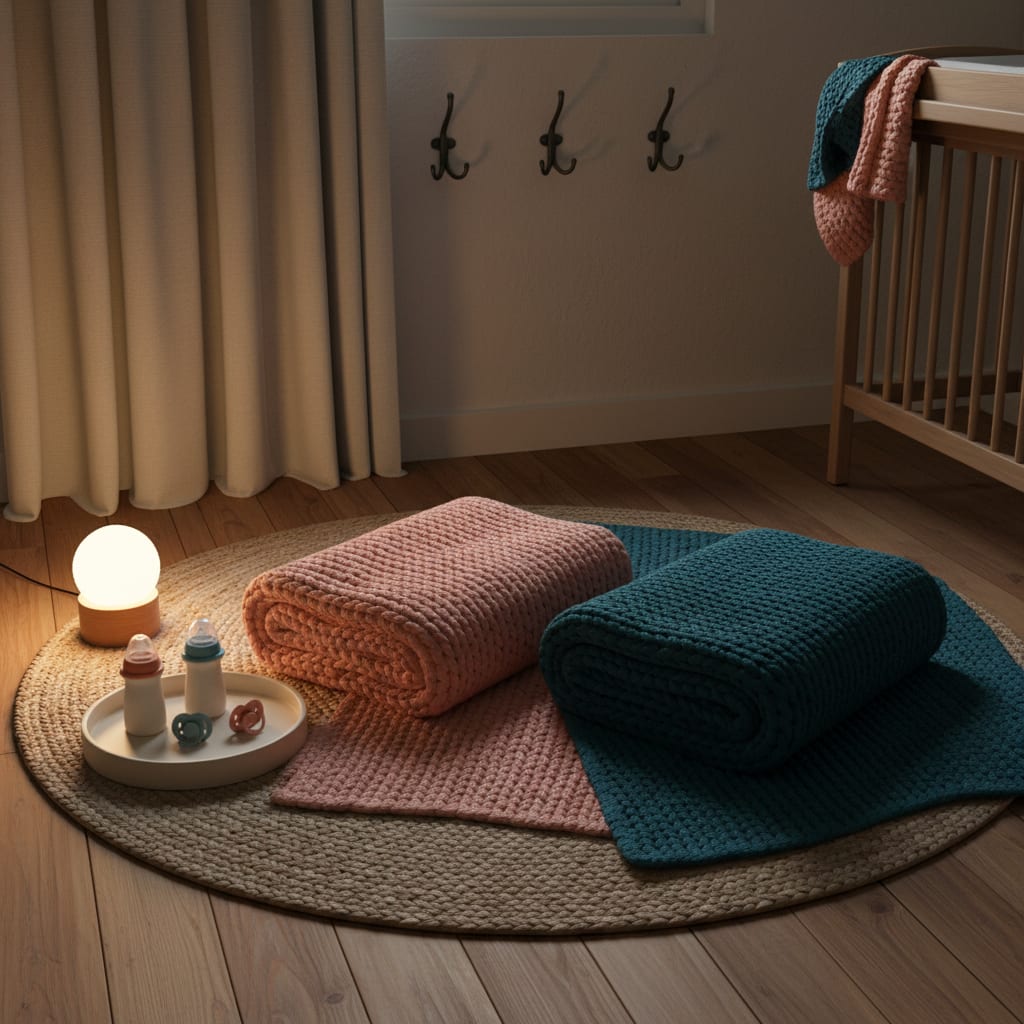
If one of your twins is genuinely a night owl — still wide awake 30 or 40 minutes after the other has gone down, night after night, in the same room — the fix is almost never a later bedtime for that baby. It is an earlier and rigidly identical morning wake time for both, plus a room the late twin can leave and re-enter without waking the early one. Body clocks move from the wake end, not the sleep end. And in a shared room the real problem is containment: where does the awake twin exist while the asleep twin sleeps.
Ours ran 25 minutes apart for four months. Baby A was asleep by 7:05 with no effort; Baby B was still doing gymnastics at 7:40 and had opinions about it. Nothing in the evening fixed it. The morning did.
Is it a real late-timer, or one of the three impostors
Log a week first — time into the cot, time asleep, total day sleep, per baby. Three things look exactly like a night owl and are not:
The under-tired twin. Same-room twins go down for naps together and get picked up together, so their day sleep is often equal on paper and unequal in reality — one slept 40 minutes of that hour and the other slept the whole thing. That gap lands on the evening.
The overtired twin. The counter-intuitive one, and the more common one. A baby who missed a nap or stretched a wake window arrives at bedtime wired rather than sleepy and reads as a late chronotype. The tell is how they are awake: a late-timing baby is calm and cheerfully awake, an overtired one is frantic. That one is fixed in the day, not the evening.
The slow settler. Eight minutes to fall asleep versus twenty-five, with identical underlying sleep drive — a wind-down-length difference, and what the offset lights-out in split twin bedtimes already handles.
A real late-timer is consistent across ten days or more, survives a corrected nap schedule, and shows up at the morning end too: the night owl usually also sleeps in.
What a shared room takes off the table
You cannot let the later twin simply stay up in the room. An awake, mobile, chatty baby three feet from a sleeping one is not a neutral presence, and the arithmetic is unforgiving: you trade one baby’s 25 extra awake minutes for a real chance of losing the other’s whole first sleep cycle.
You also cannot run two morning wake times, because in one room the early riser wakes the late sleeper — precisely the twin whose clock you are trying to pull earlier. Which is why the fix works: you were going to have to hold a single wake time anyway.
Under six months this is constrained further, correctly: both babies in the parents’ room, each on their own firm flat surface, no shared crib. Chronotype is a second-half-of-the-first-year conversation.
The setups that work with one room
The staggered entry. Early twin goes in at the normal time. Late twin stays with you somewhere dim and boring — no play, no new toys — and goes in 20 to 30 minutes later, already drowsy. Most families land here, and the whole game is making the second entry silent.
The out-and-back. Both go in together. If the late twin is still wide awake after 20 minutes and escalating, they come out, sit somewhere dim for ten minutes, then go back in — which stops that baby spending 40 minutes learning that the cot is where you shout.
Cap the afternoon nap. If the log shows the late twin banking an extra 30 minutes, cap it. Waking a sleeping baby feels criminal and is occasionally the entire solution.
All three need a room that tolerates a second entry, which means sound masking that runs all night rather than a track that stops. A mechanical machine like the Yogasleep Dohm is the standard worked example: same sound, same level, indefinitely — exactly what a door opening at 7:40 needs to disappear into. One unit, placed between the cots rather than beside either baby.
Move the morning, not the bedtime
Pick a single wake time and hold it for both babies every day, weekends and the day after a bad night included. Then move it earlier in 10 to 15 minute steps every three or four days, until the late twin’s sleep onset slides back to meet their co-twin’s. Naps and feeds move with it; bedtime follows rather than leads.
Why this works when evening tinkering does not: the wake time is the anchor a circadian rhythm is set from. Pushing bedtime later hands a late baby more awake time and lets the system drift; pulling the morning earlier compresses it. Expect four or five worse days first.
Light is the lever, and it runs both ways
Mornings: bright, immediately. Curtains open, lights on, into the brightest room in the house within minutes of the wake time. Both babies get it, because both are on one clock now.
Evenings: dim, and earlier than you think. The hour before bed should be visibly darker than the rest of the house, and the room properly dark — in summer, or under a streetlight, that means blackout rather than “quite dark”. A portable option like the Amazon Basics suction-cup blackout curtain suits rentals and travel, which is where a hard-won twin bedtime usually falls apart.
A room can support a body clock; it cannot override one. If the late twin also needs to fall asleep in a room where someone else is already asleep, that is a skill rather than a setting — and when babies can self-soothe is the honest timeline for it.

The mistake that makes it worse
Keeping the night owl up later “so they’ll be properly tired”. It reliably backfires: the extra awake time tips a calm late-timer into an overtired one, and an overtired baby takes longer to fall asleep, not less. You get a later bedtime, a worse settle and usually an earlier morning waking as the bonus.
Two others. Changing more than one variable a week, so you learn nothing from either. And treating the gap as a behaviour problem — the twin who runs late is not being difficult and the twin who goes down at 7:05 is not better at this, which is the premise of one twin sleeps, one doesn’t. For the per-child version rather than a compromise, Betteroo builds one child at a time.
When one room stops being the answer
Give the plan a fortnight. If the late twin’s onset has not moved, if the second entry wakes the early twin most nights, or if the two are now waking each other in a loop — its own problem, with its own fixes — the room itself is the constraint, and that decision has criteria and a two-week trial in when to separate twins for sleep. Separate rooms are a housing decision, not a verdict.
FAQ: when one twin is a night owl
Can babies really have different chronotypes?
Sleep timing varies between individuals, and twins are two individuals, so a consistent difference in when one falls asleep is a real observation. What causes it matters less than what moves it — and that is the morning wake time and light exposure, not the bedtime.
How long should the shift take?
Two to three weeks for a 30-minute move, if you hold the wake time exactly. Most families lose it in week one by allowing a lie-in after a bad night, which resets everything. That lie-in is the most expensive 20 minutes in this plan.
Should I put the night owl down first or second?
Second, almost always. The baby who falls asleep quickly should be asleep before the room has to tolerate any disturbance, and the late twin’s extra 20 minutes are cheaper spent outside the room than in it.
What if the night owl also wakes earliest?
Then it is probably not a late chronotype — a baby going down late and waking early is under-slept, which points at the nap schedule rather than the body clock. Rebuild the day first, starting with the last nap.
Does the early twin get penalised by all this?
They get a fixed wake time they may not have needed — the honest cost. Everything else, the dim hour and the blackout and the steady sound, is neutral or good for them.